
What is Quantum Computational Complexity? (# 11)
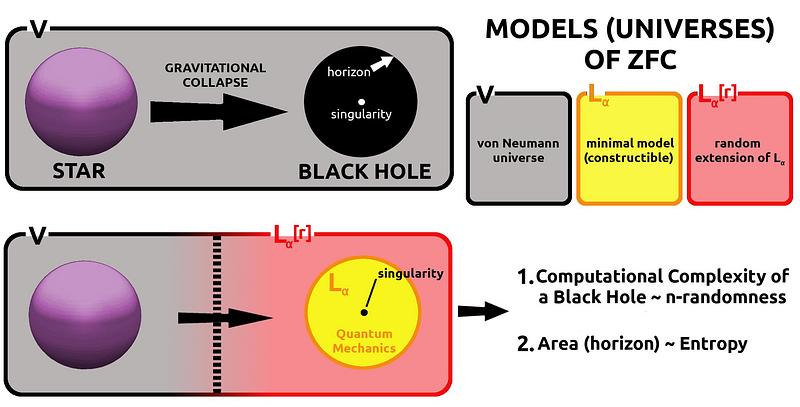
This article sets out some ideas about how relatively simple rules could emerge from Efimov effects that lead to more complex content. This article which follows on from Article 10 about the origin of force fields is part of a series explaining how our universe could have emerged from mathematics.
While it may be somewhat misleading to describe content in the AdS force fields as particles since content is a mathematical description, use of the term particle linguistically simplifies presentation of how content becomes more complex. Particles go through the black/white hole cycles many times. As a consequence of Efimov effects, the complexity of these particles can increase.
A particle in the boundary inside an AdS black hole can be described as a hologram i.e. mathematical description of content in one less dimension. Since the Efimov effect can cause new features to appear in the content in a boundary in AdS space, holographic descriptions of particles can be very complex. Holographic descriptions of particles in a boundary could be descriptions of content emerging from white holes in the original AdS space. For example, an AdS space with four dimensions includes black holes with five internal dimensions (including two time-like dimensions). The interior of such a AdS black hole would contain a boundary displaying four dimensional holographic images. These four dimensional holograms could emerge via a white hole as mathematical objects in the original AdS space which also has four dimensions.
When these four dimensional holographic objects become part of the original AdS space, the nature of that space changes even though the content of that space is still not dynamic. The new objects incorporate information created by Efimov effects inside black holes. The mathematics describing the AdS space now includes features not present in the original three dimensional AdS space which consisted of Platonic solids. The new content is forever encoded in the AdS space and does not disappear when a black hole evaporates.
When content goes into black holes, the content inside a black hole does not need to ‘recreate’ each time how quantum phenomena, force fields and mass arise. The outcomes of a bazillion iterations are already encoded in the mathematical descriptions of objects going into black holes. Jumping ahead of the story a bit, there is no need to apply the duration of our universe as a constraint on how the number of permutations available to create complex life on Earth. A bazillion earlier forms of our universe could have been created before our universe eventually emerged.
Entropy and Efimov effects
The Efimov effect and the Noether symmetry effect explain how non-random complex mathematical shapes arise naturally in AdS space. A black hole in AdS space is always finite in size even though it might grow continuously before it eventually collapses. As the content of a black hole is finite, there are a finite number of ways that content (information) can be arranged. The concept of information entropy has been used by mathematicians to describe the probability distribution of information inside a space i.e. the number of ways content can be rearranged. Low entropy means many different arrangements are possible, high entropy means only a few possibilities exist.
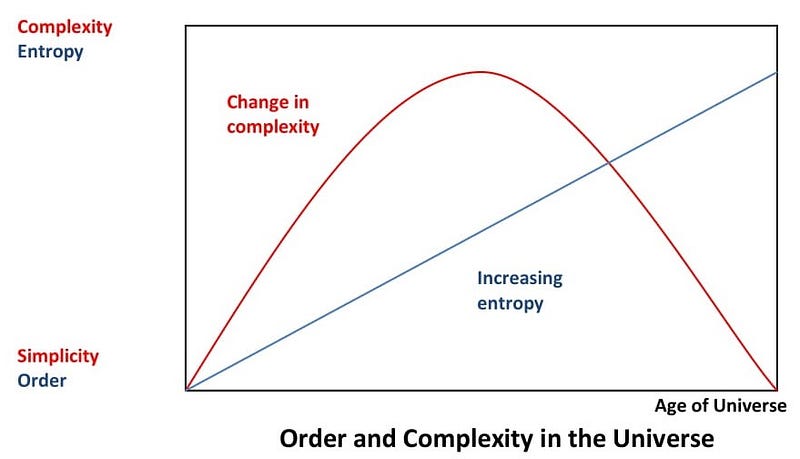
Application of the Efimov/Noether combination means the number of possible arrangements of particles (information complexity) in a boundary inside a black hole could, at least initially, increase as the particles go through black/white hole cycles i.e. information complexity increases. As the size of the black hole is finite, however, even though more content continues to enter the black hole, the number of possible arrangements will eventually start to decline i.e. at some point information complexity inside a black hole will reach a maximum value.
One of the features of quantum mechanics is the principle ‘What can happen, does happen’. This principle could be considered to be a meta-Efimov effect. For example, an Efimov effect could be consistent with a rule requiring each new Efimov effect to be different from the effect associated with any previous combination e.g. a new Efimov effect requires information about all previous Efimov effects to be instantiated in particles.
A complex Efimov effect could introduce a new force that orders content in a way that ‘displays’ the number of possible arrangements of particles in a black hole in a time-like way i.e. increasing complexity. Eventually, since a black hole is finite, a point of maximum information complexity will be reached; the point of maximum complexity could depend on how information about existing Efimov effects is instantiated in particles. The graph, Order and Complexity in the Universe, describes a possible relationship.
The mathematical process of identifying points of increasing complexity may be facilitated by an Efimov effect that introduces a rule about increasing entropy, in particular the principle of maximum entropy. According Cory Simon:
The principle of maximum entropy is invoked when we have some piece(s) of information about a probability distribution, but not enough to characterize it completely– likely because we do not have the means or resources to do so. As an example, if all we know about a distribution is its average, we can imagine infinite shapes that yield a particular average. The principle of maximum entropy says that we should humbly choose the distribution that maximizes the amount of unpredictability contained in the distribution, under the constraint that the distribution matches the average that we measured.
When an increase in the number of possible arrangements of particles associated with a new Efimov effect can be described by a probability distribution, the introduction of an entropy rule about how particles in a black hole are arranged could provide a mathematical approach to choosing between possible new Efimov effects. For example, to minimise increases in entropy, there may be an Efimov effect that identifies and facilitates efficient methods of storing information.
Mathematically, there are close links between entropy and Kolmogorov complexity e.g. expected Kolmogorov complexity equals entropy. As discussed in a later article, Professor Leonard Susskind of Stanford University has identified two equations describing what happens inside a black hole. One equation is associated with the concept of Kolmogorov complexity. In brief, using the concept of entropy to help measure complexity inside a black hole is consistent with some mathematical models describing what happens inside a black hole.
Second Law of Thermodynamics
The second law of thermodynamics states that the total entropy of an isolated system can never decrease over time, and is constant if and only if all processes are reversible. Isolated systems spontaneously evolve towards thermodynamic equilibrium, the state with maximum entropy.
From the perspective of identifying ways to increase mathematical complexity in a finite isolated system, efficiency in the storage of information can be an important determinant of the maximum level of complexity. In our universe, videos can be shared over the internet because ways have been found for efficient storage of information about images. Each new frame of a video does not involve sharing all the information in that frame, only changes in the image from the previous frame need to be shared.
A second law of thermodynamics could increase complexity by facilitating efficient storage of information i.e. ordering content, thereby increasing the capacity of a finite system to explore new types of mathematical complexity. The scope for increasing mathematical complexity may also be facilitated by the emergence of new forces (Efimov effects) e.g. heat.
In our universe, a hot gas with individual gas particles moving rapidly inside a closed space has more complexity than a gas at zero degrees Kelvin. The temperature of a gas is linked to its potential to reorganise itself i.e. its entropy. An Efimov effect that creates a new force, namely temperature, would be consistent with evolution of AdS space to accommodate more mathematical complexity. The hotter is a particle, the greater is the potential for increasing mathematical complexity.
Second Law of Quantum Complexity
Professor Leonard Susskind of Stanford University has researched what could happen inside an AdS black hole. He concluded that, immediately after a black hole is created, the inside of the black hole quickly reaches a thermodynamic equilibrium while continuing to expand in quantum complexity. According to Wikipedia:
Quantum complexity theory is the subfield of computational complexity theory that deals with complexity classes defined using quantum computers, a computational model based on quantum mechanics. It studies the hardness of computational problems in relation to these complexity classes, as well as the relationship between quantum complexity classes and classical (i.e., non-quantum) complexity classes.
Susskind discusses:
… a correspondence between computational (circuit) complexity of a quantum system of K qubits, and the positional entropy of a related classical system with 2K degrees of freedom. … the kinetic entropy of the classical system is equivalent to the Kolmogorov complexity … the expected pattern of growth of the complexity of the quantum system parallels the growth of entropy of the classical system.
… whether there is an analog, involving quantum complexity, for the Second Law of Thermodynamics.
My interpretation of Susskind’s conclusions includes:
- The expected pattern of growth of the complexity of the quantum system is related to the rate of growth of our universe i.e. dark energy; and
- Kolmogorov complexity is related to the force of gravity. The equation for Kolmogorov complexity will lead to an understanding of Newton’s law of gravity and help explain why there seems to be dark matter in our universe.
These interpretations will be discussed in more detail in subsequent articles. The main point to be noted here is that if Susskind’s research is consistent with the idea that content in AdS space can be explained by the mathematics discussed here, then:
Newton’s law of gravity needs to be modified to take into account information that could be instantiated in matter, such as the history and temperature of that matter.
A later article will discuss how the ideas presented in these articles may be tested empirically by examining the rotation velocities of stars in galaxies.
The question for this article is:
Could predictions of the velocities of stars be improved by taking account of the age and temperatures of the stars?
To view the headings of all the articles to be published in this series please click on https://readmedium.com/orbiting-stars-and-origin-of-our-universe-338906930f51
To obtain a copy of the book ‘Orbiting Stars’ which contains the first drafts of all these articles, please visit https://www.amazon.com