
What Is Polyphasic Sleep And Should You Try It?
Are we getting sleep all wrong?
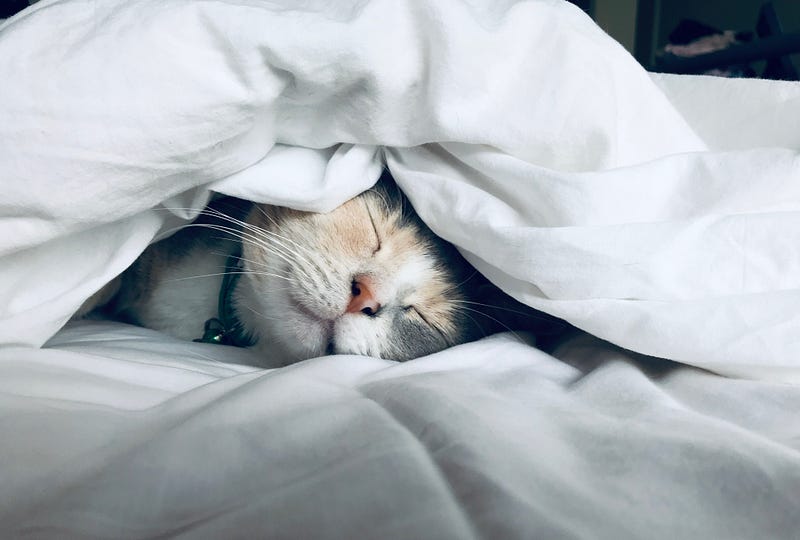
Since December last year, I have spent extended time at my girlfriend’s home. We plan to move in together, but I thought our vastly different sleep habits would be a hurdle.
While I am an early morning bird and go to bed relatively early, my girlfriend is a late riser and often stays up until midnight. My attempts to adjust to my partner’s schedule have been unsuccessful.
I have been waking up during the night more frequently.
My days were less productive.
Most of all, I miss the early morning solitude — a time for me to reflect and do creative work.
However, keeping my sleep schedule the same and getting to bed earlier isn’t an option either because my girlfriend has a daughter and two cats. The house is pretty noisy in the evenings until everyone goes to sleep. Besides, I enjoy spending the evenings with my partner and her kid.
Racking my brain about setting up my schedule, I remembered a blog about polyphasic sleep I read many years ago. I was just getting started on my personal development journey.
The concept of a vastly different sleeping pattern seemed totally crazy to me back then.
Now, however, I was intrigued. So I started researching. And what I have found encouraged me to start a polyphasic sleep experiment. Since two days ago, I haven’t been sleeping the recommended 7–9 hours per night anymore.
There’s More To Sleep Than An 8-Hour Window
Basically, there are 3 sleep patterns that people adopt — monophasic, biphasic, and polyphasic.
Monophasic sleep is your standard sleep pattern in the Western World.
The experts tell us that we should aim for 8 hours per night.
However, what if these experts are wrong?
Many sources point out that the current monophasic sleep cycle, where people sleep in one large chunk during the night, results from the Industrial Revolution. Before artificial lighting, people followed different sleep patterns, and most hunter-gatherer societies still do.
Biphasic sleep describes a pattern where you divide your sleep into two chunks.
Also called the siesta sleeping pattern, this is pretty common in Southern Europe. Some of my Spanish friends still practice this lifestyle living in Germany. They sleep around 6 hours at night and then have an afternoon siesta of around 60–90 minutes.
A particular form of biphasic sleep is the “segmented sleep” common in Europe before the Industrial Revolution. Researchers believe that people would go to bed after dawn, wake up during the night and stay awake for several hours before resuming for a second sleep.
Some researchers argue that segmented sleep is healthier than the commonly pushed monophasic sleep pattern.
Polyphasic sleep is a sleeping pattern where you sleep several times per day.
People have experimented with various patterns, and today a couple of differently named sleep schedules exist. They all allow for several short naps during the day.
You can roughly divide polyphasic sleeping patterns into nap-only schedules and “Everyman” schedules.
Nap-only schedules remove an extended sleep period during the night. Instead, you take 20-minute naps, evenly spread out throughout a 24-hour cycle.
On the other hand, Everyman sleep cycles allow for an extended sleep period of around 3–5 hours during the night and for 2–4 short naps during the day. This is a simple overview, and I will detail the different sleep schedules in a future article.
Monophasic, Biphasic, Polyphasic — Is There An Optimal Way To Sleep?
Interestingly modern hunter-gatherer societies follow biphasic and polyphasic sleep patterns. The article “Toward A Comparative Developmental Ecology Of Human Sleep” is one of the best resources on sleep patterns of modern hunter-gatherer societies. I encourage you to read it, if you are interested in different sleeping patterns.
The tribes this paper describes follow a biphasic or polyphasic sleep pattern. However, the sleep behaviors vary considerably between tribes, suggesting three things:
Firstly, there is no perfect sleep pattern that is right for everybody.
Secondly, humans can adapt to different sleep patterns.
And lastly, our modern-day monophasic sleep pattern is the least “natural” and possibly least healthy sleep pattern we could adopt.
Maybe my supposedly “problem” of waking up in the middle of the night and being fully awake is not a problem after all?
Perhaps it is my natural sleep pattern, passed on from generations before me. It is likely that my ancestors would get up in the middle of the night and resume sleep after several hours.
I am 2 days into adapting to an “Everyman” schedule, with a night-time sleep of around 4 hours and 2–3 short naps during the day.
So far, it’s been going well, and I enjoy spending my early morning hours in solitude again. I will write a more detailed article on everyman schedules and my own approach in the next few days, so stay tuned 😉.

You just read another post from In Fitness And In Health: a health and fitness community dedicated to sharing knowledge, lessons, and suggestions to living happier, healthier lives.
If you’d like to join our newsletter and receive more stories like this one, tap here.


