
Next-Gen Crypto? The Battle to be the Ethereum-Killer
Cryptocurrencies have come a long way since their original inception in Bitcoin. Blockchains started as distributed platforms for digital tokens, but now blockchains are the backbones that underpin some of the largest financial transactions on the planet. Billions of dollars are regularly moved in across nations in minutes with no overarching authority. Massively distributed applications allow virtual worlds to run where real money is used and exchanged. Some networks even boast throughput higher than that of the Visa Credit-Card network. How did we get here?
Blockchain technology is generally split into three generations, let's explore them.
Generation 1: Bitcoin and Distrusted Ledgers
Bitcoin was the first cryptocurrency created and is the very definition of a generation one blockchain. From its inception in 2009, it launched the modern cryptocurrency movement and defined what a blockchain could be. In Bitcoin, and similar currencies like Litecoin (a fork of bitcoin), the blockchain network maintains a distributed ledger of transactions. Its sole purpose is to keep a distributed network of computers that agree on how many tokens each wallet has.
Furthermore, Bitcoin is backed by what is called the “Proof of Work” algorithm to guarantee the validity of blocks of transactions. This is a battle-tested approach that has maintained the network for more than 10-years of operation. In the proof-of-work consensus, the network will set some difficulty to produce the next block represented by how many zeros must be present at the start of the hash function. Simply put, the more zeros, the more difficult to generate, the more time computers need to spend to produce a block, and the slower the blocks are published. Slow blocks lead to high security for bitcoin but also cripple the throughput of the network and dump 80 terawatts of electricity into computations.
Key Features of a Generation-1 Chain:
- Distributed Ledger purely for transactions
- Proof of Work Consensus which is slow and energy-intensive
- Less than 10 transactions per second
As compared to next-gen blockchains this is rather limited, but this on its own was game-changing and Bitcoin remains at the time of this publication as the largest cryptocurrency and the network is worth over a trillion dollars. This may change soon (looking to Ethereum or later Cardano), but for now, they are the largest and most valuable network.
Generation 2: Ethereum and Smart contracts
Ethereum was the first chain to launch smart contracts and in effect defined generation 2 blockchains. Smart contracts are scripts that are run on a distrusted network allowing for autonomous operations to happen within a blockchain. Entire applications are currently running live on the Ethereum chain backed by a global network of computers.
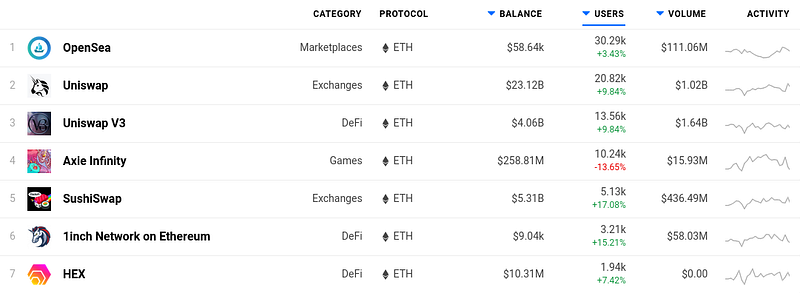
These scripts can and do run everything you could think of. NFTs or Non Fungible Tokens are backed by Ethereum and are possible because of the ability to code smart contracts to track and exchange them. Many games run on Ethereum as well, Axie Infinity is a good example of a full Pokemon-esk game that allows the trading, breeding, and battling of NFT assets called Axies.
A list of some of the popular applications can be seen below. Since these smart contracts manage their own wallets on the chain a good number of them have millions if not billions of dollars of assets under management.
To explore the process of using smart contracts on Ethereum, check out some of the previous articles I've written:
Notably, though Ethereum is much more powerful than bitcoin it still is backed by proof-of-work and thus is slow to post transactions. There are a good number of solutions such as layer-2 scaling, sharding, and side-chains that address this, but for the sake of this post, we will focus on the base layer. Furthermore, these additions in some ways allow cross-chain communication but it's not part of the base implementation and is in no way a solved issue, something gen-3 networks aim to fix.
Key Features of a Generation-2 Chain:
- Distributed ledger and Smart Contracts
- Proof of Work Consensus which is slow and energy-intensive
- Ability to run full distributed applications
- About 10 transactions per second
- No built-in way to communicate with other blockchains
- Transaction costs of $1 to $20
Generation 3: Cardano, Polkadot, Solana, and Reaching Scale
Generation 3 is what we see rolling out today in 2021. These chains are similar to previous generations but with one huge difference, scale. Chains of the past were slow. This is something that the proof of work consensus method mandated to operate correctly. Through the creation of alternative consensus methods, these generation-3 chains are rolling out with vastly more throughput.
As it stands right now, the Solana network is easily pushing 1,800 transactions per second with a throughput theoretically reaching 50,000. These speeds are a game-changer. With its current rates alone it's a contender for the Visa Network, but with the support of smart contracts, the possibilities are yet to be fully explored. The key in these speeds is a modification to the consensus called “Proof of Stake” that allows blocks to be mined much faster without competition between nodes in the network by selecting a single node to perform the transaction. This node will be forced to stake a certain amount of tokens on their result, which will be taken from them if the resultant block is fraudulent (put another way, they stake their money on their truthfulness, the more money, the more likely they are elected and the higher the risk for them to cheat).
Similar to Solana, Cardano is a next-generation smart contract platform. There are a lot of key technical differences that I won't get into here, but they have slower speeds ( a few hundred per second ) when compared to Solana and they have a unique consensus algorithm that is peer-reviewed for security called Ouroboros. Their popularity stems from their development methodology and their founder who is promising a methodical rollout and highly tested and proven network.
Polkadot is the different one of the group. Their approach offers a set of 100 auctioned chains in a single ecosystem with the goal of hosting 100 projects that all cross-communicate with each other through in-network bridges. The Polkadot network isn’t fully operational as of this article, but they boast a theoretical 100,000+ transactions per second and a unique approach that may be more than Ethereum can weather.
Key Features of Generation-3 Chain:
- Proof of Stake, a much faster and less energy-intensive algorithm
- Distributed Ledger and Smart Contracts
- Ability to run full distributed applications
- Cross-chain Bridging
- 1000s of transactions per second
- Transaction costs of < $0.10
Closing
I purposely left out Ethereum-2, side chains, and sharding from this article as they are topics in their own right. They are interesting approaches to solving some of the issues with Generation-2 without a brand new chain or an overall of the base chain. Explore them separately if you are interested, they are promising.
We are in an exciting time for blockchains. The launch of Generation-3 chains will unlock a new world for cryptocurrencies. The scale and the speed these networks operate will revolutionize what blockchain can do. It's no exaggeration to say that the leap from Bitcoin to Ethereum will be comparable to the leap between Ethereum and Generation-3


