
What is merged mining & can it mitigate the effects of BTC & LTC halving
As the deadline for halving nears, Miners might find an unlikely ally in this concept
One of the many reasons that have been associated with the recent rise in Bitcoin & Litecoin is the effect of block reward halvings in both cryptos — August 5, 2019, for LTC and May 2020 for BTC. There has been some concern among some smaller players in the crypto mining business amid declining profit margins as a result. There is a very real danger of these players going out of business — however, merged mining techniques can be used to tackle halving. Binance Academy recently conducted a case study on the merged mining & defines it like this:
“Merged mining refers to the act of mining two or more cryptocurrencies at the same time, without sacrificing overall mining performance. Essentially, a miner can use their computational power to mine blocks on multiple chains concurrently through the use of what is known as Auxiliary Proof of Work (AuxPoW).”
Simply put Merged mining, which was first introduced in 2011, can be defined as a process whereby miners can utilize the same hash power to mine two different cryptos — one on a parent blockchain & the other one on its ‘child chain’ using the same hash script. There are currently three examples of merged mining — Bitcoin-parented Namecoin (NMC), Litecoin-parented Dogecoin (DOGE) & Myriadcoin (XMY) which merged with both BTC & LTC. The biggest & most popular example, which was also taken up for a complete analysis for this report was of Dogecoin.
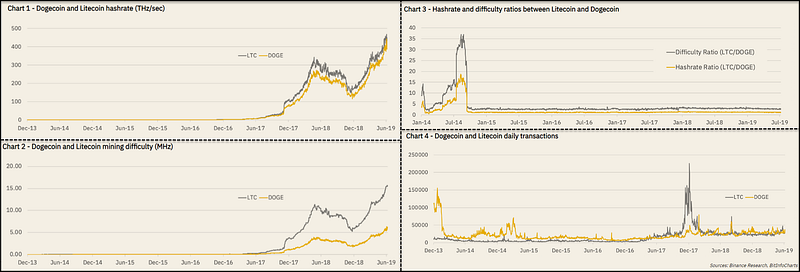
The so-called “meme currency,” DOGE was created in December 2013 & adopted the merge mining protocol Auxiliary Proof of Work (AuxPoW) in July 2014. Forking away from the parent Litecoin with a different consensus mechanism but using the same hash script (Scrypt), DOGE’s hash rate increased by more than 1500% as miners started mining the new coin on their existing LTC mining operations.
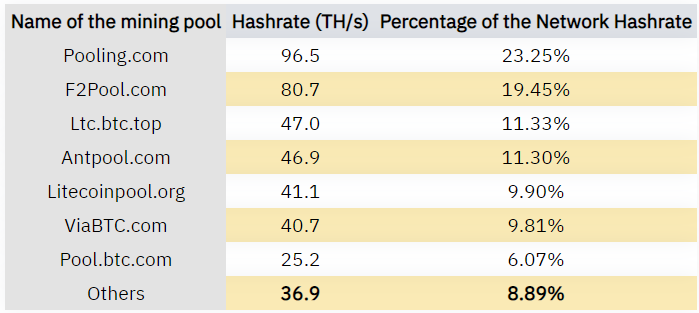
The data above suggests the close mirroring of DOGE with LTC in Hash rates, difficulty rations, mining difficulty & daily transactions. Most of this has been possible since the Top 7 of the 15 LTC mining pools provide support for DOGE coin mining (Figure 2). Since the implementation of the merged mining protocol by Dogecoin, LTC/DOGE correlation coefficient has shown a strong relationship with a current value of 0.95 as evident from the charts above (Figure 1).
Apart from the potential advantage of increased mining rewards in the case of block halvings in BTC & LTC, smaller chains can also provide better network security features using the AuxPoW consensus mechanism.
According to the report, there are some potential drawbacks with the process that need to be considered by miners.
- Costly Maintenance — Increased Operation costs to adjust mining operations for child blockchains, wallet management & disbursal processes.
- Reward value decline — If the miners believe there is little value in the child chain, they will not feel incentivized to secure the smaller network.
- Lack of Awareness — Newer mining pools might not be aware of extra mining rewards available via merged mining.
Similar shortcomings in the form of Concentration risk, Potential new attack vectors & dependency on a parent blockchain from a Project team’s perspective were also discussed in detail in the report.
While we are at the topic of mining, The Cambridge Centre for Alternative Finance (CCAF) recently launched Cambridge Bitcoin Electricity Consumption Index CBECI — a real-time index that provides an estimate of the total annual electricity usage by the Bitcoin network. This is a pretty nifty tool considering the never-ending debate on the energy-intensive Bitcoin network.
The tool also includes some interesting statistics about Bitcoin electricity consumption while comparing it with some of the countries & the total production of the world from various sources. At the time of writing, the Bitcoin network was using 7.10 GW of power with an annual average of 55.69 TWh.
As more of the energy-intense & non-eco-friendly PoW cryptos move away to other efficient & secure algorithms like Proof of Stake (PoS), merged mining provides an opportunity for smaller chains to sustain themselves with existing mining capabilities of the parent chain & offer increased security via AuxPoW consensus mechanism.


