
What is Learning Science?
By Applied Learning Sciences Team

If you are reading these words, it is very likely you have spent some time as a learner in at least one educational setting — a classroom, for example, or an online course, or even a more informal setting such as an after-school club.
Take a moment to picture one of those settings. What do you see?
Perhaps what you notice in your mind’s eye is the arrangement of the room: desks or tables, bookshelves, whiteboards, and various materials and technologies. Maybe what you picture are learners engaged in various activities and the educators who are supporting those learners. Or possibly you are envisioning something else entirely — such as the actual content itself, or inter-personal interactions, or that feeling you have when you haven’t quite studied enough for a test.
If you can picture these things, you are already very well-acquainted with some of the foundational issues that are at the heart of learning science. As a discipline, learning science is both as old as the hills, and so new that it is still labeled an emerging field.
How we learn, and how to apply that knowledge of how we learn, has long been a point of human fascination. In ancient times, Socrates and Aristotle spent much of their lives developing theories of knowledge and learning — and their influence is still felt in education today. In the nineteenth and twentieth centuries, other influential researchers, ranging from Jean Piaget to Benjamin Bloom to David Kolb to Lev Vygotsky, began to shape educational practice through the application of their theories and research.
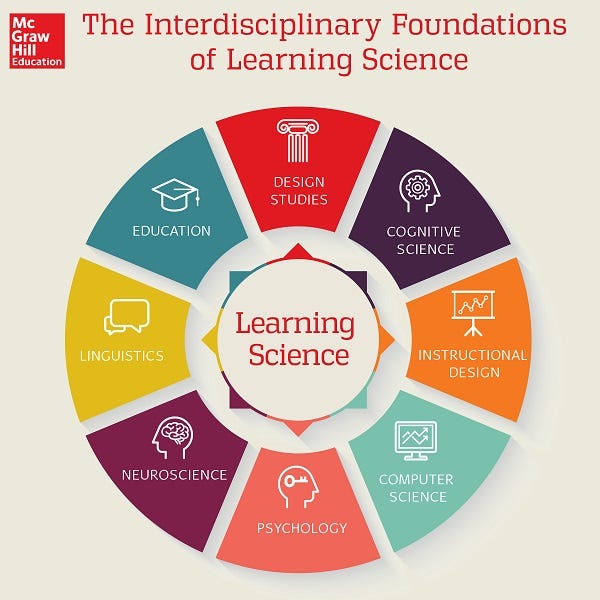
But learning sciences, as a standalone discipline, is relatively new. Definitions are still emerging, but most agree that learning science is an interdisciplinary field focused on the development of effective learning methodologies and solutions. The empirical and theoretical underpinnings of neuroscience, cognitive science, instructional design, data analytics, anthropology, linguistics, computer science, psychology, and education have formed the foundation of the discipline. We expect that the discipline will continue to evolve, especially with the introduction of programs and institutes designed specifically to build a learning work force (e.g. the Science of Learning Institute at Johns Hopkins University or METALS at Carnegie Mellon University).
But how does this all relate to the educational setting in your mind’s eye — or to actual practice?
Picture that imaginary learning setting one more time. Look once at the seating arrangements. Look at what the learners are doing. Take a peek at the materials they are using.
The learning sciences allow us to ask fundamental questions about every single aspect of the classroom, and then draw from a broad and deep base of research to answer those questions in ways that enhance our practice and empower our learners. This truly is the intersection of where the science of learning meets the art of teaching — because learning science offers us the power to apply empirical validation to our decision-making in education.
For us at McGraw-Hill Education, it is worth noting that there is one more very important, and very exciting, aspect of learning sciences. When we ask those fundamental questions, conduct that research, and apply it to practice, we place ourselves squarely in the space in which the greatest innovation may take place.
It is already happening. Educators and researchers are already asking incredible questions, and the learning sciences are already informing equally incredible solutions. As a learning science company, we will build on this momentum, explore this remarkable space, and adapt it further to improve learning and instruction.
Why?
The answer is everywhere we look: because learning, and understanding how that learning happens, really does change everything.
About the Applied Learning Sciences Team
The McGraw-Hill Education Applied Learning Sciences (ALS) team is dedicated to the application and translation of foundational and cutting-edge learning science research toward product development. Working collaboratively across all School Group teams, ALS draws upon the vast body of research in fields such as neuroscience, education, cognitive science, psychology (including educational psychology), learning analytics, applied linguistics, anthropology, computer science, and philosophy.


