
What is Jaliya?
Our Mission Statement

“Nyama be kuma la.”
— A Mande Proverb.
It means, “there is nyama in speech.” Nyama being a Mande concept that westerners might liken to supernatural power. The closest American concept I can think of would be George Lucas’ “Force.”
As a more academic source, McNaughton describes it as:
“The necessary power force behind every movement, every task. It is a prerequisite to all action and it is admitted as a byproduct of every act. The more difficult the task, the more energy demanded and the more emitted… But it is more than energy. When the Mande tell folk stories, recount legends, or explain things to researchers, it becomes clear that they view nyama as a rationale for their most fundamental behavior patterns and as an explanation for the organization of their world.”
What’s in a Story
Why does that matter to us?
Because many of the Mande believe that nothing holds as much nyama as a story. Stories define our world. Everything and everyone we interact with has a reason (a story) for being such.
But the way we perceive the world around us can easily be manipulated by falsehoods and stories that are more interested in clickbait and marketing than they are in truth. Because of that, we must take care of how we tell our stories.
Who are the Jali?
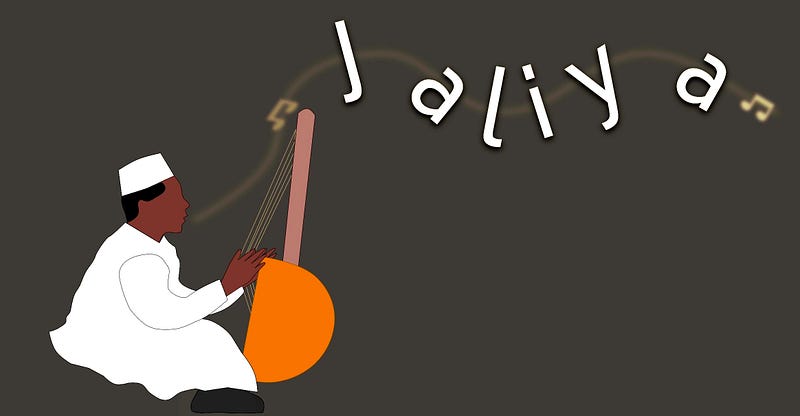
The Jali is the keeper of histories in many West African societies. While telling a story could excite and intrigue their audiences, most often these stories were told to incite people to action. Their stories were educational and reminded people who they are and where they came from.
Their language, “Jaliya” (can be rendered a few different ways: Jalikan, Djeliye, Balemani, etc.) is thought to hold more power than anything else. It can stimulate a person to take action, to do something that perhaps they thought beyond their capability.
Here’s a description from Ethnologist Dominique Zahan:
“The Balemani [Jaliya] is a narrative destined to trace the origin and the genealogy of a person, of an animal, of a plant, or even of an object… Because of its richness, the Balemani [Jaliya] constitutes the literary genre most capable of exciting the nyama of the individual.”
While the concept of nyama doesn’t exist in the western world, we’re certainly inspired by stories, both real and fictional. And just like the horon citizens of Mande culture, we’re enthralled by tales of our past.
Where do we come in?
This publication was created to share in the Jali’s work.
While the writing strives to be engaging and entertaining, that isn’t the primary focus of it. Jaliya will only publish well-researched articles with sources listed at the bottom of the page. Plagiarism is obviously not allowed, meaning that you must engage with your sources in a meaningful way.
Teaching history should be neither boring nor sensationalist.
I’ve found the more dogmatic a piece of history, the less likely that it’s true. We’ll try to present the facts in an entertaining, yet honest way. If we don’t have concrete evidence for something, we won’t state it as a fact. Instead, we’ll share the information as we understand it and perhaps give some alternative theories.
The concept of the Jali is not one that can be transferred like-for-like to articles written for a web publication. With the same breath, their language was used to both obfuscate information and shed light on truth.
That won’t be the case here. Instead, we’ll take the spirit behind the action, telling stories to enlighten and incite.
There is power in speech. And no stories hold power as much as re-tellings of the past. Jaliya will do our best to help you connect with your history in a personal — but never misleading — way.
After all, isn’t that what Jalis ought to do?
Sources
- Status and Identity in West Africa Edited by David C Conrad and Barbara E. Frank
- The Mande Blacksmiths: Knowledge, Power, and Art in West Africa by Patrick McNaughton
- La Dialectique du verbe chez les Bambara by Dominique Zahan