
What is intelligence, resurrecting Steve Jobs, and AI that can reason
Intelligence is the extent to which actions are likely to achieve objectives. Hallmarks of intelligence like learning, solving problems, etc. increase the likelihood of this success
Giving credit where it is due: the profound one-line definition of intelligence:
Intelligence is the extent to which actions are likely to achieve objectives
is not of my own creation- but paraphrasing from Stuart Russel’s book Human Compatibility ( apparently this books rates high on Elon Musks’ list of books to read). But why does this matter? Russel argues that machines powered by AI are starting to make important decisions with lack of oversight. Thus, we run the risk of super-intelligent AI making bad decisions that affect humanity.
Intelligence and AI
To demonstrate the problems of intelligent AI- Russel considers the following application of AI in real-life: content selection algorithms. Russel argues that these algorithms are designed to manipulate people into being more predictable, as a consequence of which they can be fed items that they are likely to click on which generates revenue for platforms. Russel further states that people with more extreme political views are more predictable. And that these algorithms are manipulating people to be more extreme (extreme left or right, but not centrist). This is just one illustration, but Russel says that more “intelligent” algorithms can be more effective in manipulating us.
According to Russel, one way to solve this is to change the mindset around AI from intelligence benchmarks to how much the improvements benefit humans:
Machines are beneficial to the extent they achieve our objectives
Russel does mention however, that one his interests in AI is that it might help us understand the precursors for true intelligence. Characteristics we evolved such as logical reasoning, planning, wit, creativity, etc. — help us in evolutionary success. However, that does not mean to say that this evolution could have occurred without these hallmarks of “intelligence”. He offers up an interesting idea that AI can be used as experimental proving grounds for the important question:
What are the basic requirements for intelligence?
Can there be other ways that AI can be intelligent without some of the hallmark characteristics?
Introducing reasoning in AI
Some very recent developments in the past year have resulted in spectacular performance boosts in AI. Google envisions a single AI model, , that could generalize on multiple tasks and domains. This excerpt is taken directly from the google page on pathways:
We want a model to have different capabilities that can be called upon as needed, and stitched together to perform new, more complex tasks — a bit closer to the way the mammalian brain generalizes across tasks.
Today’s models mostly focus on one sense. Pathways will enable multiple senses.
In a recent paper, Google released the Pathways Language Model (PaLM), a 540-billion parameter model that achieved state-of-the-art on multiple language tasks.
Apart from the language model itself, Google also showed a remarkable breakthrough when prompting language models to “explain themselves” as follows:
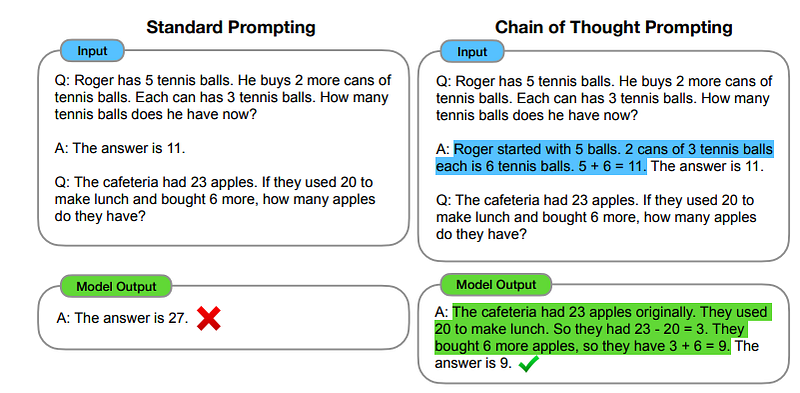
To give context; the standard prompting on the left-hand side is when a fully trained large language model is given labels corresponding to inputs (also known as few-shot learning). A standard generative question-answer prompt would ask a question (here how many balls Roger has) and give the answer (here 11). Then you can test this on an example that the model has not seen (the question about apples) and observe the output (in this case, 27 is the wrong output).
Whereas the chain of thought prompting would give the reasoning behind the answer for how many balls Roger has. What is remarkable is that with just a handful (less than 10) of these sorts of chain of thought prompts essentially gives the model the “sense” to explain the reasoning behind its deductions. And more often than the standard prompting- the model gives the correct answer (on the bottom right)!
Give a man a fish and he will eat for a day. Teach a man how to fish and you feed him for a lifetime.
Give an AI labels and it will solve your task of the day. Teach it to reason and it will solve more tasks than you can imagine.
Because chain of thought prompting makes the model better than the previous state-of-the-art, the model is becoming more “intelligent” as it pertains to solving tasks that benefit humans. Interestingly, though — rather than a divergence from human intelligence; this state-of-the-art is actually getting more and more similar to the way humans reason based on deduction. But we are no closer to actually understanding the reasoning process from fundamentals. One could argue that adding this chain of thought prompting increases the complexity!
Sure, chain of thought prompting means we can understand how the model reasons in a similar way to when we teach young kids of 3 or 4 years old how to count and explain their thought process by using their fingers and/or pointing out objects. However, we still don’t understand the mechanisms that go on in their brain — in the same way that we don’t (yet) understand how all this prompting actually helps these models perform better!
Does this mean that we cannot understand the human brain through AI? Or the idea that machine intelligence will be fundamentally different from human intelligence is not true?
Only time will tell. Although, observing AI as they compute is more feasible than observing the human brain as it thinks. We can break open AI models, experiment with them, and see how they function — which is something we cannot do with living, human brains.
In fact, it might well be that we have found the basic ingredients of intelligence!
Resurrecting Steve Jobs in a podcast
In recent news, podcast.ai, is a podcast that is entirely generated by AI. Their first episode features a conversation between Jobs and Joe Rogan. While the AI has a voice remarkably similar to Steve Jobs’ voice — it rambles many times. It almost sounds like a machine that gets into a strange loop and is quite disconcerting. Like Steve Jobs has been brought back but is not quite the same. The AI was trained Steve Jobs’ biography and all recordings found of him.
If you are not yet a Medium member and want to support writers like me, feel free to sign-up through my referral link: https://skanda-vivek.medium.com/membership
If you enjoyed this post, feel free to also subscribe to cyber-physical, where I discuss artificial intelligence, data, and security in our everyday lives.


