
What is Generative AI?

What does Generative AI mean in simple words?
Generative AI is a type of artificial intelligence that can create new content, such as images, text, or music, by learning from existing data.
Imagine you have a big box of Legos. You can use the Legos to build anything you want, like a house, a car, or a robot. Generative AI is like a big box of Legos, but instead of Legos, it has data. The data can be anything, like pictures, text, or music. Generative AI can use the data to create new things, just like you can use Legos to build new things.
What is the difference between Generative AI, LLMs, and Foundational Models?
Generative AI is a broad field of AI that encompasses any approach that can create new content, such as text, images, or music.
Large language models (LLMs) comprise a specific category within generative AI systems tailored to working with language. These models are trained on extensive datasets of text and code, earning their “large” designation.
Foundation model refers to the fundamental architecture or framework upon which more advanced models are built. For instance, GPT (Generative Pre-trained Transformer) is a foundational model because it introduced a novel architecture that has since been adapted and improved upon in various ways, leading to models like GPT-2, GPT-3, and beyond. A foundational model sets the groundwork for further advancements in the field.
Foundational models like GPT-3 can be considered generative AI because they can generate coherent and contextually relevant text.
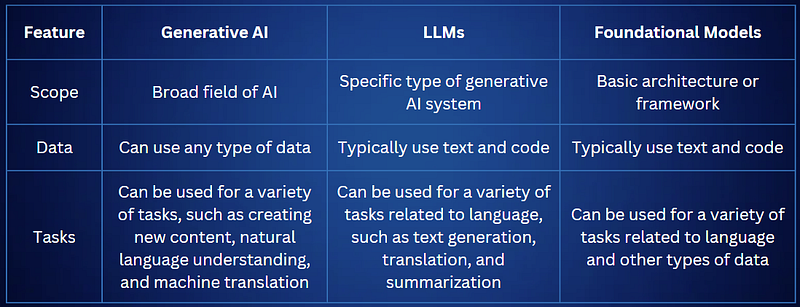
Here is a table that summarizes the key differences between generative AI, LLMs, and foundational models:
Where is Generative AI being used?
Generative AI is a rapidly growing field, and it is being used in a variety of applications.
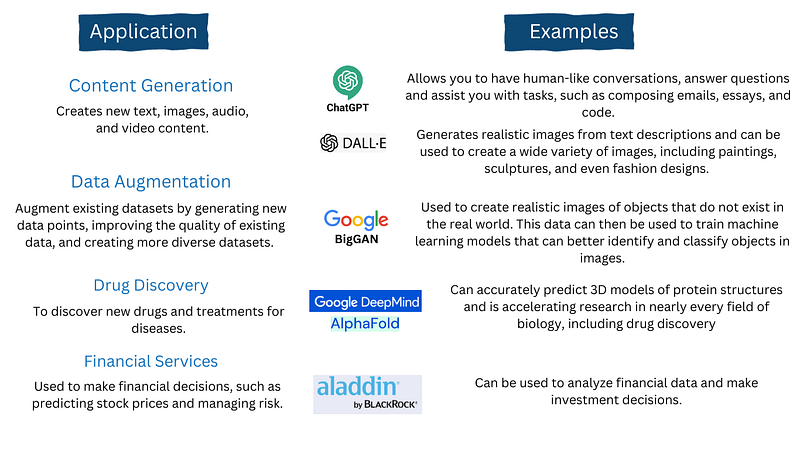
These are just a few examples of the many ways that generative AI is being used today. As the field continues to evolve, we can expect to see even more amazing applications of this powerful technology. Keep in mind, AI applications have ethical considerations, particularly in terms of generating realistic but fake content (like deepfake videos). As the technology continues to develop, there are ongoing discussions about responsible use and potential misuse of generative models.


