
What Is Fully Homomorphic Encryption and Why Is Important
Imagine having a magic key that not only unlocks any door but also allows you to peek inside without ever opening it. This is the kind of revolutionary change Fully Homomorphic Encryption (FHE) promises in the realm of data security.

If you’re worried about keeping your digital information safe while also making the most of it, you’re not alone. The quest for a balance between data privacy and utility is a real challenge in today’s digital age.
So, what’s the secret sauce behind FHE, and why is it creating such a buzz?
In this article, you’re going to discover the nuts and bolts of FHE, a technology that lets us work with encrypted data without ever needing to decrypt it.
I’ll break down the complex technicalities into bite-sized, understandable pieces, showing you why FHE could be a game-changer in how we handle secure information.
By the end, you’ll see the potential benefits and hurdles of adopting FHE, making you well-informed about this exciting frontier in cybersecurity.
What is Fully Homomorphic Encryption?
Fully Homomorphic Encryption, or FHE for short, is honestly a game-changer in how we think about keeping data safe.
Imagine being able to work with your data, do all sorts of calculations on it, without ever having to unlock it.
That’s what FHE does.
It’s like having a secret diary that you can let others add notes to without them ever seeing what’s inside.
This isn’t doesn’t just sound cool; it’s a massive step forward in making sure our private stuff stays private, no matter who’s poking around.
Now, I’m not going to sugarcoat it.
FHE is complex.
It’s not just about scrambling your data into code. It’s about doing that in a way that still lets you, or anyone you authorize, to work with it without ever seeing what’s underneath the code.
And yes, it demands a lot of computer power. We’re talking serious number-crunching ability needed here, which isn’t something every laptop or server can handle.
But let’s not miss the forest for the trees.
The real beauty of FHE is how it stands up to the kind of cyber threats we’re starting to see, including those scary quantum attacks that could make mincemeat out of older encryption methods.
In a world where hackers are getting smarter by the day, having something as tough as FHE could be the difference between keeping our digital lives safe or watching them get picked apart by cyber thieves.
If you feel confused about what FHE is, check this 1 minute video of this guy, that helped me understand this concept better.
What is the difference between conventional encryption and fully homomorphic encryption?
When we talk about keeping data safe, the difference between old-school encryption and fully homomorphic encryption is like night and day.
Let’s break it down in simple terms.
Standard Encryption
So, you’ve got your standard encryption, right? It’s pretty much the basics.
You take your data, scramble it up so no one who shouldn’t see it can read it, and then when you need to, you unscramble it back.
It’s like locking your diary in a safe. It’s fine, it does the job, but it’s got its headaches.
Say you want to do some math on the stuff in your diary without taking it out of the safe.
Tough luck, you can’t. You have to take it out, do your math, and hope nobody peeks over your shoulder while you do it.
Homomorphic Encryption (FHE)
Now, enter fully homomorphic encryption (FHE). This thing is a game-changer.
Imagine being able to do all the math you want on your diary while it stays locked up tight in the safe.
Sounds like magic, right? But it’s not. It’s FHE. It lets you work on your data without ever exposing it.
Your data stays encrypted the whole time, and nobody gets to peek. It’s a massive win for privacy.
What is the difference between partial and fully homomorphic encryption?
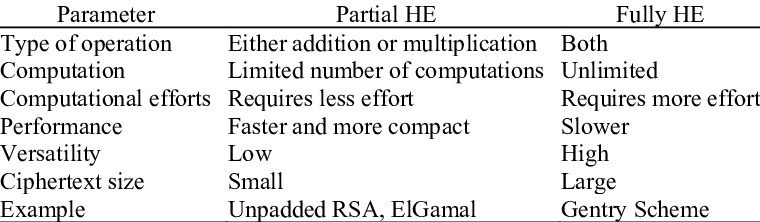
When you get down to the nitty-gritty, partial homomorphic encryption is like being allowed to play a game but only with one move.
It’s like, sure, you can keep your data safe by letting it do one thing — maybe add numbers or multiply them — but that’s it. You’re stuck in a box.
On the flip side, fully homomorphic encryption is the game changer. It’s like having an all-access pass.
You can do all sorts of math on your data without ever peeking inside the envelope. It’s a big deal for keeping secrets in the digital age.
Think about it. With partial homomorphic encryption, it feels like you’re getting shortchanged.
Yeah, you get a bit of security, but you’re missing out on so much because you’re limited to doing just one thing with your data. It’s safe, but at what cost? You can’t really use it to its full potential without taking a risk.
Now, fully homomorphic encryption, that’s where it’s at.
It’s like someone finally figured out how to let you have your cake and eat it too. You get to play around with your data — adding, multiplying, the works — and none of it gets exposed.
This isn’t just some nerdy detail. It matters big time for anyone who cares about keeping their digital life private. Fully homomorphic encryption isn’t just a step up; it’s changing the game on how we secure and work with data.
What are the use cases for fully homomorphic encryption?
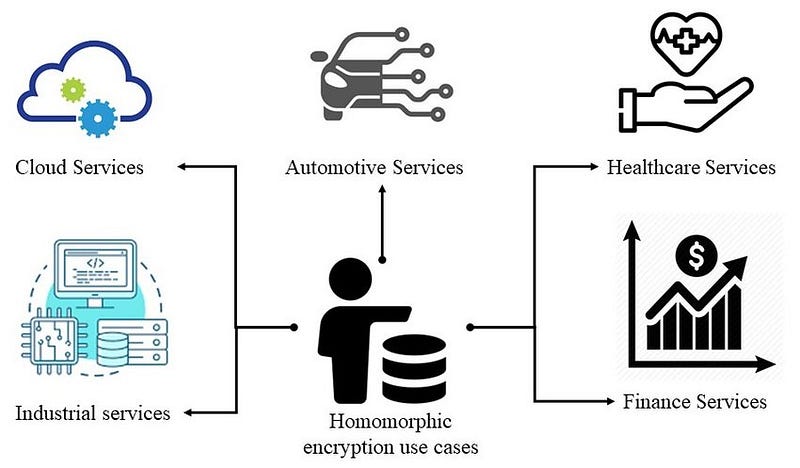
Fully homomorphic encryption, is a total game-changer for how we handle data privacy and security across various industries.
What’s fascinating about FHE is its ability to let’s work on encrypted data without ever needing to decrypt it.
This is a big deal, especially in areas like healthcare, where you can use encrypted patient data for research and not worry about personal info getting leaked.
It’s brilliant, really, making sure that sensitive health details stay safe from prying eyes, even when they’re being used for analysis by other folks.
Then there’s the magic it brings to secure multi-party computation.
Imagine different groups wanting to work together on some data analysis without wanting to show each other their actual data. FHE makes this possible.
It’s like having your cake and eating it too, allowing for a kind of teamwork and data sharing we’ve never seen before, all while keeping everyone’s data under wraps.
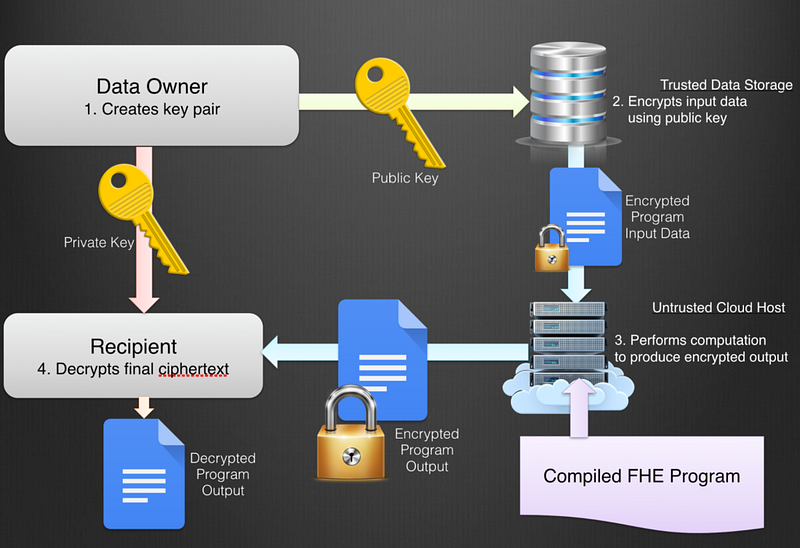
And let’s not forget about confidential computing. With FHE, companies can store and process data in the cloud without freaking out about data breaches.
This is super important for any business that deals with sensitive info. They can use cloud computing without losing sleep over security concerns.
How will it change blockchain?
Fully homomorphic encryption (FHE) is a game-changer for blockchain, hands down.
It’s making a huge splash by bringing top-level privacy and opening doors to new features we’ve only dreamed about. Imagine being able to do stuff on the blockchain without anyone snooping on your data. T
hat’s what FHE is all about. We’re talking private supply chains, voting systems you can trust, and gaming without anyone peeking at your moves.
The privacy level we’re getting here is something else.
Now, with FHE mixed into blockchain, we’ve got this cool thing where we can all share a secret space.
It’s not just about keeping our data safe anymore; it’s about making sure our entire online life is private. This is huge for anyone making apps or just using them.
We’re not just talking about making things secure; we’re building a whole new world that’s private from the ground up.
Seeing FHE in action, like with Fairblock’s test version, is pretty exciting.
We’re getting into some serious privacy tools, like making sure only the right people can see your data.
It’s pushing us toward a future where privacy is first, and I think that’s where we all want to be.
Blockchain is all about freedom and keeping our digital lives our own, and with FHE, we’re really seeing how far we can take that idea.
Frequently Asked Questions
What Is the Difference Between Partial and Fully Homomorphic Encryption?
Partial homomorphic encryption handles either addition or multiplication on encrypted data, but fully homomorphic encryption does both, offering stronger privacy by enabling complex computations without exposing the data’s raw form.
What Is Homomorphic Encryption in Simple Words?
In simple terms, I’d say homomorphic encryption is a technique that lets me perform calculations on encrypted data without decrypting it.
It’s like doing math on sealed letters, keeping the contents secret and secure.
What Is the Difference Between Conventional Encryption and Fully Homomorphic Encryption?
I’ve learned that the key difference lies in conventional encryption securing data at rest or in transit, while fully homomorphic encryption allows computations on encrypted data, ensuring privacy throughout the entire process.
What Are the Use Cases for Fully Homomorphic Encryption?
I’m exploring how fully homomorphic encryption’s unique capabilities unlock secure cloud computing, enable private data analysis in healthcare, and ensure confidential voting systems, fundamentally transforming data privacy and security in our increasingly digital world.
Conclusion
Fully Homomorphic Encryption (FHE) isn’t just a theoretical marvel; it’s a practical tool poised to redefine data security.
By allowing computations on encrypted data without decryption, FHE bridges the gap between privacy and utility.
It revolutionizes traditional encryption, extends beyond partial schemes, and finds diverse applications, from cloud computing to blockchain enhancement.
In my opinion, FHE is more than just another tech buzzword. It’s a bold move toward keeping our digital stuff under lock and key, but in a way that still lets us use it, share it, and work on it without handing over the keys to the kingdom every time.
Sure, it’s got its challenges, especially when it comes to the computing firepower needed, but the potential benefits are too big to ignore.
To put it simply, FHE could change the game on data privacy. It’s all about giving us the power to keep our data safe and sound, even in the hands of someone else.
And in an age where our personal info is more valuable and vulnerable than ever, that’s a pretty big deal.