
What is DeFi or Decentralized Finance Explained
Meaning, Working, CeFi vs DeFi, Advantages & Disadvantages

Decentralized finance (also called as DeFi) is a rapidly-growing sector of the blockchain industry that is focused on using blockchain technology to create financial products and services that are decentralized and open to anyone. DeFi has gained significant traction in recent years, with many users and investors turning to DeFi platforms to access financial services that are not available through traditional channels. As of 2021, the total value locked in DeFi platforms was over $40 billion, and this number is expected to continue growing in the coming years.
DeFi refers to a wide range of financial products and services that are built on blockchain platforms, including decentralized exchanges, lending and borrowing platforms, stablecoins, and more.
TLDR; Don’t have time to read? Here’s a video to help you understand What is DeFi or Decentralized Finance in detail.
So, how does DeFi work?
At the core of DeFi is the use of smart contracts, which are self-executing contracts with the terms of the agreement between buyer and seller being directly written into lines of code. Smart contracts can be used to facilitate financial transactions and other types of agreements without the need for intermediaries, such as banks or credit card companies.
One of the main applications of DeFi is decentralized exchanges (DEXs), which allow users to trade cryptocurrencies and other assets without the need for intermediaries. DEXs use smart contracts to facilitate trades and ensure that they are executed in a transparent and secure manner.
Another popular DeFi application is lending and borrowing platforms, which allow users to lend and borrow assets using smart contracts. These platforms can provide users with access to credit and liquidity, as well as the opportunity to earn interest on their assets.
Stablecoins are another important part of the DeFi ecosystem. Stablecoins are cryptocurrencies that are pegged to the value of a real-world asset, such as the US dollar, and are designed to maintain a stable value. Stablecoins are used in a variety of DeFi applications, including lending and borrowing platforms, DEXs, and more.
Centralized Finance vs Decentralized Finance (CeFi vs DeFi)
Centralized finance (CeFi) and decentralized finance (DeFi) are two broad categories of financial products and services that are built on blockchain technology. CeFi refers to financial products and services that are centralized and controlled by a single entity, such as a bank or a credit card company. DeFi refers to financial products and services that are decentralized and open to anyone, and are built on blockchain platforms using smart contracts.
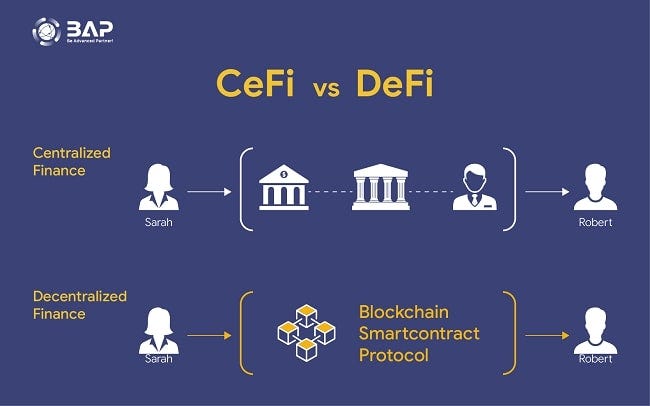
There are several key differences between CeFi and DeFi:
- Control: One of the main differences between CeFi and DeFi is the level of control that is exercised over the financial products and services. In CeFi, a single entity controls the financial products and services and makes decisions about how they are used. In DeFi, control is decentralized and is distributed among users and smart contracts.
- Intermediaries: CeFi products and services often rely on intermediaries, such as banks or credit card companies, to facilitate financial transactions and other types of agreements. DeFi products and services, on the other hand, use smart contracts to facilitate transactions and agreements without the need for intermediaries.
- Accessibility: CeFi products and services are often accessible only to a limited group of users, such as those who have a bank account or a credit card. DeFi products and services, on the other hand, are open to anyone with an internet connection and a digital wallet.
- Security: CeFi products and services are often vulnerable to security threats, such as hacking or fraud. DeFi products and services, on the other hand, use smart contracts and blockchain technology to increase security and reduce the risk of fraud or tampering.
In conclusion, we can say that CeFi and DeFi are two broad categories of financial products and services that are built on blockchain technology. While they share some similarities, they differ in terms of control, intermediaries, accessibility
Advantages and Disadvantages of DeFi
Like any other technology, DeFi has both advantages and disadvantages that are worth considering. Here are some of the main advantages and disadvantages of DeFi:
Advantages of DeFi
- Accessibility: DeFi products and services are open to anyone with an internet connection and a digital wallet, which makes them more accessible than traditional financial products and services that often require intermediaries such as banks or credit card companies.
- Decentralization: DeFi products and services are decentralized, which means they are not controlled by a single entity. This can make them more resistant to censorship and manipulation, and can give users more control over their own assets and data.
- Transparency: DeFi products and services use smart contracts and blockchain technology, which can increase transparency and make it easier to track and verify financial transactions.
- Efficiency: DeFi products and services can be more efficient than traditional financial products and services, as they do not require intermediaries and can be automated using smart contracts.
Disadvantages of DeFi
- Volatility: DeFi products and services are often linked to cryptocurrencies, which are known for their volatility. This can make DeFi products and services riskier and less stable than traditional financial products and services.
- Technical failures: DeFi products and services rely on complex technology, which means they are vulnerable to technical failures. This can disrupt financial transactions and cause losses for users.
- Regulatory uncertainty: DeFi products and services are still in the early stages of development and are not yet fully regulated.
- Security vulnerabilities: DeFi products and services are vulnerable to security threats, such as hacking or fraud. This can be a concern for users, as there may not be the same level of protection as with traditional financial products and services.
- Lack of protection: DeFi products and services are not subject to the same regulations as traditional financial products and services, which means users may not have the same level of protection in the event of losses or disputes.
While DeFi products and services offer many benefits, such as accessibility, decentralization, and transparency, they also come with risks, such as volatility, technical failures, and security vulnerabilities.
Conclusion
Overall, DeFi relies on smart contracts and blockchain technology to create financial products and services that are decentralized and open to anyone. By using DeFi, users can interact with financial services without the need for intermediaries and retain control over their own assets and data.
Get Certified in Blockchain Technology.
Both tech and Non-Tech can apply! 10% off on Blockchain Certifications. Use Coupon Code — blockchain10 Enroll Now — https://bit.ly/3ND4QAl
You may also like,


