
What is Chain-of-Thought Prompting(CoT)? Explained in Everyday Language for AI Beginners
If you’ve ever wanted to break down your answer step by step on a college math exam to get partial credit, then it’s the same Chain of Thought we’re discussing in AI — which means, it is important :)
So in this article, let’s go through the definition, advantages, examples, and how it works.
What exactly is Chain of Thought Prompting?
Chain of Thought prompting (short for CoT) was first introduced in 2022 through the paper titled: Chain-of-Thought Prompting Elicits Reasoning in Large Language Models, where, in the very first sentence, CoT is explained as follows:
We explore how generating a chain of thought — a series of intermediate reasoning steps — significantly improves the ability of large language models to perform complex reasoning.
As its name suggests, “chain of thought” aims to explicitly show thoughts step by step, linked together like a chain, instead of providing only the final answer. Thus, Chain of Thought prompting is a special method of instruction or prompt design that allows you to guide your AI in providing answers in a more transparent manner, revealing the AI’s thought process. In an everyday scenario, it is how you tell ChatGPT (or any AI models that take in prompts) to break down a problem and provide better answers.
Imagine you’re teaching a young child how to draw a teddy bear. You don’t just show them what a teddy bear would look like in the end; instead, you guide them through each step, explaining why you’re drawing each stroke in a certain spot and coloring a shape in a particular way. This way, the child learns the process, understands the reasoning behind each decision, and can apply these skills to draw new things in the future.
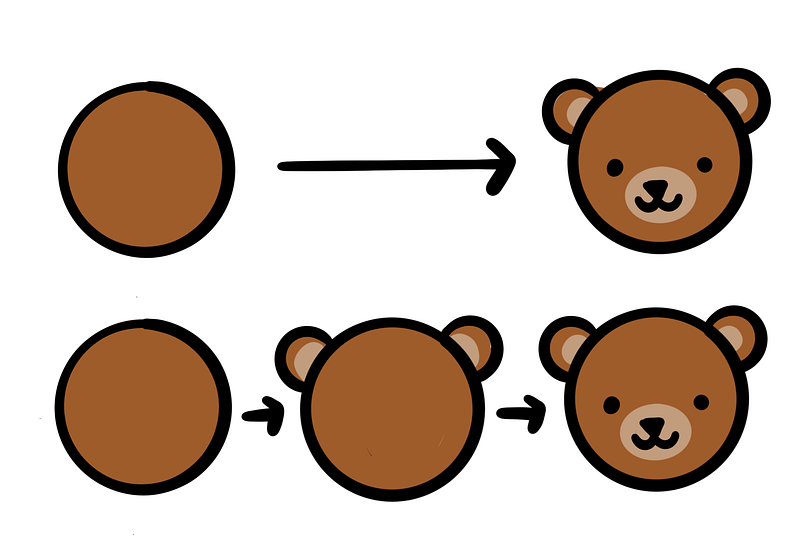
Chain of Thought (CoT) prompting in AI works in a similar way. Instead of AI models jumping straight to an answer, CoT prompting guides the AI through a series of logical steps or “thoughts” to reach a conclusion. This is like laying out a thought process for drawing, where each step builds upon the previous one, leading to the final answer.
Here’s an example:
Let’s take a math word problem as our example. Note that math problems are also very common problems where Chain of Thought can be more helpful than fact-based Q&As :
Example:
Problem: Calculate the total cost of 5 books if each book costs $8.
CoT Prompts:
Step 1: “First, let’s identify what we’re calculating. What does one book cost, and how many books are we buying?”
Step 2: “Now that we know the cost per book and the total number of books, how can we calculate the total cost?”
Step 3: “Can you explain how multiplying the number of books by the cost per book gives us the total cost?”
Final Step: “Given our calculation, what is the total cost for all the books?”
In this example, the CoT approach breaks down the problem into a sequence of logical steps leading from the initial setup to the final solution. Each step is explicitly stated, mimicking the natural reasoning process a human might use to solve the problem.
Tips on How to use:
1. Understand the Problem: Start by clearly defining the problem you want the AI to solve. A thorough understanding is crucial to break it down into smaller, manageable parts.
2. Identify Key Steps: Analyze the problem and identify the key steps or stages the AI needs to go through to solve the problem. Think about how you would explain the problem-solving process to another person in a step-by-step manner.
3. Sequence the Steps Logically: Arrange these steps in a logical order. Each step should naturally lead to the next. Ensure there’s a clear progression from the initial understanding of the problem to the final solution.
4. Create Detailed Prompts for Each Step: For each identified step, create a prompt that guides the AI on what to consider or calculate at that stage. These prompts should be designed to elicit detailed responses, encouraging the AI to not only provide answers but also to explain its reasoning.
5. Encourage Explanation and Justification: Include instructions in your prompts that encourage the AI to explain its thought process. This can involve asking for justifications for decisions made or for explanations of how it arrived at certain conclusions.
6. Test and Refine: After creating your CoT prompts, test them with the AI model to see how it responds. It may be necessary to adjust the wording, add more detail, or provide additional guidance based on the outcomes.
7. Ensure Coherence in Final Response: The final step should ensure that the AI integrates all the intermediate steps into a coherent and comprehensive final response that directly addresses the original question.
It sounds quite “making sense”. So why is it important in AI today?
In today’s world, where AI applications are becoming increasingly complex and integral to decision-making, CoT prompting represents a significant step forward in making AI systems more understandable, reliable, and capable of sophisticated reasoning.
- Improves Understanding: Just like our puzzle example, CoT prompting helps AI models better understand complex questions or problems by breaking them down into smaller, manageable parts. This step-by-step approach mimics human problem-solving strategies, enhancing the model’s reasoning capabilities.
- Increases Transparency: CoT prompting makes AI decisions more transparent. By revealing the intermediate steps leading to a conclusion, it allows humans to see how the AI “thinks” and arrives at its answers, making AI workings less of a “black box.”
- Enhances Trust: When users can follow the AI’s thought process, they’re more likely to trust its conclusions. This is crucial in applications where AI decisions have significant impacts, such as in healthcare, finance, or legal advice.
- Facilitates Error Correction and Learning: By observing the chain of thoughts, developers can identify where the AI might have gone wrong in its reasoning process and correct it, similar to how a teacher spots and addresses a student’s misunderstanding. This also provides an opportunity for the AI to learn and improve over time.


