
What Is Blockchain Technology?
Explained the essential elements and features of blockchain technology in a simple way that a middle schooler can understand!

Satoshi Nakamoto, who conceptualized and implemented Blockchain for the first time, named it a “Peer-to-Peer Electronic Cash System”.
An Internet search will appear: “A Blockchain is a distributed, decentralized, public, digital ledger that exists across the network.” I used a similar definition in my article “Will Blockchain be mainstreamed?” and received multiple questions like “how is it decentralized? “, “can you explain Blockchain in detail? “, “what is so special about it?” and so on. In this post, I will try to answer a few questions.
Knowledge of its essential elements and features is necessary to understand blockchain technology.
Blockchain
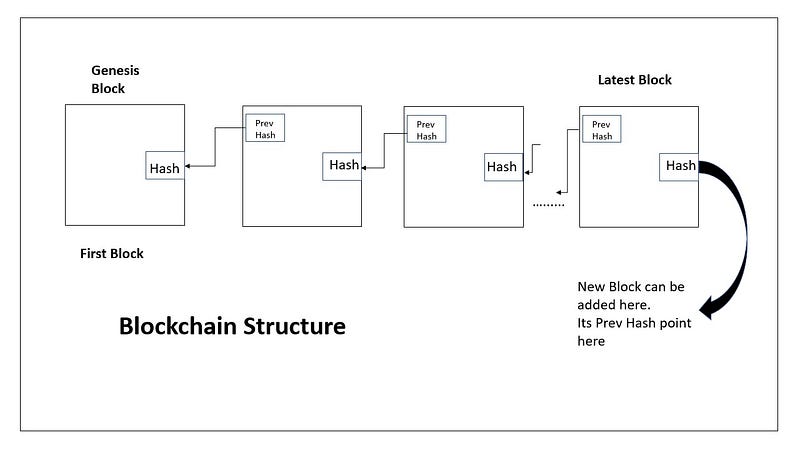
As the name suggests, it is a chain of Blocks. The Blocks contain transactions done using the native currency of that Blockchain. Generally, these transactions happen between two entities. The blocks are timestamped and append-only. They cannot be deleted or inserted, or modified.
The blocks are chained through hashes. A newly created block points to the Hash of the previous Block, which in turn points to the previous block that points to the previous block, and so on. The first block of the Blockchain is named the ‘Genesis block’. It doesn’t have a prev Hash.
Each block represents a unique value, ‘Hash’. Unique value as an email address or thumbprint. The Hash value changes even if the block’s tiniest data is altered. This append-only feature and ‘Hash’ make the Blockchain immutable.
Nodes
The nodes are powerful computing machines in the network. The nodes communicate with each other only through messages, but they work independently; one node cannot control or influence the decisions of any other node. It is a Peer-To-Peer network. A participating node can add blocks to the Blockchain.
As this is a decentralized or peer-to-peer network, there is no centralized authority to add or validate the transactions. Here the consensus algorithms play a vital role. Proof-Of-Work(POW) and Proof-Of-Stake(POS) are the most commonly used consensus algorithm. Bitcoin, the largest Cryptocurrency, uses POW, whereas the second largest Crypto, Ethereum, recently moved from POW to POS.
As bitcoin uses POW, we will see how the node gets chosen to add the block in the POW blockchain. The nodes will have to solve a complex puzzle. A node that solves it first can add a block to the Blockchain. Once a block is added to the Blockchain, other nodes also update their copy with the new block. This is how it is a decentralized and distributed system, which eliminates the need for the central authority and makes the system more transparent and reduces the costs associated with the centralized authority.
Mining
When a node adds a block to the Blockchain, it gets awarded tokens or native currency coins, which are newly generated currency or mined coins. This is called mining. When one digs down a gold mine, mines or generates the gold. Similarly, when a miner node generates a block and adds it to the Blockchain, they mine new coins.
Over the years, the difficulty of the puzzles increased so high that miners or nodes started pooling their computing powers to generate the blocks to form mining pools.
Thus ‘Mining’ is an incentivized feature of Blockchain, which ensures smooth peer-to-peer operation of the Blockchain though it is not mandatory.
Public Ledger
The Blockchain is a public ledger, meaning the transactions are publicly available for viewing, making it transparent. If you go to blockchain.com, you can see the transactions. This is like putting all bank transactions on the Billboard for public viewing. The only difference is that the transactions contain bitcoin addresses, not the owner details. Though the owner names are not associated with the bitcoin addresses, one can track the activities and actions and track down the owner related to a particular bitcoin address. Thus it is not anonymous but a pseudonymous system. This is why financial institutions consider the Blockchain less secure and lack privacy.
This public ledger is protected and secured on various levels with the implementation of the following features:
Bitcoin Address which helps achieve pseudonymity; Asymmetric (Cryptographic) key pairs — Private and Public key pairs- ensure there is no double spending and secured transactions; Merkel tree and Hashing Algorithms make the system immutable and hard to solve but easy to verify, helping achieve immutability in the Blockchain.
Thus Blockchain is an immutable, distributed, decentralized, public digital ledger. It is a complex digital Peer-to-Peer payment system that ensures transparency and integrity of the transactions avoiding unnecessary frills and costs of traditional centralized systems.
With the introduction of Smart contracts in Ethereum, blockchain technology has gone beyond Cryptocurrencies and proved its potential in solving many real-world problems, from voter fraud to supply-chain issues.
Still, if there is a question, “Why bother to acquire this information?” think on this line. If you are driving a car, you don’t need to know in-depth technical details like how the car engine works, but it is good to have basic knowledge about the car parts and their functionality.
Similarly, suppose you are planning to invest in crypto or NFTs, looking for a career change in web3, designing/minting NFTs, or a finance person; in that case, it is essential for you to know the basics about blockchain technology. As it progresses exponentially and soon, blockchain technology will be widespread and dominate every significant domain.