
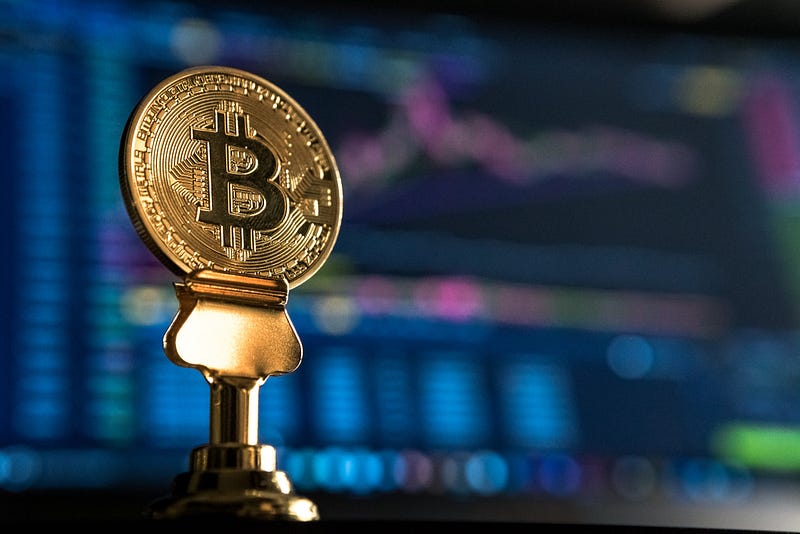
WHAT IS BITCOIN? And What it Isn’t!
The purpose of this article is to explain some ins-and-outs of Bitcoin. Hopefully, it will give you some background and information to help you decide what, if anything, to do about it. This is NOT investment advice!
What is it? Bitcoin is described as a “digital currency”. This explains some key points about the “what” part — firstly, being digital means that it doesn’t exist in any physical form. There are no actual “coins” — it’s all just numbers in the cloud. So that pretty picture at the top of the page is just for show! Secondly, being a currency implies that it is a type of money for use as a medium of exchange. Thirdly, as money, it can be considered as a store of value. Unlike other types of money, Bitcoin is not issued by any country, government, or central bank. It is not “legal tender” in any country. Nevertheless, it is considered to be “property” for taxation purposes. It is not illegal to own Bitcoin.
A Form of Exchange It has no physical existence and can only be exchanged over the internet. Very few traders of goods and services accept Bitcoin as a medium of exchange, and it is mostly traded by conversion to regular currencies at specialized, online cryptocurrency exchanges. It can also be sent, received, and stored in “digital wallets” on specialized hardware or smartphone apps. At this time, its use for commercial transactions such as online purchases of goods and services is restricted to the fringes of the economy. But this may change in the future — PayPal is currently introducing access to Bitcoin and several other cryptocurrencies through their user accounts. But these accounts, which will initially be restricted to US users, can only be used for exchanging the cryptocurrencies with US dollars and cannot be used for regular transactions or transfers between accounts.
The limitations on its ability to be used as a medium of exchange for everyday transactions raises serious questions about its overall usefulness.
A Store of Value Bitcoin is often represented as “digital gold” — this relies on it being seen as a scarce asset. Real gold has many practical uses that underlie its long-term value, but Bitcoin is devoid of such practical uses.
Bitcoin is often regarded as an alternative to regular currencies, and this value is reinforced by claims that there is an imminent risk of a global economic collapse. But it is difficult to understand how an untradeable currency could serve in such a difficult situation, without even getting into the details of how the crypto network could stay alive after the collapse.
Bitcoin has been called a hedge against looming inflation, and its recent increase in popularity has been closely linked to the economic effects of the Covid-19 pandemic. These beliefs follow the idea that regular currencies will soon be devalued (causing rapid inflation) because of increases in the volume of money by central banks to fund unemployment etc.
This concept of money exists even though there is no evidence that governments with sovereign currencies have ever caused inflation by supporting their societies through fiscal injections. In fact, the opposite is true — a quick check of current interest rates will provide some evidence for this. Bitcoin’s value as an asset comes down purely and simply to demand exceeding supply. For many (the writer included), this defines Bitcoin as a speculative asset rather than a medium of exchange.
What about the concept of scarcity? At the time of writing (Jan 2021) there is a current supply of 18,590,300 Bitcoins. The maximum supply has been hard-coded to a limit of 21 million, which can’t be changed. Bitcoin has a fixed supply that can’t be inflated, even by political decisions. As long as the demand for Bitcoin remains at or above its level of supply, its value will be retained or increased. Please note the “As long as ..” part. So the scarcity is set. But what sets the demand? Without the backing of any practical usage, even as a medium of exchange, its reasons for demand are unclear. One probable reason for its recent increase in demand is simply due to the overall growth of funds available for investment. It appears that much of the money created by central banks to bolster economies during the pandemic (and previously during the GFC) have gone into deep pockets already lined with cash. And funds that are not required for day-to-day living and survival are available for investment. Voila! This situation can be evidenced by the fact that more and more companies, businesses, and wealthy individuals are now investing in Bitcoin in addition to pushing the prices of most popular stocks beyond any level of reason. These investors are seeing little or no increase in demand for their products and services, so they have little or no reason to invest in increasing their productivity. So what to do with all this extra money? This leaves the big question unanswered: Why choose Bitcoin over other types of investment? Here are some of the reasons:
Privacy The growth of online activities through social media etc. has lead to people becoming more aware of risks to their privacy. In this area, Bitcoin can shine as a beacon of personal privacy where an individual’s transactions are kept anonymous, secret, and away from prying eyes. The only problem with this concept could be that there is little or no likelihood of undertaking any useful transactions in the first place.
So while Bitcoin could encourage participation from those seeking greater privacy, it has little opportunity to actually deliver anything of value. But that doesn’t mean that “privacy” doesn’t add to its demand.
Safety It has been claimed that cryptocurrencies are safe from theft because they’re not in physical form. This isn’t true, as proven by the most infamous example of the Mt Gox attack of 2014, in which over 850,000 bitcoins were stolen and never recovered. More recently, the Binance exchange, one of the world’s largest, was hacked several times, costing investors tens of millions of dollars.
Safety is always relative to caution, and a key ingredient of caution is uncertainty. There is no doubt that uncertainty has grown over the past few years, and one of the most proven courses of action during times of uncertainty is to increase diversification — to spread the risk.
Diversity can lead to accepting lower returns for lower risk — such as through the purchase of government bonds, where the rate of interest is now butting against the negative. Not long ago, this was unheard of — so much for inflation!
Diversity can also head in the opposite direction, accepting an increase in risk but with an opportunity for greater returns. Some investments will fail, but others will make up for the loss. According to modern portfolio theory, investors can reduce the overall riskiness of their investments by buying some Bitcoin. The theory claims that Bitcoin’s peaks and troughs don’t line up with those of other assets.
If accurate, this character trait would provide some insurance against stock market crashes, for example. But when reality hit, the theory was proved invalid. Bitcoin’s price is always volatile, falling from $10k in mid-Feb 2020 to below $4k by mid-March, then recovering to around $6k by the end of March.
These fluctuations more or less mimicked the stock markets’ and broader economy’s reaction to the Covid-19 pandemic. It wasn’t supposed to happen. According to the theory, Bitcoin should have moved in the opposite direction to the mainstream markets. As a result, Bitcoin’s value as a “safe “harbor can now be heavily discounted.
But wait, there’s more! Both the mainstream markets AND Bitcoin were seen to recover with reassurances by governments showing they were willing and able to offer substantial fiscal stimulus to their economies. And it worked, preventing a total crash. To do this, they used their troublesome central banks and sovereign currencies, another contradiction of core Bitcoin ideology.
With the diminishing returns offered by the standard realms of security (e.g., government bonds), it is easy to understand the shift towards higher rewards offered by speculation in Bitcoin. Some commentators have defined the shift away from government bonds as a lack of faith in the currencies backing those bonds — yet these views are in total disagreement with the overpowering demand for those same guarantees. The demand for government-backed securities has never been higher, which has led to the dramatic reduction in interest rates on those assets — now butting against negative territory.
Nevertheless, there is little doubt that Bitcoin would be included in any search for greater diversity for investments. But the problem of trying to understand and evaluate its risks remains unsolved.
Risk (Supply vs Demand) Bitcoin was designed from its inception to have a built-in and limited growth of supply. Demand was always going to be relevant to its supply, but supply was the only part of the equation over which the designers had any control. It is very probable that the designers hoped for greater day-to-day usage in everyday transactions, but this potential has remained unfulfilled. So Bitcoin’s demand appears to be closely tied to its “bull market” reputation. As long as new converts continue to join the ride, its demand will continue to grow. And what happens if the bubble bursts? Actually, it’s more accurate to ask “what if the bubble bursts AGAIN” because, since its inception in 2009, Bitcoin has bubbled and burst many times. Just between March and December 2017, Bitcoin crashed six times with losses of between 30% and 82%. Eighty-two percent! But if 2017 looked like the last of the bad news, it wasn’t to be. The price fell a further 83% over the next year.
Now, at the start of 2021, it has shot up to over $30k from $8k in less than a month, and no-one knows where it goes from here. The past year’s growth has been massive -but not as spectacular as the recent weeks and months. The significant difference between this and previous “bubbles” is that Bitcoin has since been adopted by large parts of the mainstream investment community. Companies like JPMorgan Chase (the largest bank in the USA) have gone from rubbishing it to promoting it through their asset management arm. Wall Street is now in charge! More and more countries are now recognizing Bitcoin as a valid financial entity; however this recognition goes hand-in-hand with their imposition of regulations and restrictions to its use. Perhaps we can thank (or blame) the mainstream investment community for this change of direction, but what is clear is this new direction is far from what the creators of Bitcoin had foreseen or intended. What was intended to liberate the world from the financial system and its controlling elites is now, instead, being embraced by them. Personally, I can’t help recalling the mainstream’s part in the Great Financial Crash — and who paid for their collusion in that. Here are some of the critical questions: * Like the GFC and most previous bubbles and crashes, could the “greater fool theory” be fueling Bitcoin’s rapid increase in value?
* Is there still time to jump aboard the train, or did that opportunity pass by already? All cryptocurrencies remain volatile and speculative assets. Many people have been burned badly in the past by coming in at the top.
* Would I be buying at the top and be forced to sell at the bottom? The real opportunity was earlier, when prices were much lower, and when the markets were more uncertain and confused. This much we know: * Cryptocurrency markets are notoriously volatile * This could be yet another speculative bubble * It’s still a gamble
Maybe this time it’s different; perhaps the Bitcoin bubble won’t burst this time. But if that’s so, it will be because cryptocurrency has become part of the staid economic infrastructure, not the latest get-rich meme. And even if Bitcoin should collapse again, so also may any other financial asset. Perhaps investing in Bitcoin is neither more nor less risky than investing in the latest technology company launching on the stock market without ever having made a profit. Consider and compare the risks! One thing can be said: Many investors appear keen to kiss frogs in their search for a lucrative prince.
And as my daddy once told me: Bet only what you can afford to lose.
Links: Wikipedia for definitions
Why is Bitcoin’s price at an all-time high? And how is its value determined? The Conversation — 08Jan21 Jason Potts — Professor of Economics, RMIT University Kelsie Nabben — Researcher / PhD Candidate, RMIT Blockchain Innovation Hub / Digital Ethnography Research Centre, RMIT University https://theconversation.com/why-is-bitcoins-price-at-an-all-time-high-and-how-is-its-value-determined-152616
More than 1,000 cryptocurrencies have already failed — here’s what will affect successes in future The Conversation — 22Nov19 Gavin Brown — Senior Lecturer, Finance, Manchester Metropolitan University Richard Whittle — Research Fellow in Economics, Manchester https://theconversation.com/more-than-1-000-cryptocurrencies-have-already-failed-heres-what-will-affect-successes-in-future-127463
Bitcoin Crash History: Not the First and Won’t be the Last https://www.exodus.io/blog/bitcoin-crash-history/