
What is beyond our Universe?
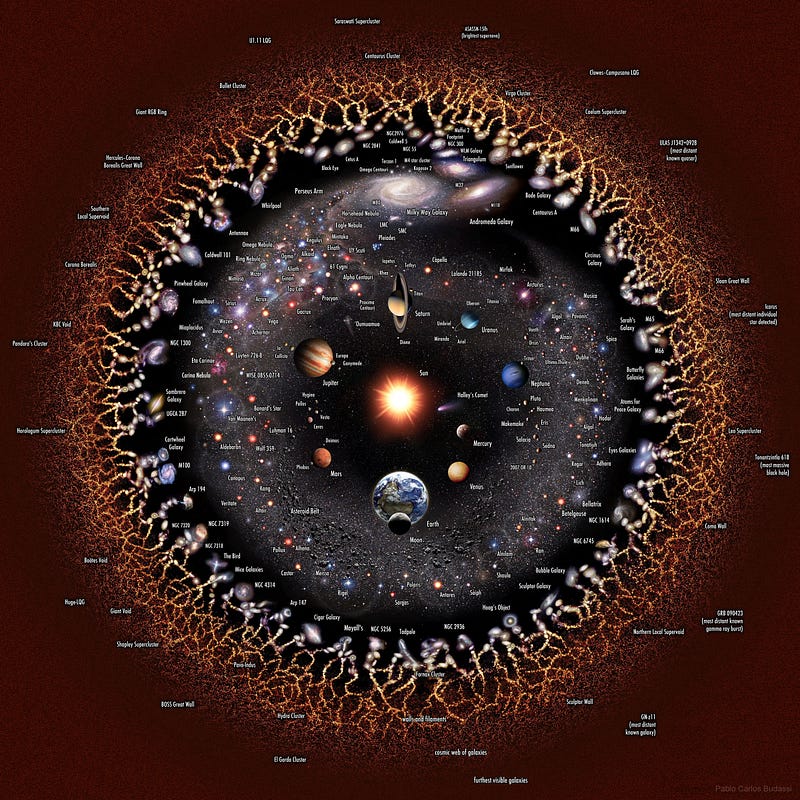
Many people have heard that the diameter of the visible Universe is about 93–94 billion light years and have seen pictures depicting our Universe in the form of a sphere just like you see on the screen now. At the same time, most people have a logical question, what is outside this sphere? Let’s look into this question together.
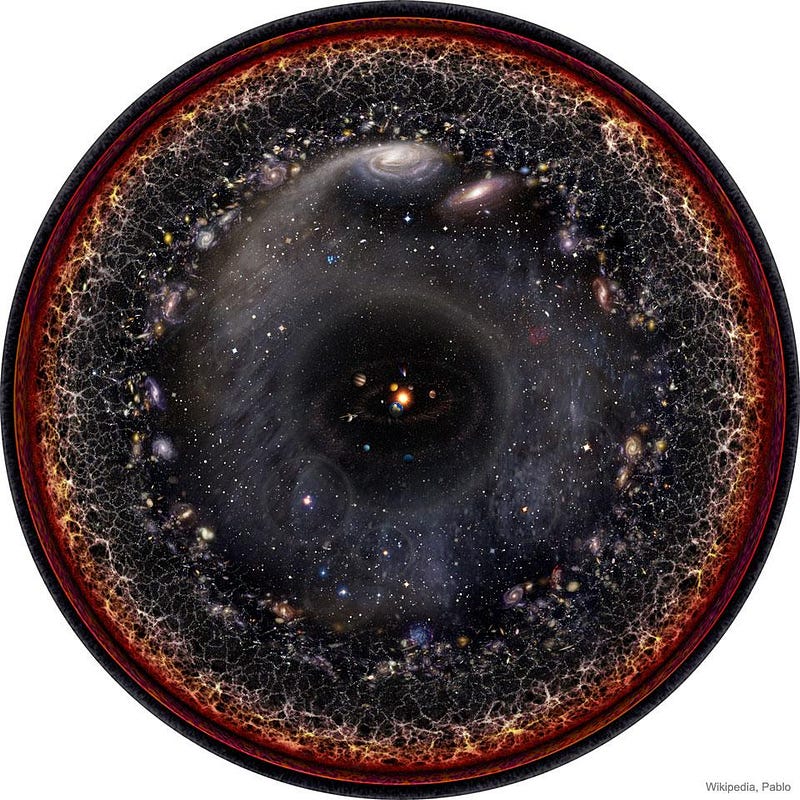
At the moment, there is no consensus in the scientific community about whether the Universe is really infinite or whether it has limits in space and volume. However, there are several dominant theories about this and we can consider the most plausible of them.
As I said, based on a lot of research, scientists assume that the universe is either infinite or just very big. To decide between these two options, astronomers look at the curvature of space-time on the scale of the entire universe. On such a large scale, it tells researchers about the very shape of our Universe: whether it is an infinite plane, sphere or torus. To be truly infinite, the Universe at a minimum must be geometrically flat, and therefore have zero curvature.
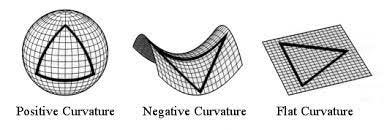
Current observations and measurements of the curvature of the Universe show that it is 99.6% flat. The missing 0.4% are due to possible measurement errors. However, this is not enough to say that the Universe is infinite. Even in the case of a flat Universe, space does not necessarily have to be infinitely large. For example, if you take the side surface of a cylinder, it is also geometrically flat, because parallel lines on its surface do not intersect, but the cylinder has a finite volume. The same can be with the Universe, that is, it can be flat, but at the same time closed in itself and have a limited volume.
In such a case, what is beyond this volume?
This question is very complicated and lies in the field of theoretical physics. If the boundaries exist and the Universe has a limited volume, then we will most likely never have any information about what is beyond them, but there are already a number of mathematical theories that describe what exactly is beyond our Universe.
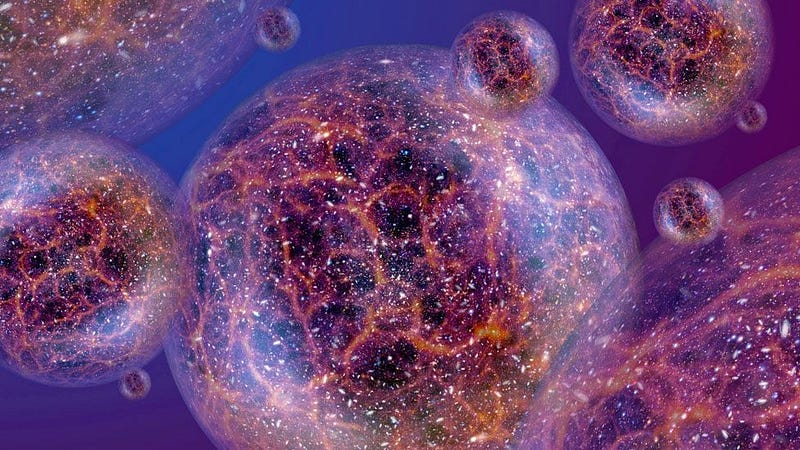
According to one of them, there may be a so-called “super” Universe outside our Universe. That is, such a space outside our Universe, which stretches infinitely and in which our Universe can expand forever. In this super universe, at a distance of hundreds of billions of light years from us, there may exist other universes similar to ours.
At this point the question arises: why do we not see them then?
The most likely explanation for this is that these universes are so far away that by the time their light reaches the Earth, it may have lost so much energy due to the expansion of the universe that we physically cannot detect it. Or even our universe, if it is not eternal, may, so to speak, die by the time this light reaches us.
According to another theory: outside our expanding universe, there is another space-time universe, with more dimensions, in which our universe is expanding. Since this universe has a higher dimension, we cannot see, detect or comprehend it, at least not yet.
Thus, there are many similar theories about what can be beyond our universe, if there are such limits, and they all boil down to the fact that beyond these limits there is either another, larger universe, or there is absolute nothing, which is impossible to describe, because there is no space itself.
Despite the fact that we still do not know whether there is a limit to the Universe, you can often hear expressions such as: a galaxy found at the edge of the Universe.
What edge are we talking about in this case?
We are talking about the edge of the visible universe, which is a sphere centered at the location of the observer (in this case on Earth). The radius of this sphere can be determined by the time for which light could reach us from the Big Bang. In general, the distance from Earth to the edge of the visible Universe should be about 13.7 billion light years, but since the Universe continued to expand during the flight of photons to us, the distance is about 46–47 billion light years.
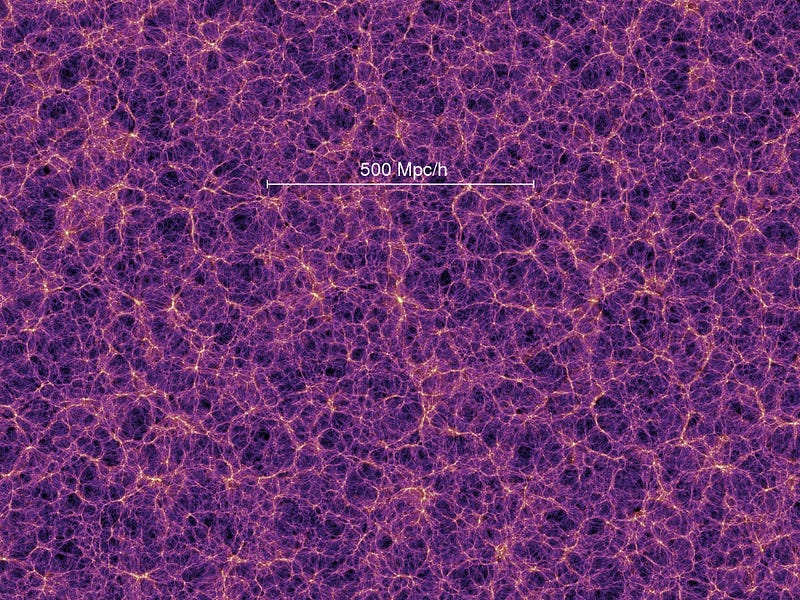
And every point in the Universe has its own visible spherical edge of the Universe, reachable for observation. We cannot see what is beyond this edge, but according to cosmological principles, regardless of whether our universe is closed or not, beyond the visible edge there must be the same space as ours, the same stars and galaxies as those that surround us scattered across finite or infinite space. Some supporters of the closed universe theory suggest that its volume is not so large, and it is possible that among the most distant galaxies we see our galaxy as it was shortly after the big bang. The light from it made a circle through the closed universe and returned to us, but at the moment it is only an unreasonable assumption.
Well, that’s all I have, do not step outside your universe.
Clappe if you want to see more articles about space in your feed!
Subscribe to our channel and ask your questions, which I will answer in the following articles.


