
Jungian Psychology
What is Behind the Need To Change Gender or Gender Identity?
Union of Opposites
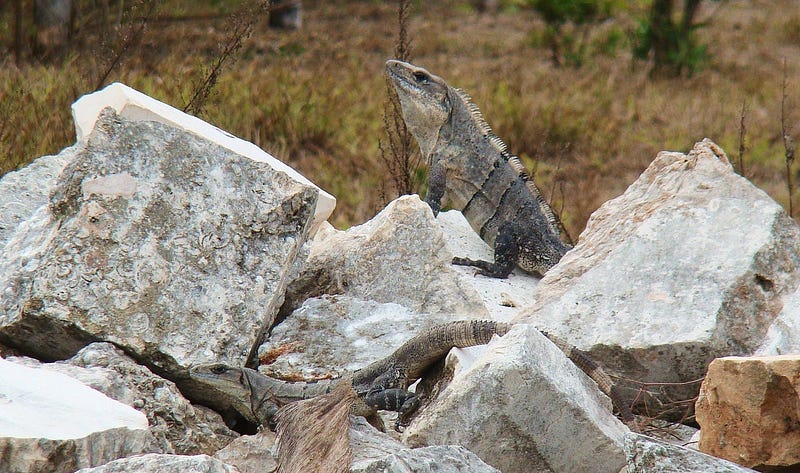
There are quite a few natural life forms in the Yucatan that I have managed to photograph: birds, insects and animals. I have frequently found iguanas emerging from piles of rocks or from crevices in walls to bask in the warmth of the sun. This fellow had his cheeks puffed out, something I had not seen previously in my wandering through the countryside with the camera. My first thoughts were that this likely had to do with him searching for a mate, for the feminine.
Later while looking at the iguana in the photograph back on my computer after the walk, I thought of ourobos, the lizard who tries to consume himself, to feed himself, and in the process, to somehow become transformed. And then as I looked at the head, I had a fleeting thought that it resembled a penis. A penis in search of nourishment, in search of nourishing, in search of the feminine.
Ouroboros is an ancient symbol depicting a serpent or dragon eating its own tail. Originating in ancient Egyptian iconography, the ouroboros entered western tradition via Greek magical tradition and was adopted as a symbol in Gnosticism and Hermeticism and most notably in alchemy.
A Swiss psychologist, Carl Jung, saw the ouroboros as an archetype and the basic mandala of alchemy. Jung also defined the relationship of the ouroboros to alchemy. And so now, the Ouroboros is a dramatic symbol for the integration and assimilation of the opposite, the shadow.
I wonder, if somehow this idea of transformation is somehow tied to the humans who externalise this drive, this pull to change into a change of gender. For some, that change involves surgery and a regime of drugs. This isn’t meant as a criticism of the individuals who have undergone the process or who are somewhere in between. I am simply looking at all of this psychologically.
In future posts, I will come back to the issues of transformation using alchemy as my guiding principle. Humans desperately need to begin looking beneath the surface of the people they meet, including themselves. And yes, I do consider myself to be LGBTQ friendly.
I want to give a shoutout to my faithful readers of my Jungian psychology posts:
Jenine “Jeni” Baines, Mitch Y Artman, Robert, K.B. Silver, Carrie Wexford, and Lucy Weir
I also want to recognise JJ Hart who I hope has a response to this post.