
What is AWS CDK? what are the advantages and disadvantages of using CDK?
The AWS Cloud Development Kit (AWS CDK) is an open source software development framework to model and provision your cloud application resources using familiar programming languages.
The AWS CDK supports TypeScript, JavaScript, Python, Java, C#/.Net, and Go. Developers can use one of these supported programming languages to define reusable cloud components known as Constructs. You compose these together into Stacks and Apps.
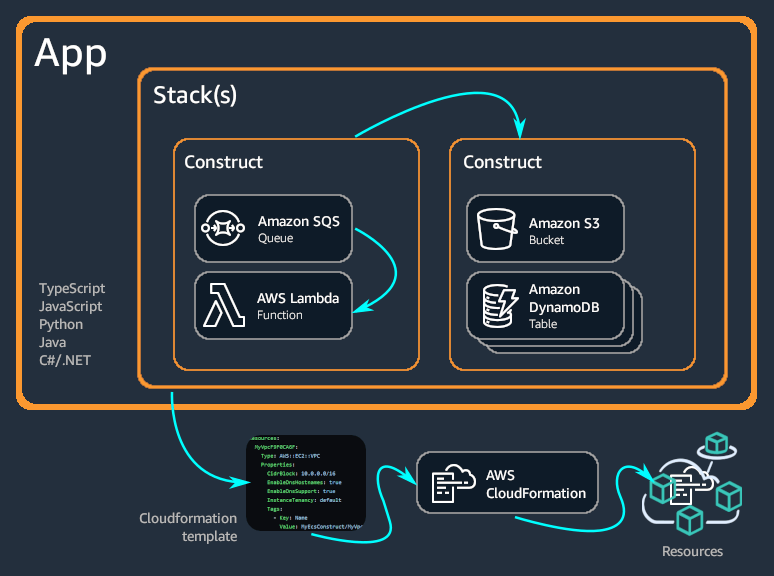
With the AWS CDK, developers or administrators can define their cloud infrastructure by using a supported programming language. CDK applications should be organized into logical units, such as API, database, and monitoring resources, and optionally have a pipeline for automated deployments. The logical units should be implemented as constructs including the following:
- Infrastructure (such as Amazon S3 buckets, Amazon RDS databases, or an Amazon VPC network)
- Runtime code (such as AWS Lambda functions)
- Configuration code
Stacks define the deployment model of these logical units. For a more detailed introduction to the concepts behind the CDK, see Getting started with the AWS CDK.
Advantages of AWS CDK:
1. Familiar Programming Languages:
- CDK supports popular programming languages like TypeScript, Python, Java, and C#, allowing developers to use languages they are already familiar with.
2. Abstraction of Cloud Resources:
- CDK provides high-level abstractions for AWS resources, making it easier to define and manage complex infrastructure components.
3. Code Reusability:
- Developers can reuse code components, patterns, and constructs, leading to more modular and maintainable infrastructure code.
4. Integration with IDEs:
- CDK integrates with popular integrated development environments (IDEs), providing features like autocompletion and code navigation to enhance the developer experience.
5. Automatic Generation of CloudFormation Templates:
- CDK automatically generates CloudFormation templates based on the code written. This can save time and effort, as developers don’t need to write or maintain the templates manually.
6. Community Contributions:
- Being open source, CDK benefits from community contributions, providing a broader set of constructs and support for various AWS services.
Disadvantages of AWS CDK:
1. Learning Curve:
- While CDK abstracts away some complexity, there is still a learning curve, especially for developers who are new to infrastructure as code or AWS services.
2. Abstraction Overhead:
- High-level abstractions can sometimes hide details and make it challenging to understand the exact behavior of the underlying AWS resources.
3. Dependency on CDK Versions:
- As AWS CDK evolves, there may be changes to APIs or constructs between versions. This could potentially lead to code changes when upgrading to a new CDK version.
4. Limited Language Support:
- While CDK supports popular languages, the range may not cover every developer’s preferred language, which could be a limitation for some teams.
5. Initial Setup Overhead:
- Setting up a CDK project might involve additional configuration, dependencies, and learning the best practices for structuring the code.
6. Mixing Concerns:
- Depending on how it’s used, CDK can lead to mixing concerns, where application logic and infrastructure code are closely tied together, potentially violating separation of concerns principles.
In summary, the AWS CDK offers powerful abstractions and productivity gains but may require a learning investment. Assessing the trade-offs and considering factors such as team familiarity, project complexity, and long-term maintenance is crucial when deciding whether to use AWS CDK for a particular project. Always refer to the latest documentation and community feedback for the most up-to-date information.
Reference:


