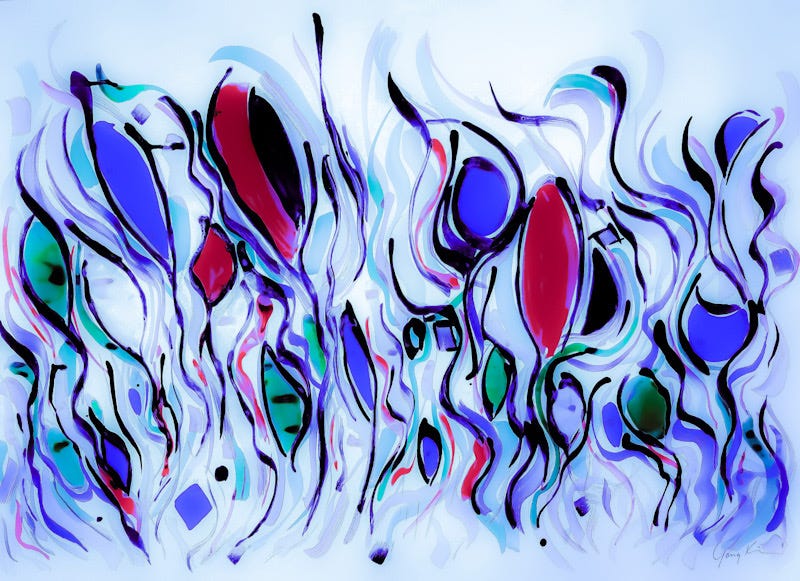
What is Art?
“You say that bag of excrement you’ve placed in a museum is art?”
What is art?
I suppose this is still a controversial question that deserves a serious answer. But that’s not what this is, at least not some well-argued philosophical answer, though I think I could make a very reasonable argument from an axiological point of view.
No, this is not that at all, at least not primarily. Because I don’t think the question is all that interesting. If you say that art is whatever you consider art, that’s fine. I used to get triggered by such bland answers, but not anymore because I see the big picture.
A more interesting question is: What is good art?
I know, it’s not the same question, but they’re closely related. You say that bag of excrement you’ve placed in a museum is art? Fine. Let’s go with that. But what makes it a good art?
(Here’s an example of good art while you think about it, one that I found on the internet, one whose greatness I cannot deny as much as I try.)

Cat got your tongue? Come on, you gotta be able to put up some kind of defense, some kind of rationale, even MoMA can spew a bunch of BS about ‘multiplicity’ or ‘cultural commentary’ to justify why Andy Warhol’s Campbell soup paintings are great. You can come up with something, can’t you?
Yes, conceptual art is not about beauty, it’s not about anything visual at all, but merely about the concept. But what makes the concept behind the bag of literal shit good?
It’s not even original. It’s just another copy of the concept behind Marcel Duchamp’s Urinal, that anything can be art, by putting it on a pedestal, by displaying it in a museum, by just thinking of it as art. There are hundreds of examples of this. Some put an unmade bed in a museum, displaying it as art. Some put up a blank canvas with an axe stuck to it, displayed as art in a gallery. Some put themselves in a museum, displaying themselves as art. All the same concept, just different executions.
What was mildly amusing and perhaps controversial in Duchamp’s case has become boring, even irritating, if not outright pretentious.
I’m not into realist art, but if you like Mona Lisa, great! If you saw, however, a bunch of Mona Lisa knockoffs, with slight changes to the hair, the eyes, the clothing, etc. you’d be annoyed too. That’s what those conceptual art pieces are. The same thing over and over again, just packaged differently. Well, at least they aren’t literal shit that stinks up the place.
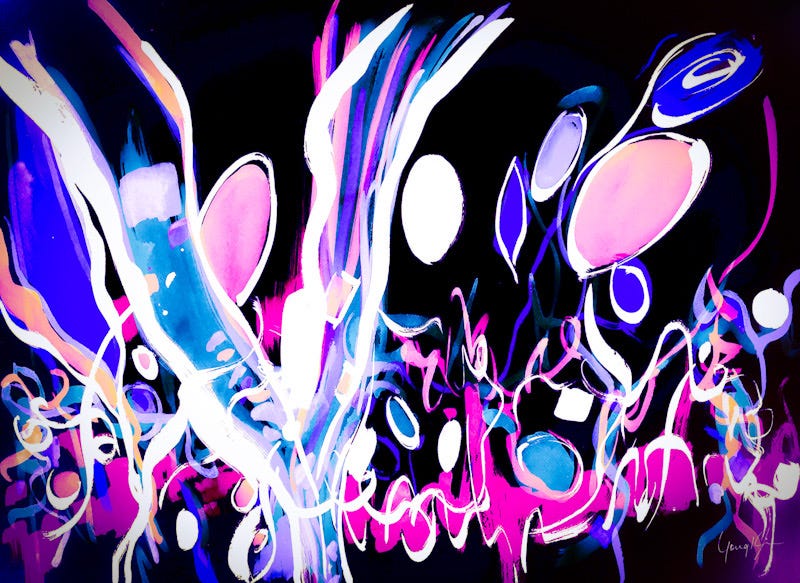
I know, I know, I don’t mean to traumatize you with this garbage, so here’s another stunning artwork that needs no BS to justify its merit. (OK, OK, I’ll stop bagging on Warhol, sorry Andy, it’s just a habit, nothing personal!):
Isn’t this guy great? I wonder who this mystery artist is, hmmm . . .
Anyway, as much as I love to bag on conceptual art, that’s not what this article is about. I don’t even hate conceptual art. Not really. I just haven’t seen any interesting concepts in it, that’s all. For an art movement that’s all about the concept, they sure love to espouse boring concepts over and over again.
The point with the slightly different question is that nothing really hangs on the question of ‘what is art?’ It is only when we consider what makes something good, what makes something a good art, that we’re asking something that matters. You gain very little in admitting something as art if it can’t also be shown as good art. Like this for example:
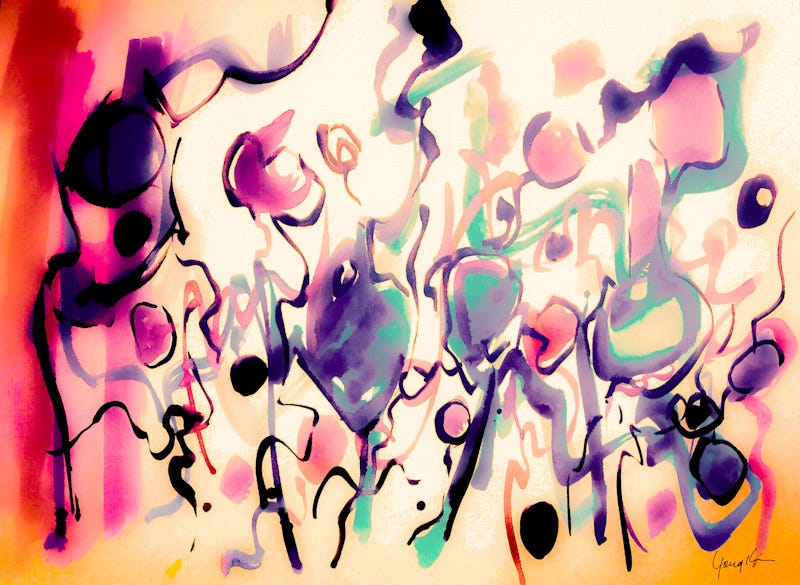
I mean, its greatness is just obvious, right? Why isn’t this guy famous yet?
Where was I? Oh, yes, what is good art? Well, that’s not an easy question to answer because there are so many different types of art and so many different genres even within a specific type of art. Because what makes something good in one genre is not necessarily what makes it good in another genre.
By ‘art’ I’m granting whatever floats your boat. Or as Jerry Seinfeld once said — whenever you make something out of nothing, a joke, a drawing, a song, a story, a dance, anything and everything really. But when we make something out of nothing, some are more interesting than others, some are more enjoyable than others, and some just work better or are better appreciated. If you’re not an artist, it’s easy to throw your hands in the air and shrug at the question “What is good art?” As if anything goes, as if it’s all subjective, like the cliche, “Beauty is in the eye of the beholder.”
If you’re an artist, you know this is nonsense. Even if only within a small circle that you operate in, you know there’s better art and worse art, and that not all art is equal. If you don’t know that, then you can’t improve in whatever art you’re working on because you have no direction and no way to evaluate your own work.
I think we all know that at some level because art isn’t that different from everything else — there are levels of competence in everything. But we feel uneasy in saying things like this because we know things aren’t set in stone. New art forms and new genres arise all the time, often flipping previous standards, even making them irrelevant sometimes, for example, in the transition from realism to impressionism to expressionism and beyond.
What you enjoy in a cubist painting is quite different from what you enjoy in a realist painting. And you don’t insist on realist standards when it comes to a cubist painting because you understand that, because they would ruin it.
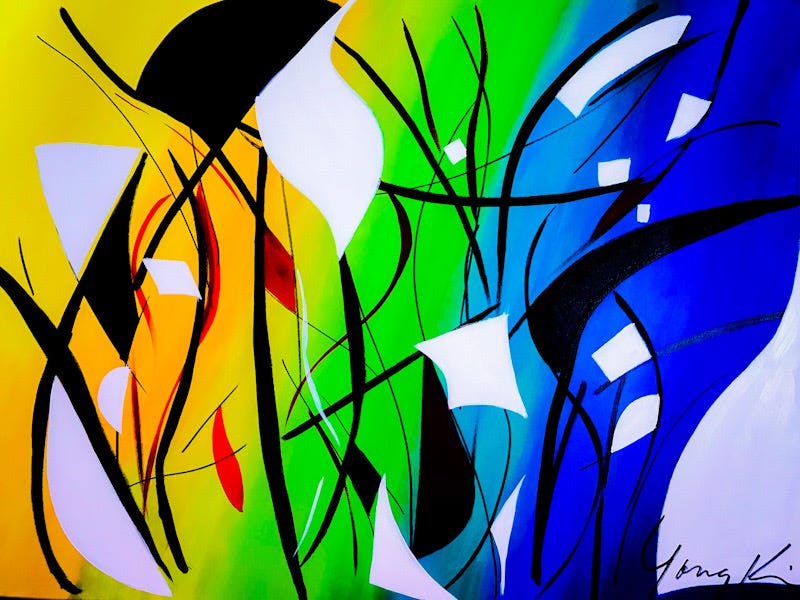
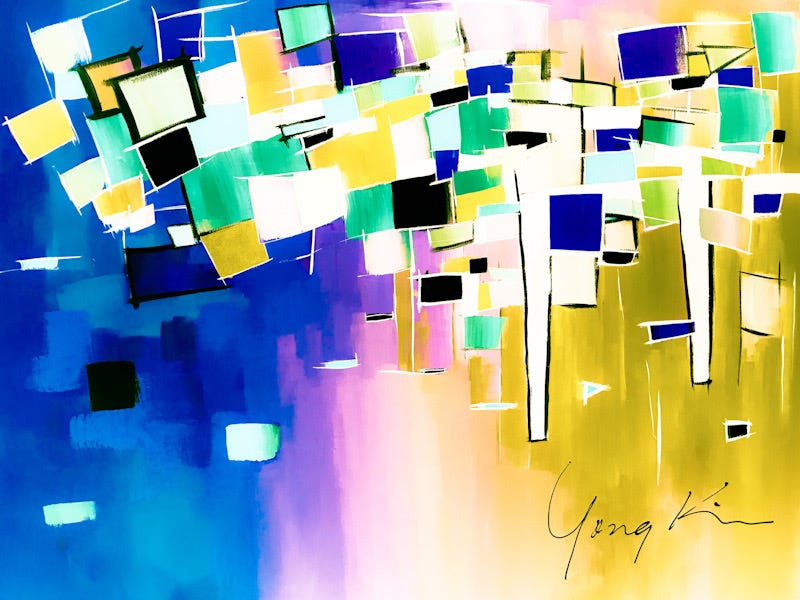
Hmmm, I was looking for some examples of cubism, but weirdly enough I couldn’t find any. I thought Picasso was still very popular? Oh well, here’s more from this amazing artist I discovered on the internet, with a slight cubist influence:

I would definitely pay hundreds of millions of dollars for that painting if I had the money. I don’t know why people haven’t gobbled up all of his paintings yet.
Anyway, you get the point, and the fact that different art forms and different genres have different standards doesn’t mean that anything goes, the opposite really. It’s just that our perceptions and tastes change over time and with different experiences. So what was once very radical, interesting, and new can become quite stale and boring, and what was at first jarring and ugly can quickly become the new Avant-Garde, even the start of a new movement. Given this evolutionary, somewhat subjective element, the best we can do to answer the question “What is good art?” is to answer it in terms of our enjoyment or appreciation, understanding that that can change over time and that different people may differ.
This doesn’t mean that chaos reigns because we are not that different from each other. Even on beauty, the prime example of subjectivity in many people’s minds, we mostly agree. It’s very rare that someone’s completely off in their judgment of a person’s (surface) beauty. Likewise with jokes, catchy tunes, gripping stories, etc. There’s a reason why some songs are very popular. It’s not random.
Of course, it helps to have a sense of humor to understand and appreciate a good joke, etc. And we don’t all have the necessary appreciation to appreciate everything. And in the things we have no appreciation for, we can’t really judge because we don’t understand them, like languages we don’t speak.

While this answer is not controversial for most art forms, like music, film, comedy, dance, etc., it is controversial for literature and visual art. I’m not sure exactly why that is. There is definitely some disconnect in these two fields.
For example, the academics love James Joyce’s Ulysses, a book most people probably never even heard of, much less read. I tried to read it once. ‘Tried’ being the keyword. I couldn’t finish it. I couldn’t even get past the first several pages. I understand that it’s innovative in its narrative experimentation, I kind of get why they love it, but I couldn’t get myself to share in their appreciation. I just couldn’t. Because it didn’t work ultimately. The story just wasn’t interesting, so much so that I don’t even remember any of it.
And it’s not because I don’t appreciate classic literature. I loved Don Quixote as a little kid, the hilarious tale of a “knight” fighting windmills and other adventures. As a kid, I was a bookworm for literature in many forms. I just couldn’t get into Ulysses.
Compare it to Robert Heinlein’s science fiction classic The Number of the Beast. It’s the sort of book sci-fi fans love and critics love to hate. The exact opposite of Ulysses, the sort of book most critics love while most people cannot stand. We call them pretentious and they call us ignorant. While I’m mostly on the side of the people, I see both sides.
They are a little pretentious. I mean, I’m not looking for a narrative puzzle to solve when I read a novel. While I’m OK with narrative mystery in general and do not like every little detail handed to me from the beginning, like John Steinbeck’s The Grapes of Wrath, I don’t want to be doing differential equations in my head just to figure out what’s going on. Some apparently don’t mind that, even love it! Maybe I just don’t appreciate modernist literature? Maybe. Most people don’t.
Regardless of who’s ‘right,’ this is not a problem. The academics and the critics are the minority. They don’t determine the New York Times bestseller list. In visual art, however, this is a problem because we’re basically North Korea.
No one appreciates the bag of shit in the museum. No one appreciates the unmade bed just because it’s displayed in a museum. No one thinks you’re any more special just because you pretend to be art in a museum. No one except those who have already drunk the Kool-Aid or are participating in the scam. And yes, it is a scam, no one can honestly say that this crap is still interesting after it’s been copied to death by every cool artist. I dare you to take a lie detector test and prove me wrong! Go on, I’m waiting!
Art is so expensive these days that it’s basically an investment. And as such you rely on the ‘experts’ to make sure you aren’t investing in the wrong thing. The ‘experts’ are the curators and the elites who decide what’s worthy and what belongs in museums, a top-down dictatorship with no input from the people. We see that the Emperor is naked and has no clue, but we don’t say anything, except to ourselves, because we aren’t buying these expensive shit anyway.
Even worse, they have a vested interest to keep the scam going. Because they have to artificially inflate their value to justify the investment. They have no choice but to keep lying, to keep the scam going, if they hope to keep the investors coming back for more.
I don’t know how I ended up at my soap box once again. I didn’t mean to. I had plenty of interesting anecdotes to share, as well as arguments to defend my thesis, but I don’t remember them anymore. Maybe I’ll share them at another time. Meanwhile, I must manage my anger by staring at more of this guy’s great art: