
What Is An ETF?
Key Information About Exchange-Traded Funds, Their Investment Benefits, Drawbacks And Calculations
Exchange-Traded Funds, commonly known as ETFs, are one of the most revolutionary investment instruments available.
Due to the dynamic and innovative characteristics of ETFs, there are 7000+ ETFs available globally and new ETfs are being manufactured on frequent basis.
ETFs, help investors diversify their exposure to a range of market sectors and industries. This article will explain what an ETF is, along with its benefits/drawbacks, how it is priced and the different types of ETFs one can invest in, in simple and easy to understand terminology.
New ETFs are being created on a frequent basis and there are thousands of ETFs available now. ETF is a must-know investment topic.
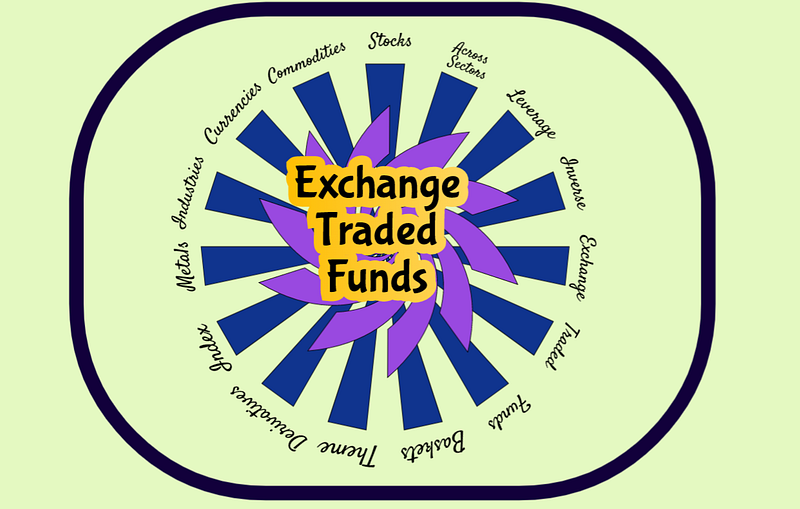
There’s an ETF that tracks the FAANG companies, ETF that tracks companies within Emerging markets, ETF on green companies, ETF with companies offering AI services as its constituents, ETF on dividend-paying stocks, ETF on stocks that are heavily invested by the insiders of the company, and so on. Essentially, there’s an ETF for nearly every theme or investment strategy.
Anyone who is interested in investing their personal finances should explore ETFs to assess whether they meet their investment requirements.
Most of the ETFs track the performance of an index. Index ETFs attempt to replicate the holding structure of the index.
Before I begin…
Disclaimer: This article is for learning purposes only and it should never be taken as investment advice. I highly recommend seeking an independent professional financial adviser before carrying out any investments. The author(s) do not take any responsibility for any loss. Therefore please use this article for educational purposes only. It is based on a view of the market environment, keeping in mind that the market is continuously changing. The article will be updated at any time without any notice as more information is gathered. If you spot an issue with the article then please do let us know.
1. Let’s start by understanding what an ETF is?
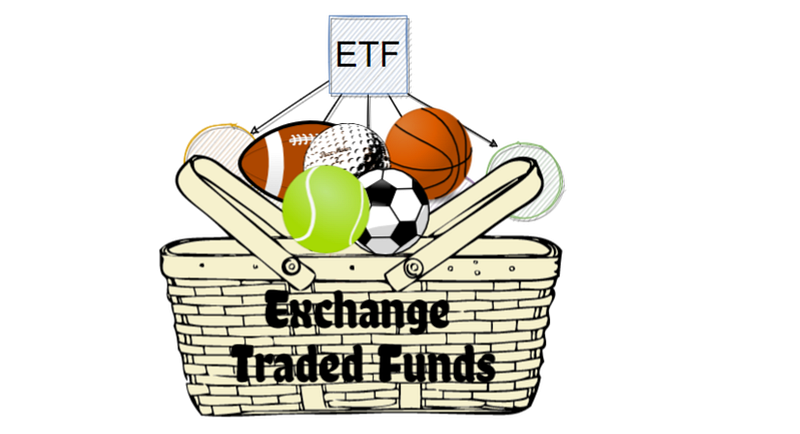
In a nutshell, an exchange-traded fund (ETF) is a financial instrument/product. An ETF usually tracks the performance or mimics one or more market segments. The segments of markets are usually indices. Therefore, an ETF can be understood as a financial product that is a wrapper on a basket of securities (indices as an instance) that represent a group of markets. The securities can range from bonds, company stocks, indices, commodities to derivatives. Derivatives are traditionally used to amplify the returns/losses and/or to create a synthetic ETF.
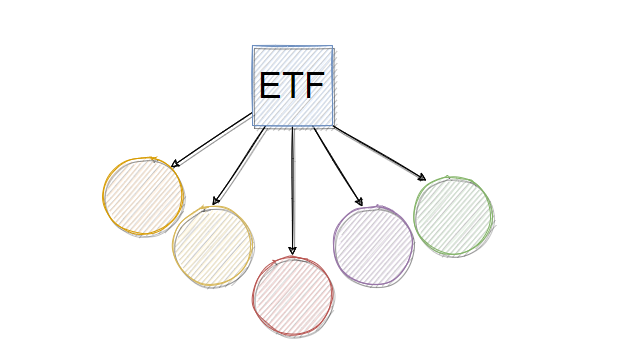
Structure of an ETF
ETFs can help an investor diversify the portfolio and gain exposure to multiple currencies and market sectors. Subsequently, ETFs help investors by investing in a basket of company stocks, commodities, indices and so on.
ETFs can track market or custom indices. A market index is a way to measure the general value of the financial market whereas a custom index is an investment strategy. Market index, therefore, reflects the price changes of the market as a whole and is a good way to understand where the market is heading. Market index is often seen as an indicator in the financial world.
Each security within an index can have a different weight associated with it. As an instance, there can be an ETF that tracks an Index that has 3 securities: Security 1 can have a weight of 50% whilst the other two securities can have a weight of 25% each. The weightings of the securities within a market index can be based on a strategy or metric such as the market cap (price * shares outstanding) of the stocks.
An ETF can have a diverse types of instruments as its constituents, e.g. an ETF can have a FX trade, a bond trade, metal derivative trade, an option on a index and cash as its constituents, each having a different weight.
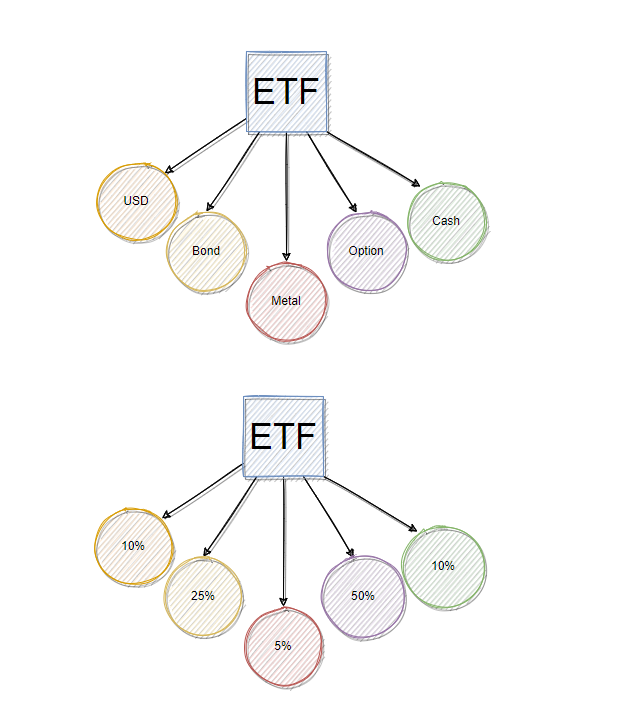
To summarise, ETF can be a seen as collection of instruments i.e. stocks, bonds, currencies, commodities etc. These instruments are commonly known as securities. The securities of an ETF are the constituents of an ETF.
It’s highly important to perform your due diligence and buy the ETFs that match your criteria, and only invest in an ETF if you are fully aware of the investment decisions you are making.
2. Why do we need to consider investing in an ETF?
Every investor can have different investment circumstances. As an instance, some investors might want to invest in companies that are riskier in nature and are looking to earn potentially higher returns with greater risks, while other investors might be interested in a particular set of companies for ethical reasons.
Some investors are interested in companies that are helping and reducing the climate risk whilst others are concentrating on the companies where there’s a lot of insider activity.
An investor can spend hours and even days screening and shortlisting the appropriate companies, buying their stocks and then managing the portfolio, or the investor can buy an ETF that tracks a specific sector, market or the type of companies or theme that the investor is interested in.
Subsequently, an investor can buy an ETF that tracks the price of an S&P 500 index, the price of environmentally friendly companies offering AI services, or companies that offer mortgages. In a nutshell, the combinations are limitless for an ETF investor.
To elaborate, an investor could buy an ETF that tracks the Russell micro-cap index to gain exposure to micro-cap firms. Consequently, instead of buying the shares of all of the SnP 500 companies and adding management and trading overhead, one can buy an ETF that tracks the Snp 500 index. The securities within an index are passively selected. The market index can track the performance of a segment of a market too such as Russell 1000, Russell 3000, SnP 500, FTSE 100, FTSE 250 and so on. The securities selection of a custom index can be based on a strategy, quantitative technical and fundamental indicators too.
It’s worth noting that the constituents within an ETF will shift from their original allocation, starting the day after you purchase them. ETFs need to be rebalanced back to their targets regularly to minimise the drift.
3. How do we buy or sell ETFs?
ETFs can be bought through an NASD registered broker on a stock exchange. ETFs are traded just how one would traded shares of a company that are listed on a stock exchange.
There are a large number of ETFs with their own characteristics available in the market. Each ETF has its own operating structure. An investor could trade ETFs that are manufactured by iShares, Direxion, Vanguard, ARK, WisdomTree, SPDR etc.
Every ETF has its own operating structure which can be found in the documents associated with the issuance of an ETF.
4. ETF Key Benefits and Drawbacks

Benefits
There are a number of benefits associated with investing in an ETF. The key benefits over mutual funds are:
- ETFs help investors create a diversified portfolio. ETFs can help investors reduce portfolio risk by enabling them to invest across different countries on various currencies.
- ETFs can lower investment costs and increase trading flexibility as the ETFs can be bought/sold any time on an open stock exchange
- ETFs provide a tax-efficient way of investing by tax-loss harvesting due to their rebalancing mechanism. Essentially the strategy is to sell money-losing ETFs or constituents to offset taxable gains from profitable trades as long as the wash sale rule is not violated.
- ETFs distribute dividends and interest to the holders.
- ETFs are transparent in the sense that their constituent holdings are published on a periodic basis to the public.
- Just how an investor can trade conditional common stocks, the investor can also place market, limit and stop-loss orders amongst others on the ETFs too.
- ETFs can be shorted.
- ETFs can be bought or sold on margin. ETFs can also be bought or sold on leverage and we can also buy inverse ETFs.
Drawbacks
The main drawbacks over mutual funds are:
- There are higher trading costs and management fees associated with ETFs, such as the commission cost that an investor needs to pay on each ETF trade.
- There is always a tracking error between the benchmark index and the ETF.
- ETFs are at times not traded widely and might not be as liquid as the individual constituents.
- The more underlyings there are in an ETF, the more factors that influence the price of the ETF. Therefore, it becomes harder to keep track of the factors and it adds a layer of complexity.
- ETFs are not as liquid as individual stocks and consequently there is a higher liquidity risk present within an ETF.
5. How Is An ETF Priced?
An ETF provider manufacturers an ETF. The provider can create an ETF that is composed of a number of company stocks.
The prices of the stocks along with their outstanding shares can change on a continuous basis during trading hours. As a result, the price of an ETF along with its number of shares outstanding can also change continuously throughout the day because it is impacted by the factors that influence the prices of each of its underlyings along with the supply and demand in market.
An ETF, therefore, tracks the market prices of the underlying securities. The market prices of the securities are primarily driven by their supply and demand.
ETF NAV
Before I explain how the prices are computed, it’s ideal to break it down into two parts: NAV and then Bid/Ask Prices.
An ETF has a Net Asset Value (NAV). The NAV is calculated when the market is closed. This is the value of an ETF that an investor needs to pay to buy one unit of an ETF. The NAV of a fund is essentially the difference between the assets and liabilities of the fund per outstanding share.
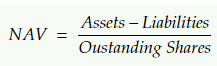
The asset of a fund is the market value of the underlying securities along with the cash holdings within its compartment, and the liabilities can be fees, or any outflows within the fund.
The liabilities side of the NAV equation, on the other hand, depends on the overall operating structure of the ETF. The asset part of the NAV can be computed by calculating a weighted sum of the market price of the securities held within the ETF.
It’s vital to understand that the ETFs are not always traded at their net asset value. This is because the price of an ETF is also impacted by the supply and demand of ETF shares.
The intraday value of an ETF is usually calculated every 15 seconds. Intraday prices are considered an estimate of the NAV. This is because an ETF can be tracking securities that are listed in exchange of a different country that are closed due to time differences while investors are trading the ETFs. As a consequence, an ETF price is impacted by its supply and demand in the market too. The actual NAV of an ETF is published only once per day after the markets are closed and are calculated by the closing prices of the underlying securities.
An ETF is considered to trade at a discount (permium) if its price is below (above) its NAV
ETF Price
The price of an ETF is computed during the trading hours. It is impacted by the supply/demand of the ETF and the underlying securities. The price of an ETF can deviate from the NAV because the price is influenced by the bidders (demand) and askers (supply) of the ETF.
An ETF has two prices: bid and ask.
The ask is usually the price an investor is willing to pay to buy 100 shares of an ETF. The bid is the price an investor is willing to sell an ETF for.
For the sake of simplicity, the bid and ask prices can be computed by scaling the intraday price of the ETF by a spread. The spread is dependent on a number of factors including how liquid an ETF is, along with the manufacturing and operating costs of the ETF. The liquidity of an ETF can be dependent on the total asset under management (AUM) of an ETF. Therefore, it’s vital to understand the structure and operating costs of an ETF before investing in it.
6. What Are The Different Key Types Of ETF?
This section will illustrate the key types of ETFs
- Equity or Index ETFs: ETFs that track equities or indices within a particular market/sector or industry with a given size.
- Thematic ETFs: ETFs that are based on a different theme and investment strategies.
- Fixed Income ETFs: ETFs that are traded on fixed income assets, including government and corporate bonds.
- Commodity ETFs: ETFs that track commodities such as metals, gas as their underliers, or they can have derivatives that track the commodities as their underliers.
- Currency and Geographic ETFs: ETFs that track the movements of currencies and help investors gain exposure to an FX market or a specific region in the world.
- Inverse ETFs: Some ETFs are inverse in nature e.g. -2x ETF. The price of an inverse ETF increases when the prices of the constituents decline. There are also leveraged ETFs e.g. 2X that magnify the movements of the constituents by using derivatives.
- Sustainable ETFs: ETFs that tend to focus on investment approaches that concentrate on environmental, social and governance policies and risks.
- Crypto and meme ETFs: ETFs that tracks bitcoin. There’s an ETF that tracks the performance of the meme stocks.
Summary
ETFs are one of the most revolutionary investment instruments available due to their innovative characteristics. There’s an ETF for nearly every trading theme and strategy.
This article aimed to explain what an ETF is, along with its benefits/drawbacks, how it is priced and the different types of ETFs an investor can invest in.
There are thousands of ETFs available and each of them can be managed differently. Just like stocks can be bought/sold on an open exchange, ETFs can also be bought/sold at any time on an open exchange.
ETFs can help an investor diversify the exposure to multiple currencies and market sectors. Subsequently, ETFs help investors by investing in a basket of company stocks, commodities and indices without buying the actual underlying.
Anyone who is interested in investing their personal finances should explore ETFs to assess whether they meet their investment requirements.


