
MOTHER NATURE WANTS US TO KNOW
What Is an Ecosystem and Why Does It Matter that We Understand It?
How do we characterize it? Define it? Account for all the interactions within it? And how do we teach it?
My friend and co-conspirator, John Williams, publisher of Salish Magazine, posed an interesting question to me recently:
At Salish Magazine, we’ve been looking for ways to represent and convey an ecosystem perspective. In other words, instead of talking about one species at a time, the way a field guide might, I’d like to talk about the roles a species plays, the many relationships it has with other things, and the big picture of all of those things working together. So, what if, as a first step toward an ecosystem perspective, we build a database containing not just all of our species, but all of the relationships that each one has with the others? — John Williams, Publisher
As contributing editor and former board member at Salish Magazine, my thoughts have been centered on this question too, for a long time. I tremble at the thought of a database that would require a bank of servers larger than a city, but perhaps this idea could give us a start.
But why are we so concerned about this idea and how to convey its significance to our readers? What’s an ecosystem anyway?
How is an ecosystem defined?
The following are some of the best and simplest definitions I could find:
- National Geographic Society definition: An ecosystem is a geographic area where plants, animals, and other organisms, as well as weather and landscapes, work together to form a bubble of life.
- A Grade 7 definition (one of the better ones): An ecosystem is a system that has formed through the interactions among different living and non-living parts of an area. Non-living parts of an ecosystem are things such as soil, water, wind, sun, rocks, etc. Interactions are the effect that living and non-living things have on one another.
- Kahn Academy: An ecosystem consists of a community of organisms together with their physical environment.
- Brittanica.com: ecosystem, the complex of living organisms, their physical environment, and all their interrelationships in a particular unit of space.
How do we study an ecosystem?
While we would prefer to expose our Salish Magazine readers to the roles a species plays, the many relationships it has with other things, and the big picture illustrating all of those things working together, the ecosystem perspective isn’t easily discussed. It’s difficult even to think about, because there are so many bits and pieces and untold (and often unknown) interactions among them, that the mind quickly boggles, and then, speaking for myself, completely bogs down.
Because of the complexity of even the simplest ecosystems, we most often see information about Nature divided into classifications and disciplines rather than emphasizing interconnections. We tend to break things down into smaller, more easily digestible chunks, and then we attempt to reassemble those chunks into a whole.
To me, this is like trying to understand how an iPhone works by looking at its home screen, its charger, and its Bluetooth earbuds.
Is there a better way?
One approach to developing a complete understanding of an ecosystem might be to make a list of everything contained within that ecosystem and ways in which each interacts with all the others. Let’s consider a very simple example: a small tabletop aquarium containing a couple of tropical fish.
What do those fish need to survive and thrive? Obviously, they need a source of food, their water has to be a certain salinity and temperature, and there must be a certain percentage of dissolved oxygen for them to breathe. We can add plants to the system to produce oxygen and absorb carbon dioxide. We can add a temperature controller and a filter to maintain a clean and comfortable environment. And each morning we tap a few crumbs of fish food into the tank. We place the tank close to a sunny window to mimic a regular diurnal cycle and to provide sunlight to enable the plants to photosynthesize.
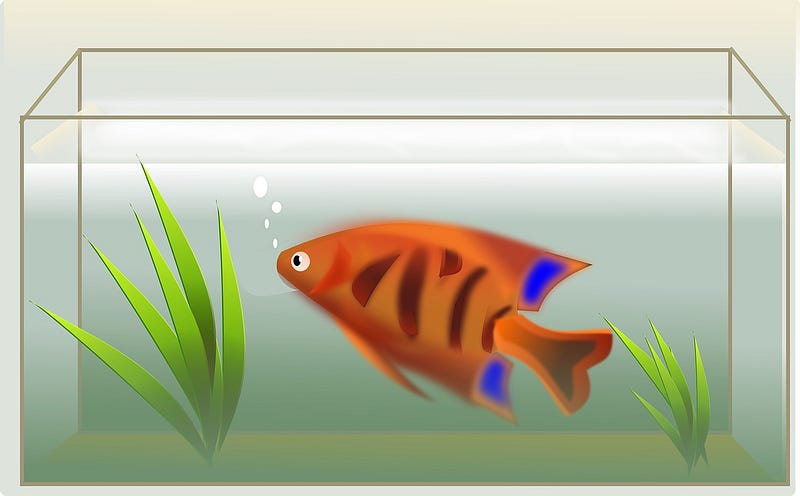
Clearly, this simplistic ecosystem requires a human as an integral component, and — until this human goes on vacation for two weeks and forgets about his goldfish — this system will theoretically perform perfectly well indefinitely. As long as it is in balance, it should continue to function until something (like lack of food) pushes the system out of balance and into severe distress.
Ecosystems are not just about who eats what.
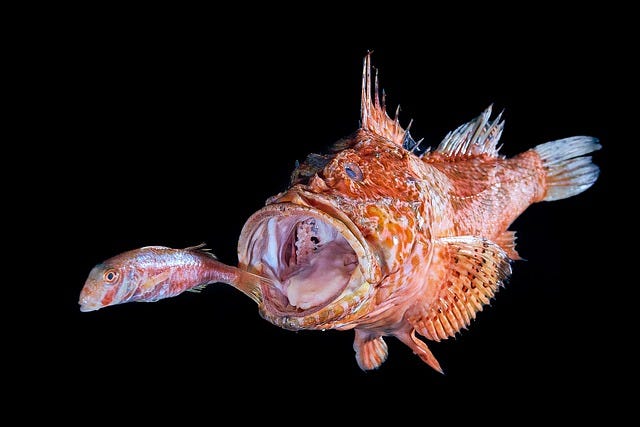
Whenever I enter a discussion about ecosystems, the first observation is usually, “Here’s an animal who has to eat something and has to avoid being eaten by something else.” This is the easy part: a hierarchy of life or “food chain” concept.
But to understand the bigger picture, we also have to consider every single entity within that whole system and everything that influences that system: prey, predator, plants, microbes, rocks, minerals, salinity, O2/CO2/other gases, temperature, sunlight, weather, climate, and more. The list of entities, factors, and influences, some of which we may not even be aware of, could be endless.
And how would we know if we considered everything? Did we include the potential eco-impact of 5 to 300 metric tons of cosmic dust that fall to earth each day? Or gamma radiation? Or plate tectonics? How will we ever have confidence that we have catalogued every entity and its role or interconnectedness with every other extant entity?
A different way to approach an understanding of Ecosystems?
Let’s consider dividing the concept of any living entity within an ecosystem into two ideas (there may be more):
- Internal, the part where a living thing feeds on something else (living or not living), or breathes, or poops, mates, moves around, or intentionally interacts with other things within its ecosphere.
- External, the part outside the creature and beyond its control, where something else preys on it, or the ambient air or water temperature changes, or toxins invade its environment, or there’s too much or too little of something the thing needs. The list of external influences on any ecosystem is vast and difficult to fully identify and characterize.
Consider what I call “the waterbed effect.” If you’ve ever slept on one with a partner, you’ll get this immediately. When something pushes down on a corner of the bed, the bed pushes up in another location. When one person rolls over, the other one can be flipped right onto the floor. That’s an effect that’s external to the object under consideration, i.e., the sleeping person who gets tossed about through no fault of their own (and subsequently sleeps on the living room sofa).
This is a type of “push” or pressure that causes an imbalance in the system and has an effect — sometimes predictable, sometimes not. In the case of the waterbed, the system is self-contained and returns to its original equilibrium quickly. This may not be the case in a natural, unconfined (or open) system.
Let’s get back to Mr. Goldfish for a moment. His total ecosystem is contained in that bowl and whatever interacts with that bowl. His food is delivered, there’s enough light to allow plants to grow and produce his oxygen, his water is clean and pure and the right temperature. Perfectly balanced. But it’s only half a system. There are no predators, for example, and his external inputs are constant and controlled, unlike in Nature. And if his caretaker goes away for two weeks, the system cannot maintain itself, it crashes, and the goldfish floats belly up in short order.
It’s meaningless to consider a system without a discussion of what “balance” or “equilibrium”means.
And that’s back to the waterbed effect. Any change (temperature, predation, pollution, drought, whatever) pushes hard on the equilibrium and upsets the balance. And when the balance — and we’re talking about every living and non-living thing in the system — is upset, something has to give, just like in the waterbed.
An out-of-balance system then has to make an adjustment in order to recover from the onslaught. For example, industrial overfishing has depleted the feed stocks of seals, and in turn now the seals are having to eat less nutritious squid to survive. What is the long-term impact of that on seals? On squid populations? On the ecosystem these creatures are a part of?
We have more questions than answers.
“I would rather have questions that can’t be answered than answers that can’t be questioned” — Nobel Prize-winning physicist Richard Feynman
But perhaps we can start a discussion of what it means for a system to be in balance or out of balance, how external events or conditions affect an ecosystem, and how a system will attempt to achieve a new balance under the new conditions. The principles of simple thermodynamics apply to any system, whether living or inorganic, i.e., any system in balance will attempt to stay in balance, even if it has to adapt or evolve to achieve a new balance under new conditions. If a new balance cannot be achieved or sustained, the system will crash and species will die.
Clearly, changes are happening globally. The planet is warming, storms are increasing in frequency and destructiveness, species are going extinct, rivers are drying up, and more. Clearly, our global ecosystem is out of balance, under pressure from a number of human-caused factors. We are all aware of what many of these factors are.
But an awareness of factors that put pressure on ecosystems isn’t enough. We need to understand what the consequences are, whether intended or unintended, of every action we take on our ecosystem, whether it’s throwing a cigarette butt into a tide pool or belching megatons of pollutants into our atmosphere and waterways.
How do we learn about these things? How much is known about all these relationships by the scientific community? How much can one person know? Knowing that everything that one does impacts not just one thing, but EVERYTHING, and knowing that one’s ability to grasp the situation is finite, how does one make good decisions knowing that they can only anticipate a small portion of the potential consequences? — John Williams
And how do we bring these concepts to schools? To adults? To legislators and governments and corporations?
We pose a serious question here. If anyone out there has any good ideas, we’re all ears. Rather than teach that “man has dominion over all creatures on earth,” we must bring to the forefront of the consciousness of all humans that every action each of us takes has consequences, has impacts on other living things, impacts on the very ecosystem that allows us to live and breathe and poop and procreate and enjoy a good meal now and then. It is crucial to the survival of the human race.
I’m fresh out of ideas and would love to hear yours.