
What is a Spiritual Master?
In this age of blurred lines between gurus and teachers, it is important to know the difference.
I am not enlightened. The following article is a series of ideas that have spewed forth from my crazy mind. They should not be taken as spiritual advice but only as food for contemplation. If you seek a spiritual path, please look for the guidance of a fully-realised master — not a sharp-tongued lizard-like myself.
A good meditation teacher will probably help you live a better life
They will show you how to meditate, and they will give you life advice on how to be a better person and all that.
But there are too many good meditation teachers spoiled by the idea that they have to spruik their enlightenment like they won it in a poker game.
Far too often, these people are dwelling within intellectual awakening after they rode a reindeer over a rainbow during an LSD trip.
A good meditation teacher doesn’t need any degree of insight. Nor do they need to sell their enlightenment as a credential.

The spiritual Master, on the other hand, is probably not there to help you live a worldly life.
That is not to say that the Master can’t advise you on worldly life. We might think that a realised guru could be good at giving life coaching because they have access to some secret database of files in the sky that we can’t see.
But, their helpfulness in our relative life is not likely because they have more information than us, but because they have less information — less mental concepts. Being free of obscurations means that they can see situations clearly, without the filter of being caught up in gross mental activity.
Still, their purpose isn’t generally to make us rich, famous or romantically happy unless that happens to be part of our path.
We can easily misconstrue much of the life advice a teacher gives us because it often doesn’t seem to make any sense according to what we know.
Sometimes, it can seem like the teacher’s actions and advice makes no sense whatsoever.
They can lead us on all kinds of wild goose chases.
We are supposed to trust their every command. But, how can we when what they say doesn’t fit with our conventional idea of success?
It’s because the spiritual path has nothing to do with worldly success.
There is something powerful to be said for following the Master’s every direction without question. Who in this modern world, though, would have the exceptional courage to undertake such a commitment?
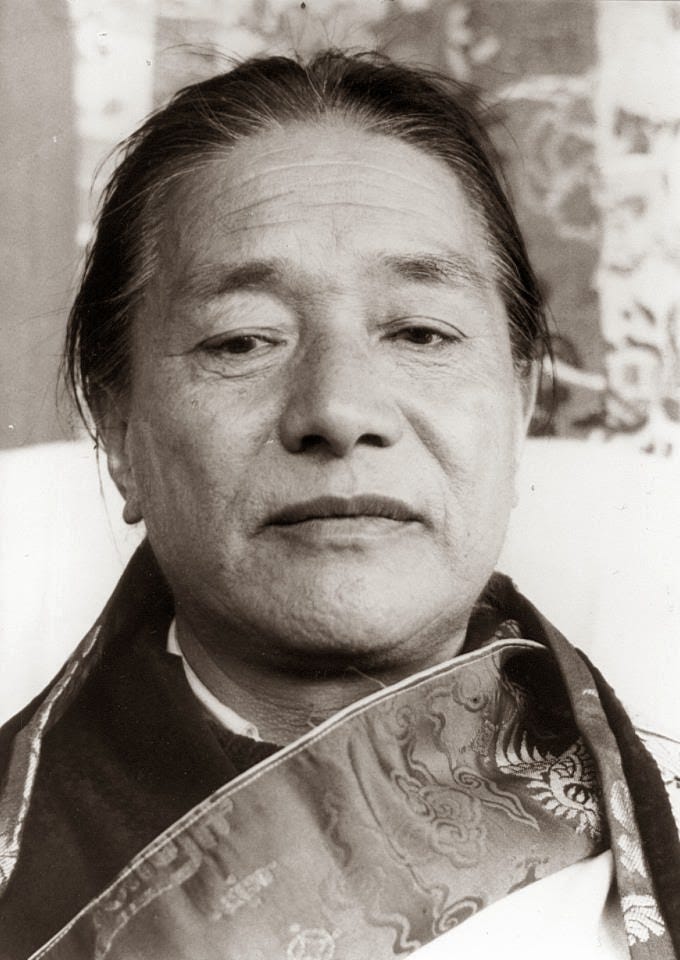
Fortunate are those disciples who at all times keep their Samaya and vows as dearly as their lives. They gain accomplishment quickly (Dudjom Rinpoche)
The main job of the spiritual Master, it seems, is to help students experience this so-called emptiness -aka spiritual insight.
The path towards this realisation depends entirely on the shape and structure of the delusion we have built for ourselves. For each of us, our delusion map is unique. So, we all need a unique teaching.

General teachings from books can be helpful, but they can also be detrimental to our progress.
If we allow ourselves to find teachings that ‘resonate’ with us, what do we expect?
After all, does it make sense for the ego to choose the manner of its own death? Would a prisoner not try and trick their way out of their own execution given a choice?
The Buddha supposedly taught 84,000 methods of practice. Some Buddhists take this as literally the entire contents of Buddhism. Some more far-out practitioners suggest that those teachings correspond to 84,000 channels of the body. Perhaps they do.
But, it is more likely that the Buddha came across approximately 84,000 different ‘shapes’ of delusion.
Do people wonder why the Buddha is always contradicting himself?
The Buddha never held a view. That is a teaching in itself.
Every expression that came forth from his lips was teaching — a perfect mirror-like response of wisdom to the delusion of whoever was before him at that particular moment.
In brief, the four noble truths are:
- The existence of suffering
- The cause of suffering
- The cessation of suffering
- The path to ending suffering.
Buddhism, as it is known, is nothing more than that one final point.
Whatever shape that takes is down to the relationship between the teacher and the student. The teacher is the doctor who prescribes the correct medicine for the specific illness of the student.
Since the delusions of beings are infinite in their scope, the teaching is endless in its scope.
Buddhists can get fundamental about what is Buddhist teaching and what isn’t. But, the nature of the teaching depends wholly on the nature of the delusion.
Even born again Christianity and Scientology can be forms of Buddhism if the delusion corresponds to that. But only a qualified teacher can know that. It’s no excuse for practising whatever you feel, stating that ‘anything is Buddhism’.
Whatever the teaching, it should lead the student to an experience of their own nature.
Then, once a student has the experience, the Master helps them integrate it so thoroughly that it becomes a stable, unchanging experience. Toward the later stages of this path, all methods have to be let go.
As the Buddha said, there is no point carrying the raft on our heads once we reach the other shore.
Meditation
It is common knowledge that the word emptiness can be problematic as a translation.
A student can misinterpret this if they take emptiness in the way we westerners are used to — as meaning some oblivion or void where there is absolutely nothing — non-existence. It is not a giant conceptual leap to think that the goal of spiritual practice is the destruction of life itself.
At no stage does Buddhism teach that there is anything to be destroyed.
It does not separate appearances from emptiness.
This is an essential point that many fail to understand.
In encouraging a student to realise emptiness, the spiritual Master does not enable them to perceive anything different from what they perceive already.
The word used is ‘realisation’. It means to realise what is already there.
When one is watching a horror film, terror arises. But, knowing that it lacks a real, central character that the horror is happening to, you can also enjoy the fear.
In a dream, a person can feel fear. Yet, if the person remembers that they are fast asleep in bed, the dream is transformed into a playground — and every being and everything they perceive is their mind. It is not the dream world that changes. The only difference is within the mind that perceives.

When you first become lucid in a dream, you might try to do something stupid such as flapping your arms like a bird in a vain attempt to fly. It is surprising how quickly one becomes lost in the dream when first starting — often just a matter of seconds. But, for a meditator, lucidity can last longer.
I spoke to my teacher about this once. I asked him what to do when I became lucid in the dream.
He told me that once I became lucid, I should not do anything other than maintain an awareness that this was just a dream.
So, rather than flapping one’s arms or trying to walk through walls, one might sit still and attempt to sustain this realisation for as long as possible.
This practice of gradually extending the length of the clarity is the first meditation of the dream state.
Practising this kind of meditation in the dream can theoretically lead to the full integration of this awareness — so one can be continuously lucid in the dream state.
To develop total power over the elements of one’s dream, a student need not practice great magic but only have this one piece of knowledge. As it is said in the teachings — knowing the one thing — everything is known.
There is one antidote that removes or “liberates” everything in a single stroke. It is spontaneous wisdom, the primal wisdom of awareness (Dudjom Rinpoche)
According to the teachings, that first glimpse of emptiness is powerful but often fleeting.
Again, practitioners learn that they should practice by extending that ‘view’ of emptiness. They learn to use the method to bring about that view and remain in recognition of that view. In doing so, as in the dream state, they work toward the full integration of that experience.
The Masters assure us that this kind of practice does not lead to our existential demise, nor a state of vegetative incapacitation.
The spiritual master cries, feels fear, feels pain, feels romantic love like everyone else.
Rather than a disappointment, this should be of great relief to us — for it is proof that our insecurities about potential meditation-induced oblivion are nothing but poppycock.
Nor does the ‘total enjoyment’ experienced by highly realised Masters mean that they laugh when being burned or smile when losing a loved one. The ‘divine enjoyment’ is within awareness itself and encompasses all aspects of human experience, including pain, grief and sickness.
So we cannot judge a spiritual master by whether they are smiling all the time or not. I have met masters who do. I have met some that seem positively miserable all of the time. Neither of these things has anything to do with realisation.

So how do we know if we have met the Buddha?
The truth is, you don’t.
When the great Tibetan Meditation Master Milarepa met his teacher Marpa, he didn’t even recognise him. Most of the time, it is like that. If we are looking for something tangible, we are on a dangerous path because the ego is choosing the teacher.
The enlightenment qualities we should be looking for as a credential cannot be seen except by other realised beings. It is an openness of awareness. It has nothing to do with external behaviour.
The Teacher-Student Relationship
The student is always dealing with their doubts about the teacher.
Students learn from the beginning that they must not doubt the teacher under any circumstances — that such doubt is a significant downfall with tremendous negative consequences. Yet, once the teacher gets comfortable with the student, they do everything to make the student doubt them. A genuine teacher can push a student’s buttons in tremendously brutal ways.
Buddhists often laugh about how good teachers do this. But, to someone at the heart of it, it is no laughing matter. It can bring a student totally to their knees.
If someone lives two thousand miles from their teacher and keeps a pure relationship, that is excellent. It is like sunbathing on a warm sunny day. One will get a fantastic suntan this way. But, if someone lives with their teacher, it is like dancing on the surface of the sun. The suntan can come about in an inconceivably short time — but it burns. It is painful.
People who live a long way from their teachers and only see them a few times a year should not be too judgemental about the relationships of those who stay with their teachers full-time.
In the teachings, we hear stories about the extraordinary devotion of students to their teachers. We put such famous students on great pedestals in our minds and see ourselves as great losers compared to them.
We need to remember that we are talking about humans here, and, in hearing their stories, we only know what they did — not what they were thinking and feeling along the way.
Perhaps it might be more inspiring for a student engaged in a testing relationship with a teacher to listen to the many awful things that Milarepa might have thought about Marpa whilst he was building towers for him by hand.
But, knowing that Milarepa constantly doubted his teacher internally would be problematic for a student since it would soften the blow, and the whole formula would fall apart. So, instead, we assume that Milarepa’s thoughts and devotion were always pure.
We should stop thinking about these things and get on with the work.
Working with a genuine teacher is seen as the most effective way to speed up our progress. But, it's not for everyone, and don’t expect anything to happen overnight.
Good Luck. You’ll need it.
If ya think this was alright, sign up for my free newsletter. That’s where I put all the really good stuff.
Also, do you like books, kind Sir/Madam/Other? How about bald, penis rocket spacemen who sell books? If so, visit my author page at the cracked head gasket of the economy AKA cockrocket.com.
More from Frank T Bird (That’s me):


