
What exactly is a “small business?”
Prepare to be outraged
If you’re anything like me, I’ve always thought of a small business as a mom-and-pop business, like a car repair shop, a floral shop, a coffee shop, a local independent restaurant, or something like that.
We have a small business
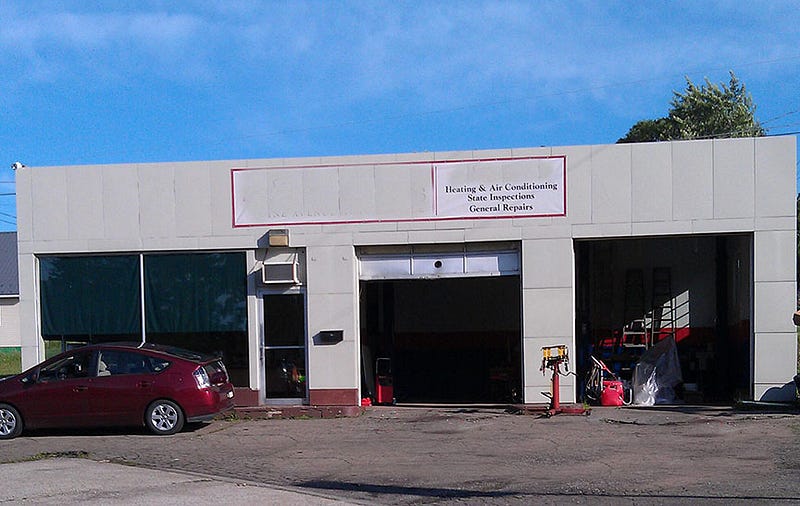
Our business is an auto repair shop. We’ve been in business for 18 years. Dear Husband (DH) and I work there, along with one employee. That’s it. With all the talk about relief for small businesses because of COVID-19, I went to the Small Business Administration (SBA) site to see what might be available to us.
I learned about the Paycheck Protection Program (PPP). This program allows a small business to borrow from the SBA to keep people on its payroll instead of laying them off.
A business can borrow 2.5 times its monthly payroll. Then, if it keeps its employees off of unemployment till June, the loan will be forgiven so the business won’t have to pay back the loan. The business will have to show that at least 75% of the loaned money was used for payroll.
I also found out the SBA regards a business with fewer than 500 employees as a small business.
500 employees! That doesn’t seem small to me. Does it seem small to you?
That size for a “small” business pissed me off. That’s not what I think of when I imagine a small business like a diner, candy shop, or gift shop.
But that’s not why I’m outraged. Read on.
More ways of defining “small”
OK, we have 499 fewer than 500 employees. I decided to apply for assistance.
As I worked on my application, I learned that there were further considerations. A business could be classified as “small” either by the number of its employees or by its annual receipts. But there are lots of exceptions to the rules. The SBA provided a convenient link to the part of the Electronic Code of Federal Regulations titled SMALL BUSINESS SIZE REGULATIONS.
I got curious. I read through the regulations so you don’t have to. You’re welcome.
First, it’s important to understand the SBA’s definition of “annual receipts.” In §121.104, I learned that “receipts are considered ‘total income’ . . . plus ‘cost of goods sold’ . . .”
The Cost of Goods Sold (COGS) includes “the direct costs of producing the goods sold by a company. This amount includes the cost of the materials and labor directly used to create the good.”
For our shop, COGS includes the costs of auto parts, tires, bulk oil, and a few other things. It does not include rent, utilities, software leases, or loan interest.
Finally, I got to §121.201. That’s where it really got interesting: “The size standards themselves are expressed either in number of employees or annual receipts in millions of dollars, unless otherwise specified.”
Specifications vary depending on industry
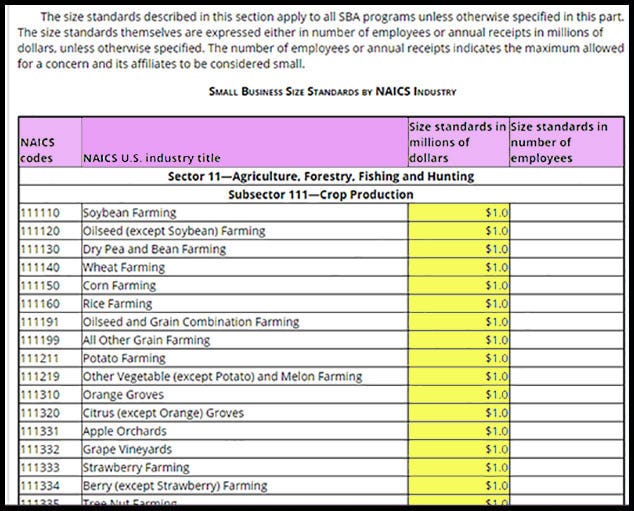
First, here’s an example of the tables included in the regulations.
The area highlighted in lavender shows the column headings that apply to all the images below.
This first section concerns agriculture. As you can see, an agricultural concern can only be considered a small business if its annual receipts are under a million dollars.
Auto Repair
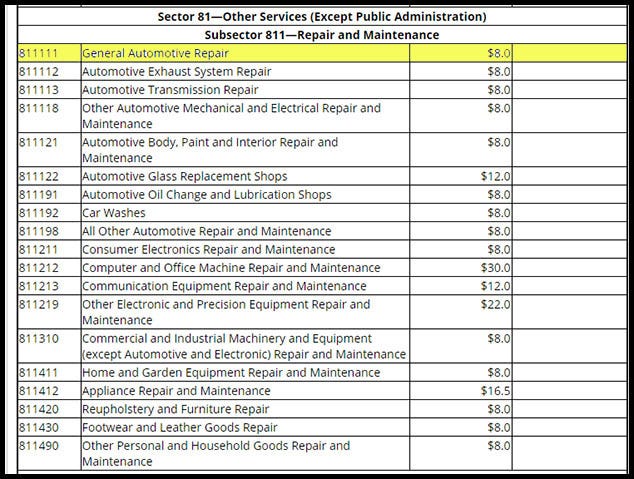
Next, I learned that our auto repair shop size was determined by annual receipts instead of the number of employees.
We could have annual receipts of up to $8 million and still be considered a small business.
DH and his one employee work in a garage with two bays. In the picture of our shop above, you can see the two bays on the right, and the office area is on the left. We could easily use three bays because there’s often a bay taken up by a car waiting for parts or waiting for the owner to approve an estimate.
Note regarding our annual receipts: DH could make a lot more money if he followed the advice of auto repair management coaching. But he doesn’t feel like those recommendations are fair to customers, so he makes less.
So, for argument’s sake, I’ll say he could have “annual receipts” of $700,000. When we divide that into $8 million, we get 11.4.
Our business could make more than eleven times what it does, and it would still be considered a small business. Now think of how many bays that would be. It would probably have 15 employees, including office staff, and 15 bays.
Now think about the size of a shop with 15 bays, a large area to store parts inventory, plus a big office to accommodate clerical staff and at least one service manager.
Is that the size you think of when you think of a small business?
Rental properties
We have friends who own and rent out houses and apartments.
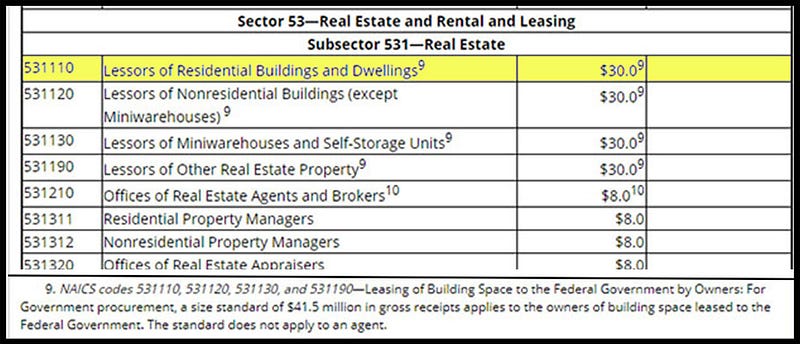
Let’s say, again for argument’s sake, that each unit has a monthly rental fee of $2,000. That’s $24,000 of income per year for one unit.
Let’s divide that into $30 million. Holy shit! That would allow a person to have 1,250 units and still be considered a small business.
Does that sound like a small business to you?
Chocolate candy maker
We have a chocolate shop in our tiny town, and there are multiple others in the larger city nearby.
I have been in two of these shops when they are operating.
The one in town never has more than five employees working during the day. Let’s be generous and say they run three shifts a day, giving them 15 employees. Yeah, that’s a small business.
The one in the nearby city has maybe 20 people working on candy production and five in the sales area. Again, let’s assume they run three shifts, giving them 75 employees. That’s a small business, too.
Now take a look at the size of a chocolate candy maker the SBA considers a small business:
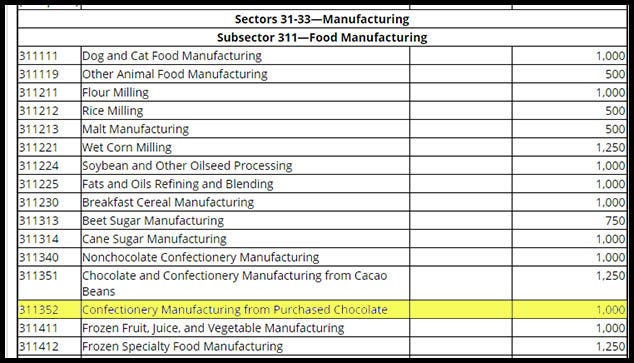
That’s right, a chocolate candy maker can have up to 1,000 employees and still be considered a small business!
Do you have any mom-and-pop chocolate shops in your town?
Do you think they have 999 employees?
I am just astounded at what the SBA considers a small business. But that’s not what I’m outraged about.
The money’s all gone before many small businesses got help
The $349 billion that was allocated for small business PPP lending is all gone. It was gone on Thursday morning, April 16. Gone in less than two weeks from the time applications were first accepted.
It was a first-come, first-served program. And the money’s all gone.
At least I got my application in on April 6, before they closed the program.
But that’s not even that outrageous. At least it helped some small businesses, right?
Coal mining qualifies for a PPP loan
Consider the Hallador Energy Co. They had revenue of $317 million last year, and they have 915 employees. They mine coal.

Of course, according to the SBA, coal mining can have either 1,250 or 1,500 employees and still be considered a small business. So this multimillion-dollar company is good to go for the PPP.
Yep. And, in fact, they were good to go because they got a $10 million PPP loan.
But at least even that falls under existing SBA guidelines.
Here comes the outrageous part.
According to The Wall Street Journal, “Big Restaurant, Hotel Chains Won Exemption to Get Small Business Loans.”
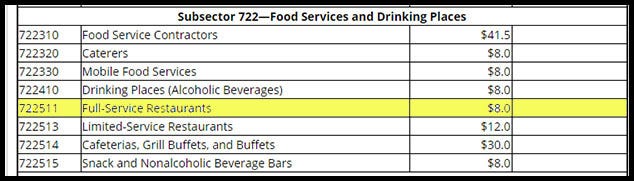
A source said that Chili’s and Denny’s are looking at applying for the PPP loans. Because language in the legislation allows “big restaurant and hotel chains to participate regardless of how many people they employ.
And get this: The company Shake Shack, has “7,600 employees, about $500 million in annual revenue and net income last year of $24 million.” Even so, it planned to apply for a forgivable PPP loan.
Small business my ass. This is outrageous.
But wait, there’s more . . .
That’s right; more outrage:
Politico reports Potbelly Corp. “told investors that a subsidiary was granted a $10 million loan by JPMorgan Chase under the Paycheck Protection Program on Friday.”
Potbelly Corp has 6,000 employees and had revenue last year of $409 million.
And The Wall Street Journal reports “the owner of the high-end Ruth’s Chris Steak House chain. . . . a company with more than 5,000 workers, received $20 million in forgivable loans.” This company “had a profit of $42 million on revenue of $468 million last year.”
They got their money on April 7. Four days after the program opened.
Forgivable loans. Loans they won’t have to pay back because their army of accountants will make sure they move the money around just right so it looks like they used at least 75% of it for payroll.
They received their funds while “Many small-business owners are still waiting for their banks to process an application or hear back about whether they qualify or will receive financial assistance from the PPP fund.”
Now that’s fucking outrageous.
The rich get richer
So for this first-come, first-served small business program, the big guys with their attorneys and accountants got in line first.
And me? I’m in line with the rest of the suckers.
Update: Shake Shack has decided to give back its $10 million because it was “able to access the additional capital we needed to ensure our long-term stability through an equity transaction. . . .” Well, isn’t that nice of them. If they were so easily able to access the capital the day after the outrage started, why didn’t they do that before they robbed the little guys?