
What is a Joro Spider?
Hope this doesn’t reach my state of residence
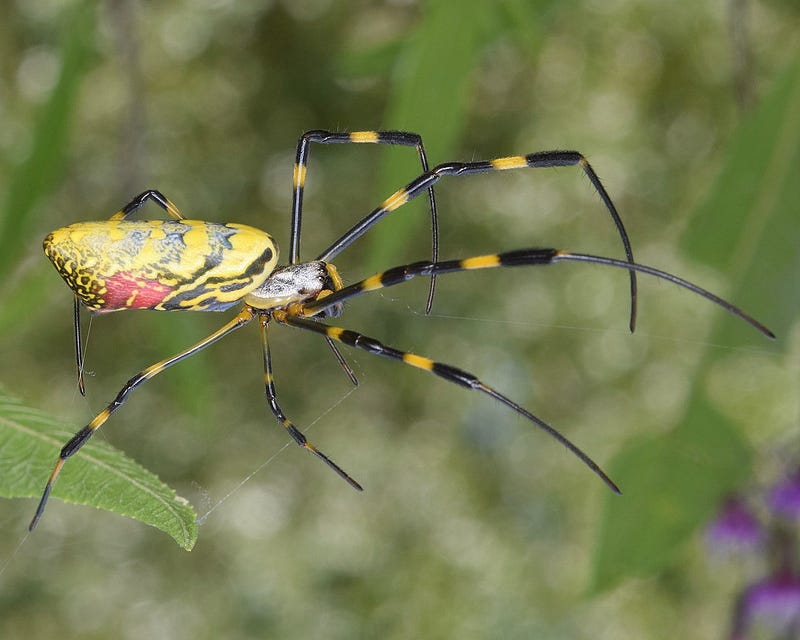
Because of my own emotional and physical reactions to spiders in general, the recent alarming articles about the Joro spider certainly grabbed my attention.
What is this Joro spider doing in the U.S.?
According to the University of Georgia’s UGA Today’s article entitled Joro spiders likely to spread beyond Georgia,
The Joro spider first arrived stateside around 2013 and has since spread across the state and Southeast. But new research from the University of Georgia suggests the invasive arachnids could spread through most of the Eastern Seaboard of the U.S. (Source.)
This subject is important to me because I have always had a dislike of spiders and in some cases dependent on the size of the spider, a fear. The Joro spider would fall under the fear category regardless of how colorful it is.
Research scientist, Andy Davis, of the Odum School of Ecology says that “It looks like the Joros could probably survive throughout most of the Eastern Seaboard here, which is pretty sobering.”
Great. It’s noted this spider could serve as a meal source for birds. Could that be because they are so big? Maybe one spider could feed a whole nest of birds.
The Joro spider is native to Japan and it’s believed they came into the United States through shipping containers. If that’s the case, then they can be transported across state borders by travelers. Oh wait, I think that happened when someone accidentally transported one on top of a vehicle to Oklahoma.
The spiders are relatively harmless to people and pets, making their presence more of a nuisance than dangerous. Joros won’t bite unless cornered, and their fangs are often not large enough to break human skin. (Source.)
Oh, so they have spider fangs. Awesome. To read that it’s not the spider’s fault that they’ve landed in the U.S. so there’s no need to kill them brings no comfort to me or stirs any empathy. It’s a little hard to appreciate their colorful nature, size, or the fact they’re part of nature when anxiety is aroused.
If you’re into science, this spider is identified as the trichonephila clavata. Besides Japan, it is also found in China, Korea, and Taiwan.
According to researchers at the University of Georgia, the Joro spider is the size of a child’s hand (up to three inches) and it’s believed they will populate the East Coast by “parachuting down from the sky.” And they think there will be millions of them and they seem to have a tolerance of the cold. Eww, I say.
The Joro spider eats stinkbugs. They do not appear to be combative but like humans, don’t want to be agitated. According to research, they are shy creatures. Their webs are very large and their leg spans can be 3 to 4 inches long. Great.
There could be many, many, many little baby Joros springing into life being carried by the wind with their long silky threads. To East Coast residents, I am sorry.
According to LX news (NBC),
The Midwest region of the United States doesn’t have a whole lot of forest and cover, so the Joros probably aren’t going to do quite as well there. We imagine the Midwest may pose a barrier for Joros, but if they manage to get to the West Coast, then they’re going to be there to stay. (Source.)
Researcher Davis thinks the spider will go far north as Washington D.C. or Delaware. The female spider is larger than the male spider. According to Axios Washington D.C.’s online piece entitled, Giant spiders expected to drop from sky across the East Coast this spring,
Researchers say there’s nothing we can do. They’re coming and they’re harmless. I say let’s pool our resources now and build a dome around Georgia and keep them there. (Source.)
I agree. Please do not travel to the state I live in and if you do, inspect your luggage and your vehicle trunks before jumping on the highways. Allegedly, for every single Joro you see, there are 10 that you don’t.
Thank you for reading.
© Cathy Coombs
About the Author
Earning a B.A. in English Journalism & Creative Writing in my 40s affirmed my love for literature, language, and writing. I published three eBooks in 2022 including the latest, Made to Think: Observations of human behavior. I’m currently editing a true-crime book that I spent over 10 years researching and hope to have that out by the summer.
Connect via Twitter or LinkedIn. Website: https://writerallday.com/


