
What Is a Fiducial Marker
And how they are used on computer vision.

If you see the image bellow, can you guess what are the card dimensions? Since you may have never seen such an object before, you will probably have difficulties guessing their dimensions. It could be as small as one millimeter or as large as 1 meter.

Now look again the next image. It becomes easier to guess the size, right? Simply putting another object, whose dimensions we know (or that we can easily guess), our brain can make an accurate estimation.
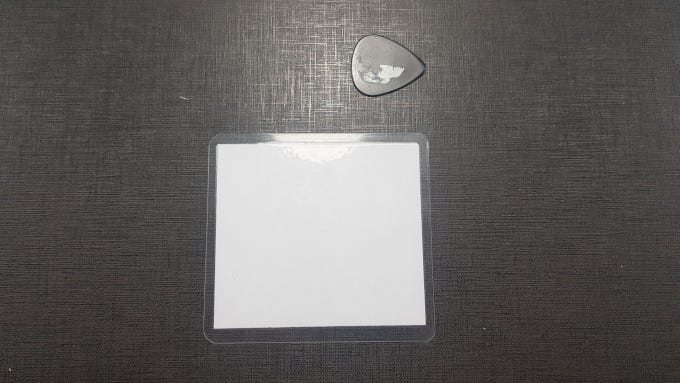
This known object is called a fiducial marker. In our case, a guitar pick whose dimensions we know (thanks, George Harrison).
A fiducial marker is an artificial landmark added to a scene to facilitate locating point correspondences between images. [1]
Basically, is anything that we add to a scene or an object that we can use as a reference or a measure point.
Applications
If you have ever watched a crime movie, you must remember when a clue is found, they put some kind of identification next to it (such as a board with a number, or a ruler).
This way you can not only verify the size of the object you are seeing but also get an idea of its size. In this case, you can call the ruler as a fiducial marker (sometimes also referred as tag).
In computer vision, you can use a fiducial marker to solve some problems:
- Reference: you can use a marker (or a set of markers) to create reference points so you can measure distance, dimension, and scale of an object. Since you know the distance and size of your reference points, you can easily extrapolate to any object in the scene. Application such as augmented reality, robotis, and even medicine can use this feature.
- Orientation: using a fiducial marker in an object you can know its orientation and then adapt your operation. This is useful for robotic system, for example, or augmented reality.
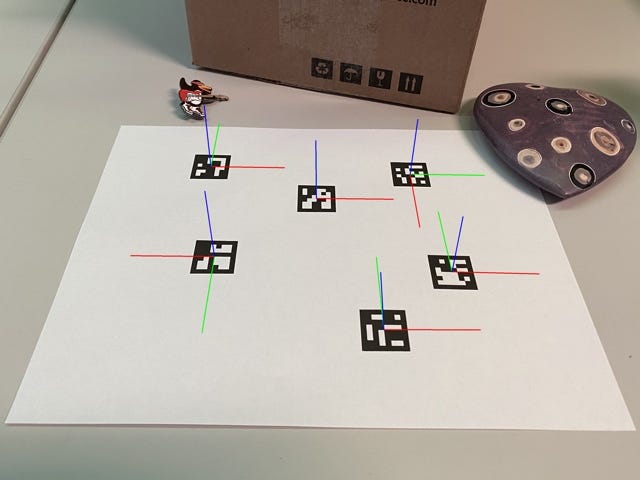
- Calibration: a camera can introduce a lot of distortion into images (for example, when a straight line appear curved). With fiducial markers you can use different sets of images to help you calibrate your camera and fix these distortions [3].
- Identification: you can use an unique marker (such as used in 2D-Barcodes) to identify an object. You can use this on social insect tracking systems, electronic PCB boards, or augmented reality.
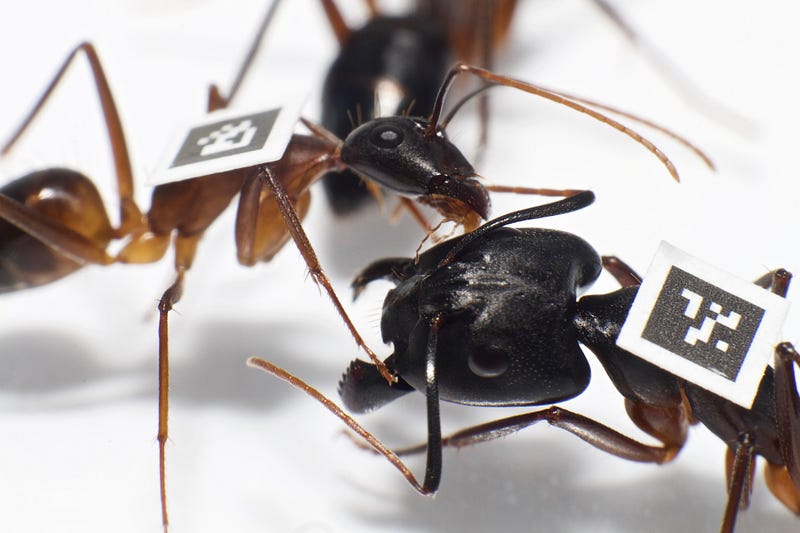
There are different types of markers you can use, from a simple dot to a complex matrix. It all depends on your application, the level of precision you need, and how much information you need.
Some examples of visual markers include:
Not only computer vision or robotics can use it, but we also have applications in medicine and biology. Some metal markers are inserted near a cancer tumor to help increase its location accuracy and avoid damaging health tissue.
Conclusion
Detect an object in scene is a time-consuming process. For some applications, we simply don’t have the time or the computational power to wait for this detection.
In computer vision systems, anything that help us improve the detection of an object is a great help.
A fiducial marker can do this. You can know the position, the dimension and even the orientation of an object inside a scene with relatively less power and time.
Thank you for reading. Hope you enjoyed.
References
[1] M. Fiala, “Designing Highly Reliable Fiducial Markers,” in IEEE Transactions on Pattern Analysis and Machine Intelligence, vol. 32, no. 7, pp. 1317–1324, July 2010, doi: 10.1109/TPAMI.2009.146.
[2] Garrido-Jurado, Sergio & Muñoz-Salinas, Rafael & Madrid-Cuevas, Francisco & Marín-Jiménez, Manuel. (2014). Automatic generation and detection of highly reliable fiducial markers under occlusion. Pattern Recognition. 47. 2280–2292. 10.1016/j.patcog.2014.01.005.
[3] Atcheson, Bradley, Felix Heide, and Wolfgang Heidrich. “CALTag: High Precision Fiducial Markers for Camera Calibration.” VMV. Vol. 10. 2010.
[4] https://docs.opencv.org/master/d5/dae/tutorial_aruco_detection.html.


