
What is #75HARD and Should You Try it?
I completed the TikTok-famous fitness challenge and here is my honest opinion about it

If you’ve been on TikTok, you will almost certainly have come across 75 HARD at some point. At the time of writing the challenge hashtag has 69million views on the platform.
After finding it on TikTok, I completed 75 HARD, and though I have some reservations about it, I’m glad I did.
What is 75 HARD?
Dubbed a ‘mental toughness challenge,’ 75 HARD was designed by Andy Frisella — a man who is notably not a certified personal trainer, dietitian, or licensed clinical therapist.
The challenge consists of meeting the following rules every single day for 75 days:
- Follow a diet of your choice with no cheating — in my case, for my dental health more than anything, this meant giving up processed sugary foods: cake, chocolate, ice cream, etc;
- Don’t drink any alcohol;
- Drink a gallon of water per day;
- Work out twice a day for at least 45 minutes each time — and one of these workouts must be outdoors;
- Read 10 pages of a non-fiction book every day; and
- Take a progress photo every day.
If you don’t meet all these aspects of the challenge before you go to sleep at night, the rules dictate that you have to start again at day 1, until you finally complete 75 days straight.
The challenge is completely free, but make no mistake, its success is in spreading the name of a man who wants to sell you any number of other things.
Why did I do 75 HARD?
I’ll be the first to say that Andy Frisella is… not someone I want to support. As a ‘motivational speaker and entrepreneur’ who will tell you he is known as ‘the MFCEO’ (The Motherfucking CEO), Andy and his content are a little abrasive for me. His political views about the ‘erosion of American values’ are, lets say, not my vibe.
After just a few minutes of Andy’s podcast, ‘Real AF,’ I chose to absolutely not dip my toe any further into Frisella-world.
However, the proposition that 75 HARD was about proving to myself that I could indeed commit to something voluntarily and of my own volition, was nonetheless incredibly motivating.
Pre-75 HARD, I was reasonably active, running and taking spin classes a few times a week, but I would easily fall out of habits, distracted by life, and ate essentially whatever I wanted.
I took on the challenge after a few difficult months of adjustment to the restrictions placed on travel and social interaction as a result of the Coronavirus pandemic. The 10km race I had trained for was cancelled, I had wrapped up a major project at work, and I was beginning to feel aimless. I was craving a challenge.
What was my experience of 75 HARD?
Once I had started 75 HARD and established that sense of motivation, having completed my first few days of workouts, healthier eating, reading and chugging water, the idea of starting over if I slipped up was out of the question entirely. I was determined not to slip up.
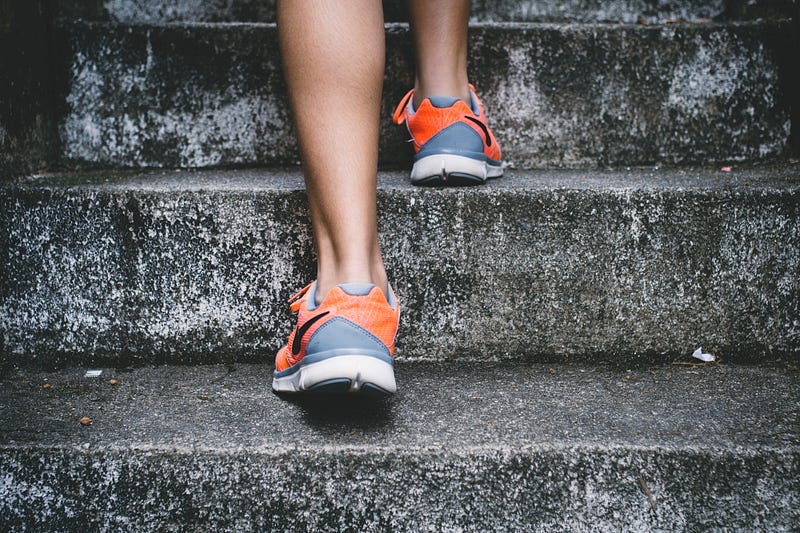
The challenge was, as the name would suggest, hard. Some days I would have to plan my day to almost the minute to make sure I would fit everything in. About midway through, I developed blisters over an inch long on each heel and I found my feet bleeding after runs — despite professionally fitted running shoes.
One weekend during the challenge, my partner and I spent a night camping in the country. For just one night away I packed our car with over three gallons of water, to make sure that no matter what, I would be able to access the gallon a day I needed (with some extra, expecting that my partner would also have some).
At times, I felt genuinely anxious about not completing the challenge, or worse, having to restart from day one.
After roughly 45 days of slowly-dwindling enthusiasm, the challenge did become monotonous. I found myself doing more walks than runs, avoiding strength training sessions and craving the foods that I had committed to avoiding.
Nonetheless, I remained committed. I spent a lot of money on blister plasters and got the workouts done. I switched up books — even midway through where necessary — to keep the reading engaging. I used different water bottles each day and I started listing my cravings in anticipation of that magical ‘day 76’ on the horizon.
What did I achieve as a result of completing 75 HARD?
The funny thing is, I now lie here, in my bed, on the evening of day 75 and I’m almost sad that the challenge is over. This is one of the hardest, longest personal commitments (certainly outside of education) I have ever made. I feel incredibly proud of myself for achieving it.
But it’s more than that…
I’m not sure whether I actually want to go back to my pre-challenge habits.
I’ll certainly celebrate finishing this challenge with a spoon of Ben & Jerry’s and a few cookies (I miss baking sweet treats as much as I miss eating them), but I feel so good. I feel healthy and driven.
Altogether, despite my misgivings about Andy Frisella — I am absolutely not a fan — and the caveat that I’m not sure my ‘mental toughness’ changed at all, I am pleased I did 75 HARD.
To answer the question I keep being asked, no, I didn’t lose any weight; that wasn’t my goal.
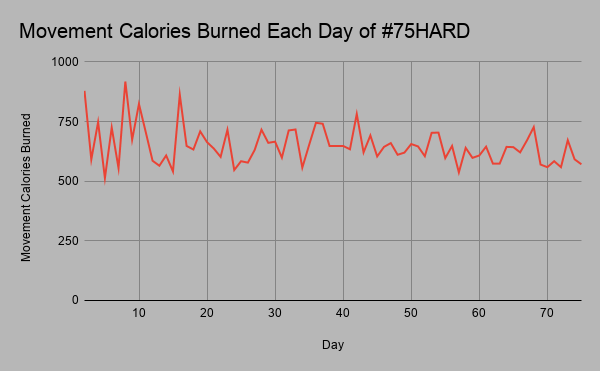
I did, in two and a half months, burn an average of 648 calories a day exercising, covering a total of 1077km with over 1.3million steps; that’s an average of 17,506 steps per day. I read over 800 pages of non-fiction books that had previously been gathering dust on my bookshelf. I regained the sense of purpose that I had lost amidst the coronavirus lockdown and I came out the other side happier and healthier.
Would I recommend 75 HARD?
At the end of the day, I would recommend 75 HARD.
If you have anxiety, particularly with obsessive tendencies or a ‘type A’ personality, this challenge may not be for you. Equally, I think it’s important to not be too restrictive with the diet element of the challenge and keep in mind that Andy Frisella is, again, not a certified personal trainer, dietitian, or licensed clinical therapist.
However, with the rules as broad as they are, as far as I am concerned, 75 HARD is what you make of it, far more so than what Andy Frisella makes of it.
Would I do 75 HARD again?
Ask me in a few months.