avatarPreeti

Free AI web copilot to create summaries, insights and extended knowledge, download it at here

3491

Abstract

the dilemma I have is multi-fold. 1) I consider myself to be mostly non-confrontational because it’s bound to hurt someone’s feelings (I am a severe empath.) 2) Do I really, <i>really</i> care? Like, does it really matter to <i>me </i>in the grand scheme of things? 3) Is <i>my</i> opinion important? 4) What’s the point? 5) Do I have the emotional space to digest the volley of replies that may come my way in return? 6) Will I regret commenting or not commenting later?</p><p id="fcd7">No points for guessing who the over-thinker in the room is.</p><p id="df52">After putting my mind through the maze of the questions above, I’m usually too tired to do anything about it.</p><p id="a147">And so I let it be.</p><h2 id="d330">All the things she said, running through my head</h2><p id="88a5"><i>Why </i>do we<i> choose</i> what we choose<i> </i>to read?</p><p id="2936">A lot has to do with the genre, topic or the title itself. If worded well, it <i>usually</i> is an indication of what to expect in the body. And we <i>had</i> a choice to skip it, but we didn’t.</p><p id="35b2">So if we were to read an explicitly titled controversial article, for example, we <i>know </i>what is to come. Yet, because of our <a href="https://en.wikipedia.org/wiki/Negativity_bias">innate negativity bias</a>, we are drawn to and enter the article riled up and ready to charge; mentally <i>tsk-tsk</i>ing and dismissing every statement, before allowing its meaning to sink in.</p><p id="cb1d">If we’re feeling particularly kindly and open-minded, we <i>may</i> decide to actually <i>consider</i> some of the arguments; to challenge our mind into accepting a contrary viewpoint. That happens occasionally, but hardly enough.</p><p id="d857">More often, though, the content prickles and snags a raw nerve here or there. We’re upset, discomfit, angry. We feel the overwhelming need to say something, <i>anything; </i>almost like our body’s natural defense system — the fight or flight response — is kicking in.</p><p id="ccd6">If you’re like me, your inner monologue is complicated. Being a strong ally or trusting your facts requires you to vouch for your side. It feels like a moral duty; perhaps it <i>is </i>a moral duty.</p><p id="07fd">There’s nothing worse than feeling like just another <a href="https://en.wikipedia.org/wiki/Bystander_effect">bystander</a>, waiting for a <i>more </i>vocal, fellow subscriber of the free speech movement to jump in with their thoughts and save the day.</p><p id="5541"><b>Damned if you do. Damned if you don’t.</b></p><h2 id="66e1">In the end, it doesn’t even matter</h2><p id="0bb0">As I said earlier, most of the time I say nothing, even if I feel poorly about my decision. I take my cue from whether the discussions are drama for the sake of drama, or if they’re unwarranted personal attacks / completely preposterous and misleading claims.</p><p id="5384">I prefer not to say things when I’m upset (except to my partner, but that’s acceptable right?). Instead I pause, physically get up and move so I can clear my head. I remind myself that I read not to <i>agree </i>with everything, but to expose myself to different perspectives. I remind myself that we are all entitled to our opinions, that it benefits no one to be rude or mean. I’m not always successful, and then I resort to ranting to my partner instead.</p><p id="b521">Often times, I scan through the comments to see if there’s one that articulately reflects my thoughts — I do a ditto, a +1, a “<i>

Options

What she said.” </i>It’s easier, safer, it preserves (what’s left of) my sanity.</p><p id="4c66">Besides, there is <a href="https://www.washingtonpost.com/news/wonk/wp/2016/02/10/how-to-change-someones-mind-according-to-science/">research and science to show that spewing a few comments in the online vortex doesn’t always help <i>change </i>the other person’s opinion</a>. There is also almost always a <a href="https://www.simplypsychology.org/confirmation-bias.html">confirmation bias</a> in play — “<i>I know what I’m saying is right because all my google searches told me so. And look, there’s at least five people here who agree with me!”</i></p><p id="33c1">So yea, it probably is not a fight worth fighting.</p><p id="8dfd"><b><i>All that said — </i></b>if what you read is something you’re passionate about, if it continues to bother you and you spend sleepless nights wondering <i>if</i> you had said something or <i>how</i> you would have said it, <b>then by all means do it.</b></p><p id="9b53">If peace of mind is ultimately your goal, like it is mine, then do whatever the heck gives you that peace.</p><p id="d319">But be thoughtful; assume less, ask more: A question if you don’t understand, clarify intent if you’re confused, speak from experience and what you know. It’s easier than you think it is.</p><p id="7139"><i>Subtitle credits: <a href="https://markmanson.net/books/subtle-art">Mark Manson’s book “The Subtle Art of Not Giving a F*ck.”</a></i></p><p id="23b9">Related reading if you’re interested:</p><ol><li><a href="https://www.theguardian.com/technology/2017/jun/14/social-media-fake-offensive-posts-speak-up">“Should I speak up when I see something offensive or false on social media?”</a><i>by Emma Brockes, The Guardian, 14 June 2017</i></li><li><a href="https://fivethirtyeight.com/features/we-asked-8500-internet-commenters-why-they-do-what-they-do/">“We Asked 8,500 Internet Commenters Why They Do What They Do”</a><i> by by Christie Aschwanden, Five Thirty Eight, 28 November 2016</i></li><li><a href="https://www.washingtonpost.com/news/wonk/wp/2016/02/10/how-to-change-someones-mind-according-to-science/">“How to change someone’s mind, according to science” </a><i>by Ana Swanson, Washington Post, 10 February 2016</i></li><li><a href="https://time.com/5125894/is-reading-news-bad-for-you/">“Is It Bad for You to Read the News Constantly?”</a><i>by Markham Heid, Time.com, 19 MAY 2020</i></li><li><a href="https://www.verywellmind.com/negative-bias-4589618">“What Is the Negativity Bias?</a>” — <i>by Kendra Cherry, Very Well Mind”, 29 April 2020</i></li></ol><p id="b226"><i>Want to be the first to know when I publish a new story? Consider <a href="https://ramachandran-preeti.medium.com/subscribe">subscribing </a>to stay in the loop!</i></p><div id="8459" class="link-block"> <a href="https://ramachandran-preeti.medium.com/membership"> <div> <div> <h2>Join Medium with my referral link - Preeti Ramachandran</h2> <div><h3>As a Medium member, a portion of your membership fee goes to writers you read, and you get full access to every story…</h3></div> <div><p>ramachandran-preeti.medium.com</p></div> </div> <div> <div style="background-image: url(https://miro.readmedium.com/v2/resize:fit:320/0*to9WwDwRXwiXetKn)"></div> </div> </div> </a> </div></article></body>

What If You Don’t like What You Read?

The subtle art of not giving a f*©k is easier said than done

To give in or not to give in, that’s the question. Photo by Daniel Mingook Kim on Unsplash

Imagine a day like this: You wake up in the morning, yawn and smile brightly, you get ready for the day, grab your morning coffee (or tea) and pick up the newspa…err, pick up your phone and open a news app or social media, or maybe Medium.

Whatever your source of reading is for the day — for entertainment or information — there is an abundance of content vying for your attention: real world events and trauma, click-bait headlines interspersed between factual and anecdotal articles, the latest in politics, science or celebrity gossip.

With the power of choice in your hands, you are free to read whatever you want from all those articles that have been organically generated, recommended or customized just per your liking; for your eyes only.

Some of the content is valuable, potentially worrisome but informational nevertheless. Some of them are eye-opening perspectives, personal story-telling extraordinaire.

While others are pure drivel — opinions garbed as factoids, facts that are so badly stated, they feel like assumptions, marketing pushes for stuff that common-sense would argue never works or How-tos that are great examples of How Not to Write.

The emotions you feel range from intrigue and enlightenment to irritation and downright whatthefuckery.

Too much time on my hands

Like everyone else, I play multiple roles — I’m a partner to my partner, a mother to my darling puppies, a loving daughter and sister in a long distance relationship with family across time zones, a favorite aunt to my 1 year old babbling nephew, full-time burnout survivor and writer, part-time worrier and anxiety body-host.

The time that I have to do anything is precious, and I tend to drown in the din of the productivity parade. I must choose wisely or my life will be a mediocre fare! (Which it is, and I’m ok with it 100%.)

So, whenever I read something that I dislike or disagree with (read: anti-vaxx or skewed pro-life sentiments, public shaming other writers, politics & religion above humanity based ideologies, homo- trans- or fat-phobia etc.), I feel like I’ve wasted my time.

And I feel the need to say something about it, to share my displeasure as a comment or a post, to leave my unwelcome thoughts in the responses section of an article.

I should go ahead and do it, you say?
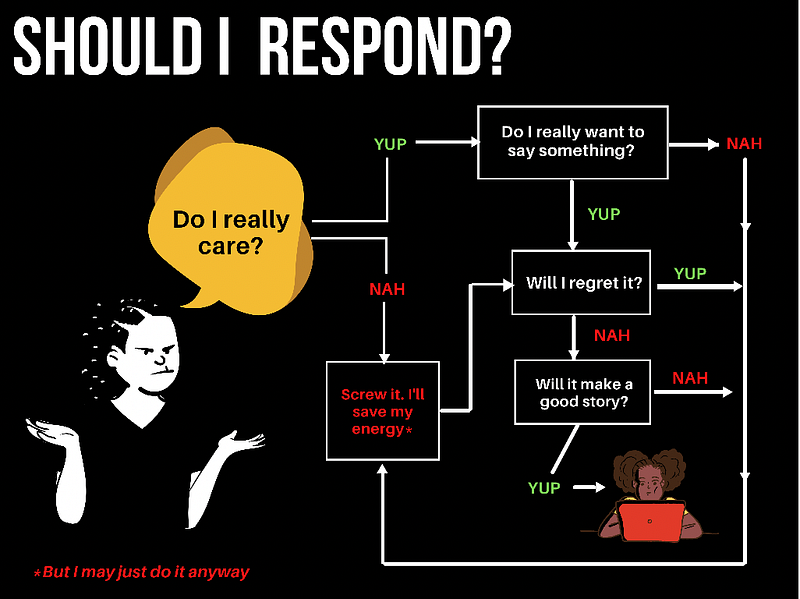
Picture created on Canva and provided by Author. No, I don’t accept requests for digital art (maybe I should?)

Well, the dilemma I have is multi-fold. 1) I consider myself to be mostly non-confrontational because it’s bound to hurt someone’s feelings (I am a severe empath.) 2) Do I really, really care? Like, does it really matter to me in the grand scheme of things? 3) Is my opinion important? 4) What’s the point? 5) Do I have the emotional space to digest the volley of replies that may come my way in return? 6) Will I regret commenting or not commenting later?

No points for guessing who the over-thinker in the room is.

After putting my mind through the maze of the questions above, I’m usually too tired to do anything about it.

And so I let it be.

All the things she said, running through my head

Why do we choose what we choose to read?

A lot has to do with the genre, topic or the title itself. If worded well, it usually is an indication of what to expect in the body. And we had a choice to skip it, but we didn’t.

So if we were to read an explicitly titled controversial article, for example, we know what is to come. Yet, because of our innate negativity bias, we are drawn to and enter the article riled up and ready to charge; mentally tsk-tsking and dismissing every statement, before allowing its meaning to sink in.

If we’re feeling particularly kindly and open-minded, we may decide to actually consider some of the arguments; to challenge our mind into accepting a contrary viewpoint. That happens occasionally, but hardly enough.

More often, though, the content prickles and snags a raw nerve here or there. We’re upset, discomfit, angry. We feel the overwhelming need to say something, anything; almost like our body’s natural defense system — the fight or flight response — is kicking in.

If you’re like me, your inner monologue is complicated. Being a strong ally or trusting your facts requires you to vouch for your side. It feels like a moral duty; perhaps it is a moral duty.

There’s nothing worse than feeling like just another bystander, waiting for a more vocal, fellow subscriber of the free speech movement to jump in with their thoughts and save the day.

Damned if you do. Damned if you don’t.

In the end, it doesn’t even matter

As I said earlier, most of the time I say nothing, even if I feel poorly about my decision. I take my cue from whether the discussions are drama for the sake of drama, or if they’re unwarranted personal attacks / completely preposterous and misleading claims.

I prefer not to say things when I’m upset (except to my partner, but that’s acceptable right?). Instead I pause, physically get up and move so I can clear my head. I remind myself that I read not to agree with everything, but to expose myself to different perspectives. I remind myself that we are all entitled to our opinions, that it benefits no one to be rude or mean. I’m not always successful, and then I resort to ranting to my partner instead.

Often times, I scan through the comments to see if there’s one that articulately reflects my thoughts — I do a ditto, a +1, a “What she said.” It’s easier, safer, it preserves (what’s left of) my sanity.

Besides, there is research and science to show that spewing a few comments in the online vortex doesn’t always help change the other person’s opinion. There is also almost always a confirmation bias in play — “I know what I’m saying is right because all my google searches told me so. And look, there’s at least five people here who agree with me!”

So yea, it probably is not a fight worth fighting.

All that said — if what you read is something you’re passionate about, if it continues to bother you and you spend sleepless nights wondering if you had said something or how you would have said it, then by all means do it.

If peace of mind is ultimately your goal, like it is mine, then do whatever the heck gives you that peace.

But be thoughtful; assume less, ask more: A question if you don’t understand, clarify intent if you’re confused, speak from experience and what you know. It’s easier than you think it is.

Subtitle credits: Mark Manson’s book “The Subtle Art of Not Giving a F*ck.”

Related reading if you’re interested:

  1. “Should I speak up when I see something offensive or false on social media?”by Emma Brockes, The Guardian, 14 June 2017
  2. “We Asked 8,500 Internet Commenters Why They Do What They Do” by by Christie Aschwanden, Five Thirty Eight, 28 November 2016
  3. “How to change someone’s mind, according to science” by Ana Swanson, Washington Post, 10 February 2016
  4. “Is It Bad for You to Read the News Constantly?”by Markham Heid, Time.com, 19 MAY 2020
  5. “What Is the Negativity Bias?” — by Kendra Cherry, Very Well Mind”, 29 April 2020

Want to be the first to know when I publish a new story? Consider subscribing to stay in the loop!

Mental Health
This Happened To Me
Short Story
Fiction
Humor
Recommended from ReadMedium