avatarHenner Townlove

Free AI web copilot to create summaries, insights and extended knowledge, download it at here

4594

Abstract

o%20generate%20electricity.">geothermal energy</a> to power turbines for electricity, and the same goes for heating purposes.</p><p id="1d1e">Scientists have also <a href="https://www.pbs.org/exploringspace/mars/terraforming/page4.html#:~:text=Scientists%20have%20considered%20placing%20Mylar,temperature%20would%20release%20greenhouse%20gasses.">proposed</a> building very large orbital mirrors called <b>Mylar Disks,</b> and direct them towards Mars to heat up the planet and release greenhouse gases. Yes, you heard that right — <b>We want greenhouse gases on Mars</b>. They are the same greenhouse gases that trap heat inside our planet, and in turn, melt the glaciers and are contributing to rapid rise in sea levels, as well as the emergence of more violent weather patterns. But those same greenhouse gases, we need them… on Mars, that is. Which leads us back to petroleum, one of the major byproducts of burning petroleum is Carbon dioxide (CO2), which is a greenhouse gas — something that we will need to heat up the planet.</p><p id="d62e">Labor will be a major problem. Working in isolation and away from your home planet will take a toll on one’s mental health, especially if the planet has ambient conditions that are uninhabitable all throughout the Martian year. Thus, we might employ various robotic machinery to do most of the work. These robots would be capable of assisting us and cater to most of the needs of Martian humans. Another major problem is human life expectancy. Humans change behavior once they get to a certain age; they change their world views and would often think about their mortality. Humans also deteriorate mentally and physically, so it is essential to develop technologies in the medical field to halt and reverse aging by this time. There is already <a href="https://nerdist.com/article/scientists-reverse-aging-skin-cells-30-years/">research</a> undergoing in this field and my hope is that this will solve most of the problems on Mars and in Earth as well. Most people need distractions or motivations to function, but as for me, I only need video games to keep me busy, so sign me up, NASA or SpaceX.</p><figure id="aaa9"><img src="https://cdn-images-1.readmedium.com/v2/resize:fit:800/0*KP-ZEEDUSgqXvNB-"><figcaption>Photo by <a href="https://unsplash.com/@lenin33?utm_source=medium&amp;utm_medium=referral">Lenin Estrada</a> on <a href="https://unsplash.com?utm_source=medium&amp;utm_medium=referral">Unsplash</a></figcaption></figure><p id="f1b5">It will probably take close to a century before we establish entire populations on Mars. But I am hopeful that the human race will become a space-faring civilization by then — if another World War doesn’t break out that is.</p><p id="34d7"><i>Cough* — Russia!</i></p><p id="aac6">Well, Even if it does happen, I guess that will only delay it for a bit, human curiosity and greed will always prevail.</p><h1 id="9990">Why Petroleum Though?</h1><p id="b536">We already have plenty of energy sources at our disposal, however, at Mars, we are extremely limited. There is no liquid water, so hydrothermal energy is off the table. <b>There is however, wind on Mars</b>, so we can probably utilize wind turbines. There is also <b>Solar energy</b>, so we can establish solar farms there, as well. These are just a few more things to add to our arsenal when the time comes.</p><figure id="97ab"><img src="https://cdn-images-1.readmedium.com/v2/resize:fit:800/0*xvvpKd9GzZ7OGN9R"><figcaption>Photo by <a href="https://unsplash.com/@mannyb?utm_source=medium&amp;utm_medium=referral">Manny Becerra</a> on <a href="https://unsplash.com?utm_source=medium&amp;utm_medium=referral">Unsplash</a></figcaption></figure><p id="0fe4">All things aside, Oil and Natural gas are still very high in the energy density scale. Hydrocarbon products such as Crude oil, Gasoline, Diesel and Natural gas have <b>45–55 Mj/Kg</b>(Megajoules per Kilogram) in terms of energy density. <b>Uranium 235</b> is probably one of the highest with <b>3,900,000 Mj/Kg</b>, and best in quality in terms of energy as per lower environmental impact. There are <a href="https://en.wikipedia.org/wiki/Energy_density#:~:text=kW%E2%8B%85h/L.-,In%20nuclear%20reactions,-%5Bedit%5D">other higher energy density materials</a> that can be generated under nuclear fission, however these technologies are still under development, and for now, require more energy input than output.</p><figure id="9214"><img src="https://cdn-images-1.readmedium.com/v2/resize:fit:800/1*6-fZLD_oZOC8kYdisuspHA.png"><figcaption>Figure 1. An XKCD comic showing the comparati

Options

ve energy density of <a href="https://energyeducation.ca/encyclopedia/Uranium">Uranium</a>.</figcaption></figure><p id="5820">Fossil fuels maybe outdated, but the main benefit of these fuels is that it’s cheap, abundant, and we have already developed and understood the manufacturing process and usage down to a science. We can use these fuels to harvest asteroids for precious metals. Now, you might be thinking, <i>“but we have<b> ion thrusters</b> for that”</i>. Yes, we do! In fact, satellites around the earth uses this same propulsion system to keep themselves on their designated orbits and the technology is still continually improving its efficiency. We have even sent probes into the solar system and beyond to study what’s out there using the same technology. It is true that <a href="https://www.youtube.com/watch?v=6H0qsqZjLW0">electric propulsion</a> systems come in handy once you’re in space, however,<b> getting the payload from ground level into <a href="https://en.wikipedia.org/wiki/Escape_velocity">escape velocity</a> levels as of today, still requires chemical rockets.</b> It’s like the fable of the <a href="https://en.wikipedia.org/wiki/The_Tortoise_and_the_Hare">Tortoise and the Hare</a>, in this case the tortoise is Electric (ion) propulsion, while the hare is rocket fuel, the turtle might have won the race in the end, but the turtle wont get rockets up into orbit, for now. I know getting stuff into space using a controlled explosion directed towards the earth’s core sounds primitive, but it’s all we got, so let’s just stick with it, for now.</p><figure id="9b6e"><img src="https://cdn-images-1.readmedium.com/v2/resize:fit:800/0*pkC7HsBd_cjkK5C4"><figcaption>Photo by <a href="https://unsplash.com/@spacex?utm_source=medium&amp;utm_medium=referral">SpaceX</a> on <a href="https://unsplash.com?utm_source=medium&amp;utm_medium=referral">Unsplash</a></figcaption></figure><h1 id="1ecc">Our Solar System Is a Middle-Aged Adult</h1><p id="9479">Our solar system is <a href="https://solarsystem.nasa.gov/solar-system/our-solar-system/in-depth/#:~:text=Our%20solar%20system%20formed%20about,of%20interstellar%20gas%20and%20dust.">about 5 billion years old</a>, and our sun is predicted to <a href="https://www.space.com/14732-sun-burns-star-death.html#:~:text=But%20in%20about%205%20billion,out%20of%20this%20stable%20phase.">die</a> in another 5 billion years. That effectively makes our solar system a middle-aged person. <b>When the sun dies, all life on earth will die as well</b>; all buildings, political ideas, scientific inventions, and evidences of our existence will be grinded and vaporized into oblivion, and that ends our story right there. We’ve <a href="https://www.nbcnews.com/science/space/astronomers-witness-explosive-death-giant-star-first-time-rcna11830">seen</a> these cosmic events unfold from our very own telescopes, even from lightyears away. Suns exploding in our skies are surprisingly very common. This is a glimpse of our future, if we remain in this planet.</p><p id="d63c">However, this doesn’t have to be.</p><p id="a815">The discovery of fossil fuels on Mars would lead to the <b>renaissance of petroleum-based industry</b>; the same industry that today still continues to plague us with environmental issues. But these are essential steps in order to make Mars a habitable place, and in turn, expand our species across the solar system and beyond. It is not just mars that houses our potential high energy fuel of the future, though. Hydrocarbons aren't actually rare in our solar system, <b>Jupiter is filled with hydrocarbons</b> such as methane and even heavier forms as you go deeper into the planet’s core. The surface of Titan (Jupiter’s moon) also contains massive organic liquids. These worlds will be our next potential frontiers in terms of energy harvesting.</p><figure id="b63d"><img src="https://cdn-images-1.readmedium.com/v2/resize:fit:800/1*ye-7xskEOCx4R7cPdt4J9w.png"><figcaption><b>Image: <a href="https://en.wikipedia.org/wiki/Geologic_time_scale">Geological timescale of the Earth</a> from 4.6 Billion years ago to the present day. Image shows humans being around for only a brief moment</b></figcaption></figure><p id="0599">The image above shows the Geological timescale of the earth. The present day represents midnight, there you will see the emergence of hominids. It is where you realize that Humanity has only been around for a blink of an eye,</p><p id="4bca" type="7">but this time, maybe the gods can rest their eyes a little longer.</p><p id="ce23" type="7">Thanks for reading!</p></article></body>

What if We Found Oil on Mars?

An untapped endless supply of Petroleum.
Photo by Paweł Czerwiński on Unsplash

Nearly everything on earth is essentially powered by solar energy. Even your gas-powered v8 engine uses energy from the sun. If you don’t believe me, hear me out. For many, it maybe hard to grasp, but fossil fuels used to be photosynthetic organisms that lived millions of years ago. To recall, Photosynthesis is the process of turning light into chemical energy. It’s sort of like the plant’s way of cooking soup, but the soup is sugar, and the ingredients are CO2 and Water, while the cooking is done by sunlight. This is what keeps plants alive and growing.

This process famously occurs in plants, however, photosynthetic plankton are the actual main drivers of this processes on Earth. The same is likely for prehistoric earth. While fossil fuels can be made from plants, animals and algae, majority of fossil fuels actually come from ancient plankton and zooplankton that thrived in the earth’s oceans in the distant past. If a country is rich in oil, there’s a good chance it used to lie on a shallow sea millions of years ago. The organic matter and stored “sun” energy in these “dead things” gets trapped and compressed in layers of sediments. Overtime, these will become petroleum deposits, or crude oil.

The topography of Mars strongly suggests that the planet used to have plenty of water. Channels or “Canals” on the surface starting from high elevations ending in low elevations suggests that it once had flowing water some time in its distant past. These features are very reminiscent of Earth’s own watersheds, and the possibility of flowing water also suggests that the planet had its own water cycle. And where there is liquid water, there is also the possibility of the existence of life. All biological organisms here on earth have internal systems that exclusively operate in the presence of liquid water.

Now you might be thinking, if petroleum exists on Mars, that means they have their own version of Prehistoric animals right? Correct, that is a possibility. There even might have been intelligent life or entire cultures that existed on Mars at some point. But these sentient lifeforms might not have formed the bulk of all the organic matter at the time. Similar to conditions on earth, the bulk of organic life will almost always be plant life or plankton.

Photo by engin akyurt on Unsplash

Mars maybe on our crosshairs for a potential next home planet, but here on Earth, money speaks louder than a few fossilized Martians. The only way for people to actually invest in an expedition is for Earthly profits. The humans who would travel to mars would have to be compensated equally once their work is done. On planet Mars, where there is virtually no definitive laws or regulations, humans can pretty much do whatever they want with it — it’s winner takes all. The vast untapped resources could be used as building materials for future colonies or to be (space)shipped back into earth for the same reason. We have 3D printing technology at our disposal to pretty much make whatever shape we want, and this technology is even used in the ISS. The potential petroleum and gas reserves would be used to heat up living spaces, however, that will require oxygen, which is a vital resource for humans. Luckily, there is evidence of geologic activity in the planet. We could make use of geothermal energy to power turbines for electricity, and the same goes for heating purposes.

Scientists have also proposed building very large orbital mirrors called Mylar Disks, and direct them towards Mars to heat up the planet and release greenhouse gases. Yes, you heard that right — We want greenhouse gases on Mars. They are the same greenhouse gases that trap heat inside our planet, and in turn, melt the glaciers and are contributing to rapid rise in sea levels, as well as the emergence of more violent weather patterns. But those same greenhouse gases, we need them… on Mars, that is. Which leads us back to petroleum, one of the major byproducts of burning petroleum is Carbon dioxide (CO2), which is a greenhouse gas — something that we will need to heat up the planet.

Labor will be a major problem. Working in isolation and away from your home planet will take a toll on one’s mental health, especially if the planet has ambient conditions that are uninhabitable all throughout the Martian year. Thus, we might employ various robotic machinery to do most of the work. These robots would be capable of assisting us and cater to most of the needs of Martian humans. Another major problem is human life expectancy. Humans change behavior once they get to a certain age; they change their world views and would often think about their mortality. Humans also deteriorate mentally and physically, so it is essential to develop technologies in the medical field to halt and reverse aging by this time. There is already research undergoing in this field and my hope is that this will solve most of the problems on Mars and in Earth as well. Most people need distractions or motivations to function, but as for me, I only need video games to keep me busy, so sign me up, NASA or SpaceX.

Photo by Lenin Estrada on Unsplash

It will probably take close to a century before we establish entire populations on Mars. But I am hopeful that the human race will become a space-faring civilization by then — if another World War doesn’t break out that is.

Cough* — Russia!

Well, Even if it does happen, I guess that will only delay it for a bit, human curiosity and greed will always prevail.

Why Petroleum Though?

We already have plenty of energy sources at our disposal, however, at Mars, we are extremely limited. There is no liquid water, so hydrothermal energy is off the table. There is however, wind on Mars, so we can probably utilize wind turbines. There is also Solar energy, so we can establish solar farms there, as well. These are just a few more things to add to our arsenal when the time comes.
Photo by Manny Becerra on Unsplash

All things aside, Oil and Natural gas are still very high in the energy density scale. Hydrocarbon products such as Crude oil, Gasoline, Diesel and Natural gas have 45–55 Mj/Kg(Megajoules per Kilogram) in terms of energy density. Uranium 235 is probably one of the highest with 3,900,000 Mj/Kg, and best in quality in terms of energy as per lower environmental impact. There are other higher energy density materials that can be generated under nuclear fission, however these technologies are still under development, and for now, require more energy input than output.
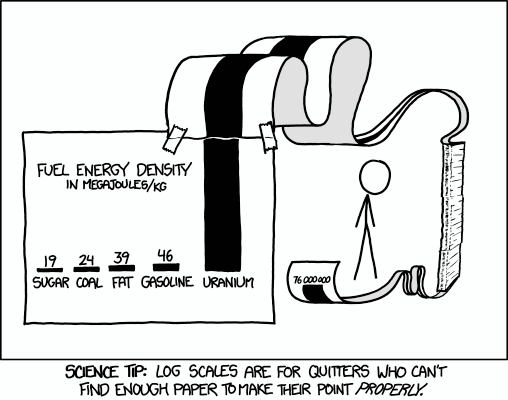
Figure 1. An XKCD comic showing the comparative energy density of Uranium.

Fossil fuels maybe outdated, but the main benefit of these fuels is that it’s cheap, abundant, and we have already developed and understood the manufacturing process and usage down to a science. We can use these fuels to harvest asteroids for precious metals. Now, you might be thinking, “but we have ion thrusters for that”. Yes, we do! In fact, satellites around the earth uses this same propulsion system to keep themselves on their designated orbits and the technology is still continually improving its efficiency. We have even sent probes into the solar system and beyond to study what’s out there using the same technology. It is true that electric propulsion systems come in handy once you’re in space, however, getting the payload from ground level into escape velocity levels as of today, still requires chemical rockets. It’s like the fable of the Tortoise and the Hare, in this case the tortoise is Electric (ion) propulsion, while the hare is rocket fuel, the turtle might have won the race in the end, but the turtle wont get rockets up into orbit, for now. I know getting stuff into space using a controlled explosion directed towards the earth’s core sounds primitive, but it’s all we got, so let’s just stick with it, for now.
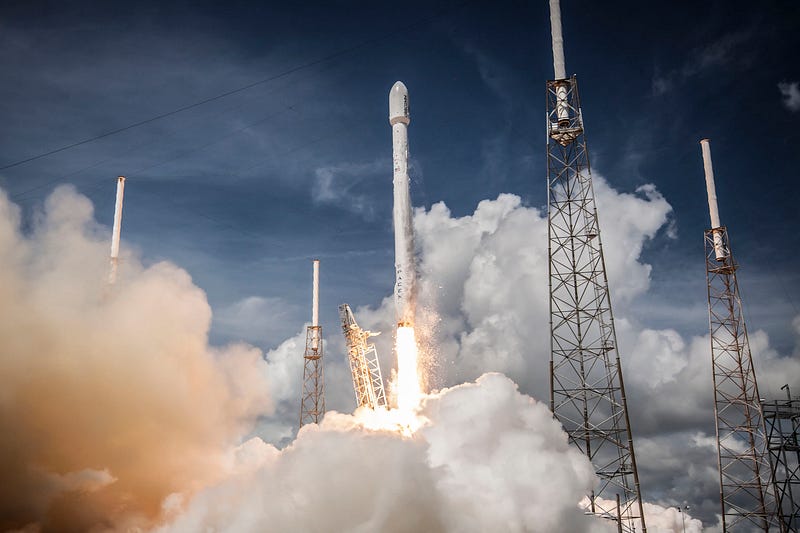
Photo by SpaceX on Unsplash

Our Solar System Is a Middle-Aged Adult

Our solar system is about 5 billion years old, and our sun is predicted to die in another 5 billion years. That effectively makes our solar system a middle-aged person. When the sun dies, all life on earth will die as well; all buildings, political ideas, scientific inventions, and evidences of our existence will be grinded and vaporized into oblivion, and that ends our story right there. We’ve seen these cosmic events unfold from our very own telescopes, even from lightyears away. Suns exploding in our skies are surprisingly very common. This is a glimpse of our future, if we remain in this planet.

However, this doesn’t have to be.

The discovery of fossil fuels on Mars would lead to the renaissance of petroleum-based industry; the same industry that today still continues to plague us with environmental issues. But these are essential steps in order to make Mars a habitable place, and in turn, expand our species across the solar system and beyond. It is not just mars that houses our potential high energy fuel of the future, though. Hydrocarbons aren't actually rare in our solar system, Jupiter is filled with hydrocarbons such as methane and even heavier forms as you go deeper into the planet’s core. The surface of Titan (Jupiter’s moon) also contains massive organic liquids. These worlds will be our next potential frontiers in terms of energy harvesting.
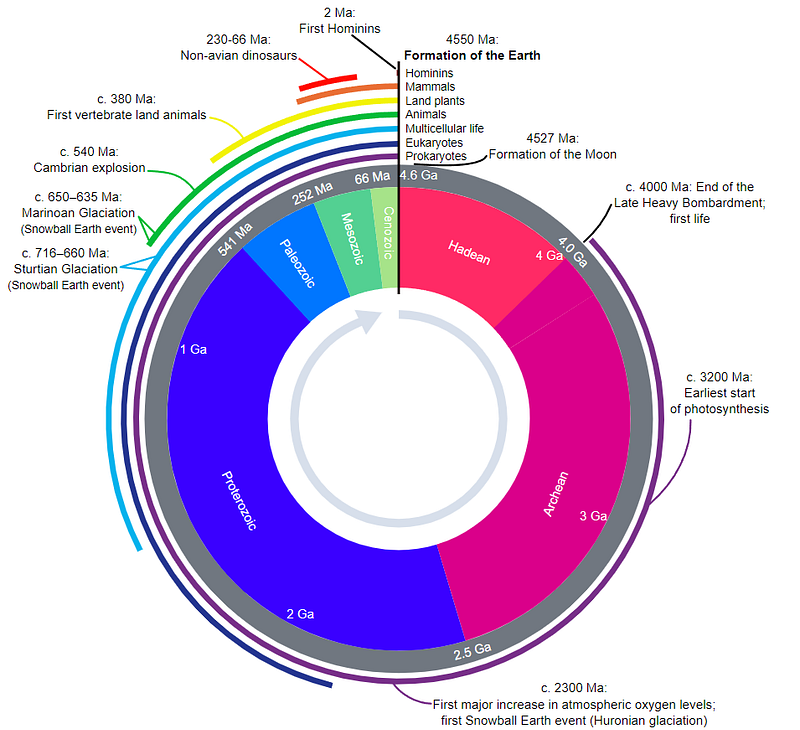
Image: Geological timescale of the Earth from 4.6 Billion years ago to the present day. Image shows humans being around for only a brief moment

The image above shows the Geological timescale of the earth. The present day represents midnight, there you will see the emergence of hominids. It is where you realize that Humanity has only been around for a blink of an eye,

but this time, maybe the gods can rest their eyes a little longer.

Thanks for reading!

Science
Space
Environment
Mars
Energy
Recommended from ReadMedium