What if the Romans had #hashtagged their written Histories?
An interview with hashtag inventor Chris Messina

“You’re the inventor of the #hashtag, you’re my universal ticket to any #BoatParty!”
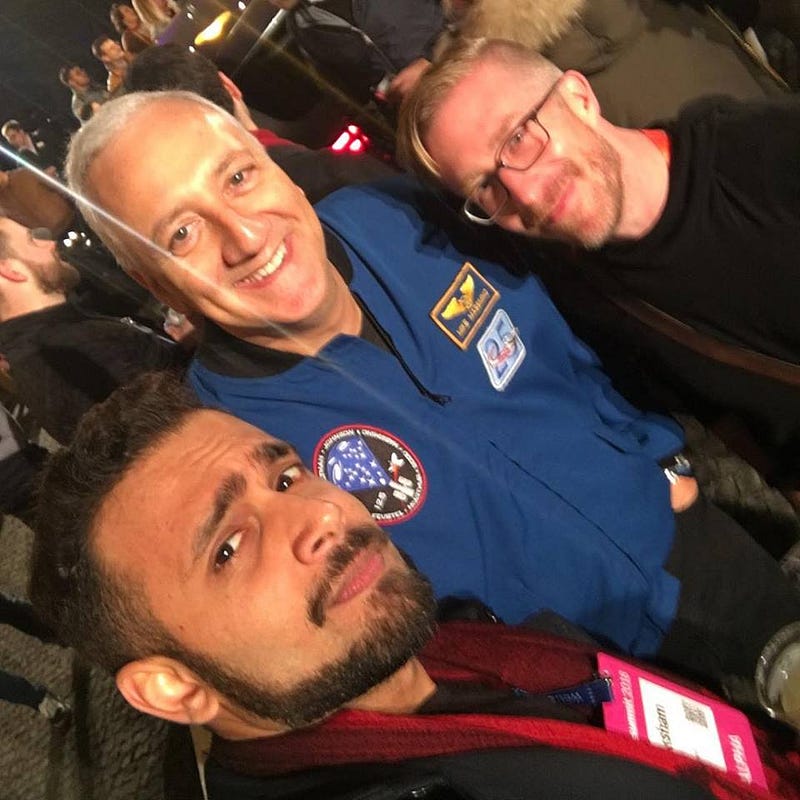
This was the line I used to try to convince Chris Messina to gatecrash an exclusive cruise party in Lisbon harbor at the peak of November’s Web Summit.
It worked.
Fifteen minutes later we were cruising through the harbor, and all the organizers of the party had personally come and shaken Chris’s hand one by one (as well as apologized for any inconveniences we might have faced while boarding). The inventor of the hashtag is on board — word had clearly spread like wildfire through the boat, the bay, and the throng of beaming millennials on the deck, so much so that no one actually had the time to photograph or hashtag Lisbon’s spectacular world heritage sites passing us by along the coastline.
Eventually I managed to wrestle Chris (after a couple of cocktails) out of the crowd and onto the bow (mostly so that we could have our star-crossed Jack-and-Rose Titanic moment, but also) so that I could interview him on topics that are taboo on terrestrial ground.
What follows is an exchange that started that evening and then played out over a few days on the course of hashtags in history, their contemporary use in social media, and where things might go in the future.
Saksham: First of all, what do you think of the influencers on Instagram who post up to 60 hashtags at a time?
Chris: Sometimes there are photos that really do warrant an abundance of tags — but from what I’ve read on the research, 9–15 tags are closer to what’s actually effective. Otherwise Instagram is likely to punish posts that attempt to be overly broad in their use of tags. I’m all for people helping others find their content when it’s timely and relevant, but tagging with the sole intention of self promotion is a drain on the commons.
That’s interesting. I’m curious, are there any celebrities/influencers you know who nail the hashtag game on Instagram every time?
Chris: That’s a good question — the way I pore over social media, I tend not to look too closely at individual uses. Obviously some people are more savvy than others — and those who are more savvy are the ones who nail a cultural moment in a short string of words and invite participation.
Speaking of nails, I see you’ve painted your nails…any story behind that?
Chris: Indeed! I first got my nails painted at Burning Man last year (as one does, of course — a bright Camero red!). When I showed a friend photos, she later surprised me with a bottle of polish to have. I ended up trying it out and it turns out that it’s the perfect solution to prevent me from chewing my nails, which is one of my lifelong bad habits. I’ve tried the clear bad tasting shit and it just doesn’t work nearly as well. And hey, if it makes other people feel somehow uncomfortable, that’s their problem and not mine, right? That same friend just got me two new colors for my birthday — Essie’s “After School Boy Blazer” blue and “Berry Naughty” maroon. Can’t wait to try’em out. 💅
So campaigns like #MeToo are inextricably linked to the hashtag that precedes the campaign name (and hence are sometimes literally referred to as “hashtag Me too”). In a sense then the hashtag evokes a feeling of ‘the collective’ that a lot of rights campaigns like #OccupyWallStreet, #FreeTheNipple have seized upon. What are your thoughts on this?
Chris: I was thinking about this the other day when I was asked after a talk I gave why a group of people took a photo of themselves with various forms of the #bringbackourgirls hashtag printed on paper:
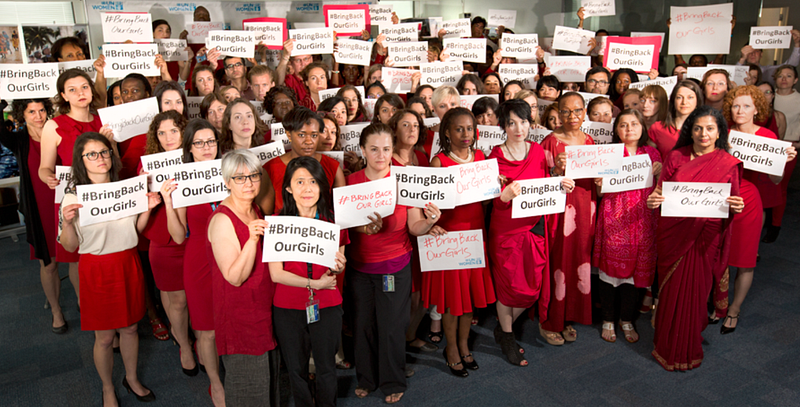
It occurred to me that the hash symbol (#) now has taken on a new meaning in culture, like the currency symbols ($, €, etc). When used in this context, it is a way of expressing group identity or affiliation. So hashtags are a new kind of token in language that expresses more than just identifying a group, but is a way of self-associating with a cause — like tagging yourself in a photo. It’s a typographic hack to create a connection between oneself and a larger participatory movement or sentiment.
What are some ways in which you’re hoping hashtags will be used in the future?
Chris: It’s almost more like — how can we teach people to use hashtags more effectively in the present so that when we do look back from the future, we’ll have a richer and more robust dataset to analyze.
This is starting to happen with subtle nudges to help people consolidate their tags around commonly trending topics… Twitter offers suggestions based on where you’re posting a tweet from, whereas LinkedIn has a long way to go. Put another way, if people get better at using relevant tags, we’ll end up with a more interesting and diversified social media experience. The consequence would be a greater set of perspectives being represented in the public discourse.
Hashtags are also useful in more contexts — even in private contexts like group chats (i.e. to help label topics within a group context) or enterprises (i.e. helping teams across a company build visibility for various initiatives).
And of course, as the line between reality and augmented reality continues to blur, we’re likely to see more interesting ways of interacting with hashtagged content in real life — on billboards, on big screens, and elsewhere.
Did you think hashtags would take off so exponentially when you first tweeted about them?
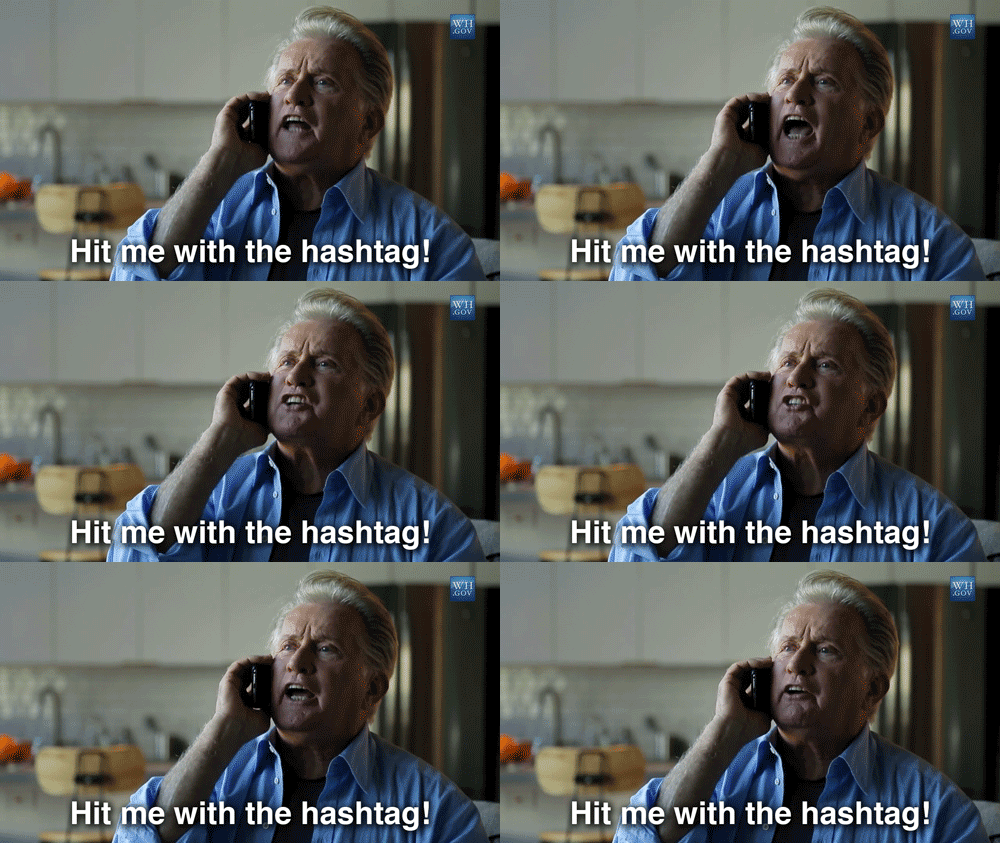
Chris: I didn’t, but not because I didn’t believe in the idea but because there of all the skepticism heaped on social media at that time. People thought Twitter was just a toy and had no real purpose. Now the president of the United States announces policies on it. Hashtags made sense to me then and seemed useful; it was necessary to first convince the world that social media was valuable in culture in order for the hashtag to grow in its general utility.
Companies across the board use hashtags for marketing. And the hashtag is essentially an interactive tool. What do you think the future of interactive marketing holds?
Chris: I believe people are looking for connection and ways of experiencing themselves and the world in more compelling and dynamic ways. The hashtag gives people a simple and effective way to convene a conversation and invites curiosity and participation. Interactive marketing, by definition, demands a more open and engaging approach to commercial conversations. This is new territory for many brands: how do they learn to listen, respond, and engage in a bilateral dialog rather than one-way media and content? I think we’ll see more of that going forward, especially as consumer expectations become demanding in how that brands interact with them.
Instagram now has dedicated hashtag pages, streams, and live hashtag stories. It is also now the most rapidly expanding social network. Do you think Instagram is set to become the dominant platform for hashtags?
Chris: I don’t think that’s quite the way to look at it. I’m impressed by Instagram’s adoption of hashtags. They’ve done more than Twitter to support hashtagged content, which surprising, to say the least.
However, I think different networks are optimized for different kinds of media, content, and interactions — and each supports hashtags in slightly different ways. I’m more interested in how those strategies and product features evolve to enhance the use of hashtags on each platform than suggesting that only one platform will “dominate” hashtag usage. That said, Instagram is enormous and an incredibly important platform, so I certainly believe ignoring it would be a mistake.
Ok so imagine the year is 3018 AD. How do you think people of that age are going to look back at our use of hashtags: what does it reveal about our generation, living in the nascent stages of the internet, and the nascent stages of social media (the latter being barely 20 years old).
Chris: I think about this a lot. Like, if the Romans or Mayans had hashtagged their written histories, would that have enabled us to understand trends and their lived experiences more easily? Probably. Now imagining having the enormous amount of content we have from today’s social media for these civilizations… what a field day historians would have! So much more context and the ability to see the rise and fall off different ideas, events, and topics…!
My hope is that over the long term — and with advances in data science and machine learning — we’ll be able to make more sense of hashtagged content longitudinally, from media of all kinds (text as well as visual and even aural content). People in 3018 will probably have a direct brain-to-computer neural link, but they’ll still need to create conceptual tokens that identify simulacra and other parts of experience in order to communicate and coordinate with other conscious lifeforms, and who knows, maybe hashtags will still be the simplest, stupidest way to achieve their desired outcomes.

Rapid fire:
Your favorite hashtag of the 21st century: #TIL, since it captures a stream of dawning awareness
Your least favorite hashtag: Any hashtags with spaces in them
One thing you’d like to predict about the internet (for marketing companies): Relationships are the future and most companies (and even some humans) are horrible at them. Those who reform themselves to become better at them will thrive.
Would you rather be called the godfather of hashtags or the father of hashtags: #godfather