
What if — the customer is a robot?
I have recently been getting a lot of posts in my LinkedIn feed on AI taking over design jobs.
Ever since AI defeated Kasparov in 1997, there have been newsbytes of AI’s new achievement every now and then — DeepMind’s AlphaGo that defeated the human world champion in the game of Go mastering it just over a weekend (and this is much more unpredictable than chess), AI that plays piano better than the best human pianist, AI that drives a car faster and safer than the best human driver and so on …. Over here we are not talking about a zero on ten, or a ten on ten, rather we are talking about the slow but sure progress from the zero towards the ten.
Recently, I came across an article on the generative design software from AutoDesk that designed a bench in a park which has a frame like a tree. The software takes in parameters from the human designer and designs it for her/ him. This was then followed by an article questioning if AI would ever be able to design cars than the best human automotive designers? Even though it does seem far-fetched, being from the automotive design industry such an article does seem scary to me! While I have lot of trust in and respect for the design sensibilities of my colleagues in creative design, the final boss is always the customer. So, what if the results from the User Surveys and Usability Testing prove to the Chief Marketing Officer and Chief Executive Office of a company that the AI design has had a better acceptability at a fraction of the cost and time? Then there might not be much of a case left for a human creative design team! And if the CEO does need a human to intervene, it might just be a Chief Creative Officer who sits and changes parameters on a software which generates numerous concepts for him at the click of a button.
We all know that “Subjective is just a complex case of Objective”, and if it can happen to a creative designer, most surely it can happen to a digital sculptor, a job which is much more objective as compared to creative design. For someone who has recently lost his job to a virus, the last thing that I would want, is the dread of losing it to AI in future. On second thoughts, in a way I have, because every time ICEMSurf or Alias ( the 3D design softwares I work on) gets a bit better (automated corners for instance or better Control Point align commands), I lose a bit of my employment to the code!! And if the generative design software can do the quick and dirty digital model for the designer based on certain parameters, what could possibly stop it from doing the same for production quality — Class A surfacing as well?
In the complete AI+ML debate the ability of the code takes a back seat, and the more difficult questions posed are the philosophical, legal, and economic ones. This is why it is quite common for AI teams to be headed not by coders but by people with a background in philosophy. It is these people who would probably want to have Isaac Asimov’s four laws of AI as their guiding principles to begin with and instruct the coders accordingly, so that we do not end up with a Frankenstein’s Monster, an Agent Smith and so on. For those who are not familiar with these laws, I would state them here itself to avoid a Google search distraction:
Asimov’s Four Laws of Robotics:
Zeroth Law: A robot may not injure humanity, or, through inaction, allow humanity to come to harm.
First Law: A robot may not injure a human being or, through inaction, allow a human being to come to harm, unless this would violate the Zeroth law of Robotics.
Second Law: A robot must obey the orders given to it by human beings except where such orders would conflict with the First Law.
Third Law: A robot must protect its own existence as long as such protection does not conflict with the first or second laws.
Fourth, Fifth …. and so on … laws will need to be framed as we go further, to take care of complications — like which human to save and which one to let die if in a situation like that and so on ….
IMO, this should be taken care of asap before those jobs in philosophy and law too fall in favor of AI!!!
But if that happens, the bigger question would be — “If everyone loses their jobs to AI, who will buy the products created by these intelligent robots?” We are being repeatedly reminded of the fact that the customer is the final boss, but what if the customers/users too are AI robots? That is the bigger question. We have a completely separate field called User Experience Research and Design (which happens to be my secondary domain as well), which focusses on empathy-based user research and design. But now that we are talking about robots selling to and buying from robots, it would be interesting to see what turn does the field of UXD take?
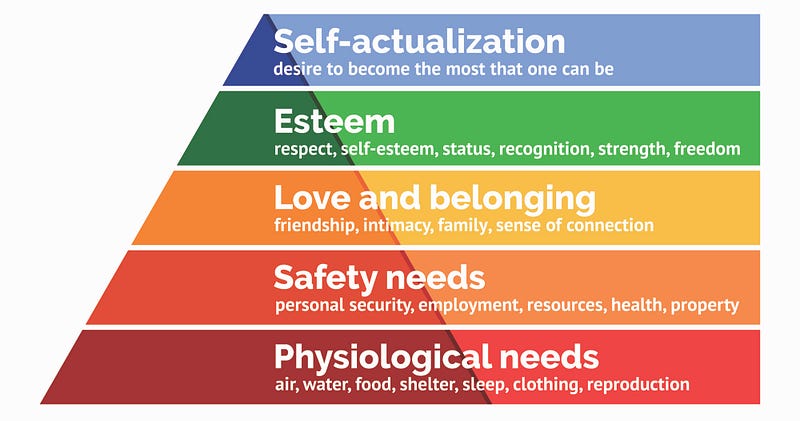
According to Maslow’s hierarchy of needs, humans have an incentive to think and act in a certain way based on their needs. This varies for each one of us depending on where they are in the pyramid. For robots to sell and buy from each other, there has to be an incentive in buying and selling to match their needs. Robots till date are intelligent but non-sentient and non-conscious beings, therefore there is no incentive for them to buy or sell from each other (or at least we humans perceive incentive to be). Again, to avoid a Google search distraction — Sentience is the capacity for subjective perceptions, feelings, and experience. Consciousness is being aware of yourself and your surroundings. So, either their incentive is coded into them along with their needs, or we hope to see sentient and conscious robots in future that would just be like non-carbon-based living beings. Since the latter seems to be far fetched it is the former that we should be more interested in. The needs and the incentives that are coded into them will determine what kind of robots they will be.
Initially, the immediate boss or parent of this robot will be the coder. But then the coder might have a boss who is a philosopher or a legal expert or another coder. But who will be the boss of this philosopher or legal expert or coder leading the AI coding teams? Would it not be the human politicians and the human big business owners? Would they not lobby and pressurize the AI teams led by whoever, to code in the needs of the robots for their own benefit and may be against the benefit of the economically, physically, intellectually and politically irrelevant masses? So, in the end would it just be the few human plutocrats and their army of intelligent robots left on Noah’s boat? And in that case whom do we really need to fear — the AI driven robots or the human techno-plutocrats?
#artificialintelligence #deeplearning #icemsurf #aliasautodesk #automotivedesign #generativedesign #userexperiencedesign