
What If It’s a Tie?
Gaming out the nightmare of a 269–269 deadlock
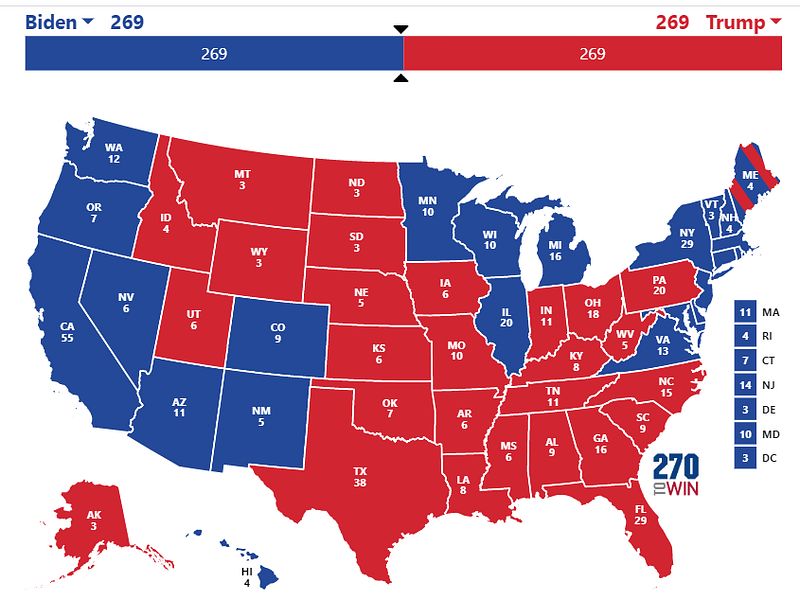
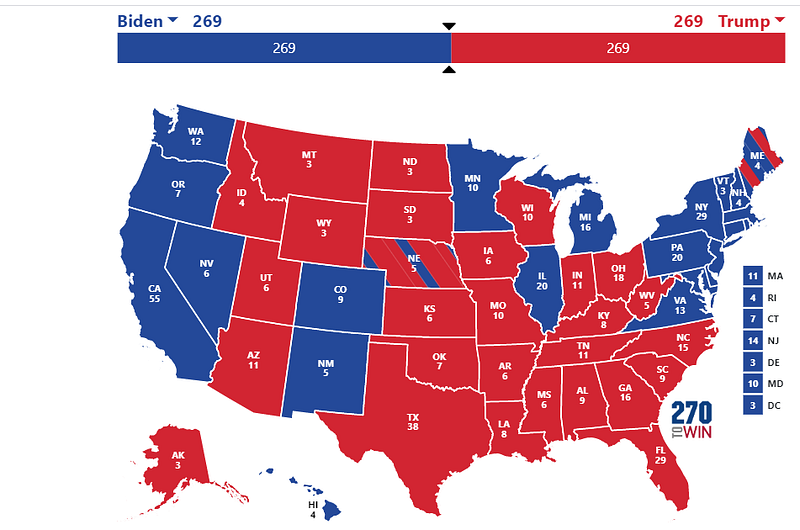
Biden leads Trump in the latest polls. But if Trump wins Florida and North Carolina, a constitutional crisis is likely.
Long story short, the House of Representatives would choose the victor — and Biden would probably lose.
NOVEMBER: Confusion, Recounts, & Lawsuits
First, lawyers and partisans would try everything to get their candidate over the 270 threshold.

After the initial results came in, weeks of litigation and recounts would ensue. At a minimum, there would be a recount in Florida, Pennsylvania, or another battleground state.
The 12th Amendment to the U.S. Constitution — the supreme governing authority on presidential elections — would face unprecedented scrutiny. It provides, in pertinent part, the following:
. . . The person having the greatest number of [Electoral] votes for President, shall be the President, if such number be a majority of the whole number of Electors appointed; and if no person have such majority, then from the persons having the highest numbers not exceeding three on the list of those voted for as President, the House of Representatives shall choose immediately, by ballot, the President. But in choosing the President, the votes shall be taken by states, the representation from each state having one vote; . . . and a majority of all the states shall be necessary to a choice . . . .
The person having the greatest number of votes as Vice-President, shall be the Vice-President, . . . and if no person have a majority, then from the two highest numbers on the list, the Senate shall choose the Vice-President . . . .
In other words, a 216-year-old compromise would throw the election to Congress. State delegations to the U.S. House would choose between Trump and Biden, while a simple majority of senators would choose between Pence and Biden’s running mate.
DECEMBER: A Presidential Election in Washington
Members of Congress would be free to vote however they saw fit — regardless of how their constituents had voted.

In December, a long battle over the presidency would brew in the House — but Pence would easily win another term as Vice President.
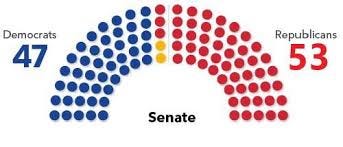
Even if all 47 Democrats and Independents were to vote for Biden’s running mate, Pence would need just 51 votes in the Senate to win reëlection.
If the Senate were to split 50–50, then Pence himself — the incumbent President of the Senate — would break the tie.
The House is another story.
Democrats won a large majority of seats in the U.S. House of Representatives in the 2018 elections.
But under the 12th Amendment, Members of Congress don’t vote individually for president in the event of an electoral college tie.
They vote collectively, in state delegations.
Ignore the numbers in this map — the colors are more important. It shows the partisan leanings of each U.S. House delegation in the 116th Congress.
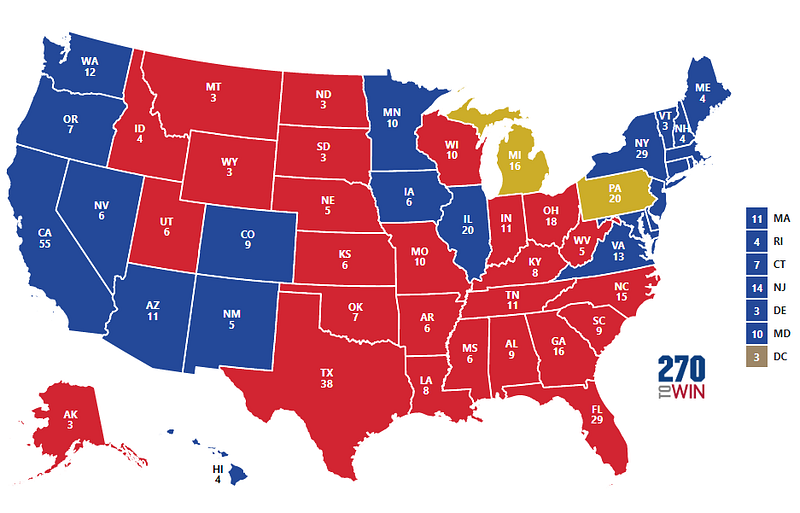
For example, Trump currently leads among voters in the State of Iowa.
But Iowa sent three Democrats and one Republican to Congress in 2018.
If the House of Representatives chooses the president, Iowa will just be one vote for Biden.
Similarly, Biden leads among voters in Wisconsin — but Wisconsin sent three Democrats and five Republicans to Congress in 2018. If Members vote along party lines, then Wisconsin will deliver one vote for Trump.
Michigan and Pennsylvania have evenly divided congressional delegations (7–7 and 9–9, respectively). So, those states would not cast any vote in a presidential contest — unless a representative could be persuaded to vote across party lines. Rep. Justin Amash, for example, may vote for Biden.
Washington, D.C., would not get to participate; only voting incumbents would influence the outcome.
By my count, Biden would get 22 votes for president on the first ballot.
Trump could easily get 26 votes — just enough to win a second term — without the support of either Michigan or Pennsylvania.
Is there any way Trump could lose?

Yes.
Five red states — Alaska, Montana, North Dakota, South Dakota, and Wyoming — are represented by just one Member in the House. For example, Liz Cheney — whose advocacy for wearing masks may be at odds with the Republican Right’s cavalier tone — could unilaterally cast Wyoming’s presidential vote for Biden.
But even if such a shocking twist were to transpire, Biden wouldn’t instantly become president-elect.
If neither presidential candidate could win an outright majority of 26 states in the House, then the House would just have to keep voting until a 26-vote majority emerged.
Having established that Trump would have a clear advantage, let’s play out the best-case scenario for Biden.
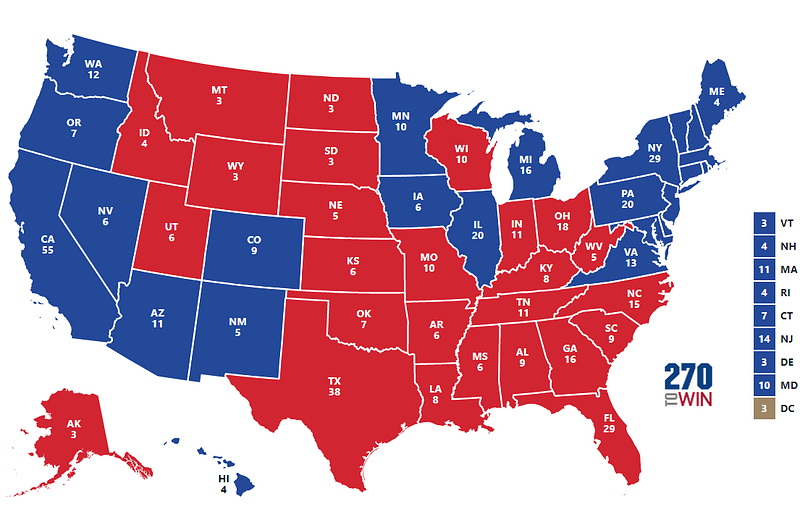
This is the same U.S. House state delegation map I included earlier.
Except, Michigan and Pennsylvania are filled in for Biden.
In this scenario, Biden would have 24 states in his corner, whereas Trump would have 26 — enough to win.
Let’s see what happens if we remove states with just one at-large Representative in the House:
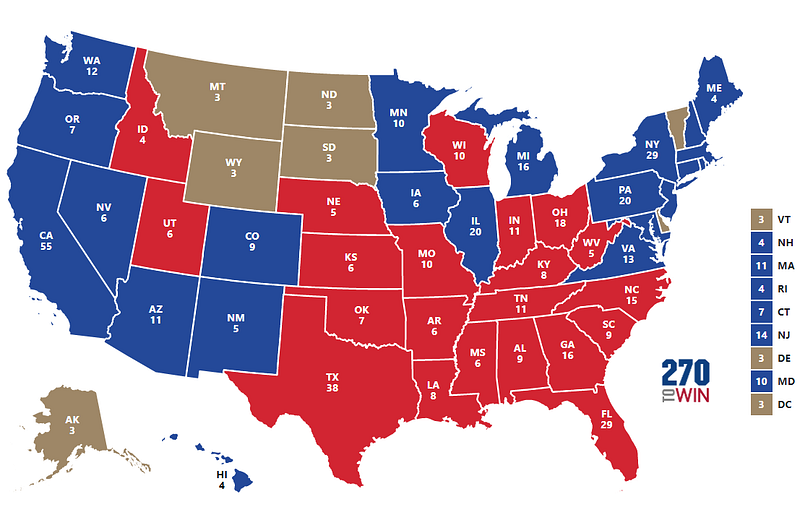
That brings Biden’s total from 24 to 22, and Trump’s total from 26 to 21.
Representatives from the seven small states would have broad discretion over the outcome of the 2020 presidential election.
This is, of course, to say nothing of the numerous states with closely divided delegations.
Consider, for example, Arizona (5 Democrats + 4 Republicans) and Colorado (4 Democrats + 3 Republicans).
Trump could, in theory, poach a whole vote from Biden’s side by offering cabinet positions, ambassadorships, judgeships, and other prizes to conservative Democrats who indicated discomfort with Biden’s prospective presidency.
This dealmaking would proceed until the House reached a consensus — if they reached a consensus.
JANUARY: President Pence?
That’s what the 12th Amendment requires, if the House can’t decide.

Let’s return to the 12th Amendment: “[I]f the House of Representatives shall not choose a President . . . before the fourth day of March next following, then the Vice-President shall act as President, as in the case of the death or other constitutional disability of the President . . . . ”
So, if the deadline is March 4th, then why would we be stuck with President Pence in January?
“ . . . If a President shall not have been chosen before the time fixed for the beginning of his term . . . then the Vice President elect shall act as President until a President shall have qualified . . . . ”
That’s from § 3 of the 20th Amendment, which was adopted in 1933.
As I said earlier, Mike Pence would probably not have a hard time getting reëlected in the Senate. He would just need 50 of the 53 Republican Senators to vote for him.
Thus, if the House of Representatives failed to resolve an Electoral College deadlock in favor of either Trump or Biden, then Michael R. Pence of Indiana could potentially serve as both President and Vice President for a brief interim.
Alex Garrett is a freelance writer from Atlanta.


