What if God Says LGBTQ+ Rights?
Is God Still Giving New Revelations Today?

Standing Up
Over the past few weeks, I have been following the story of Neland Avenue Christian Reformed Church in Grand Rapids. When the denomination ordered them to remove a deacon because she was married to another woman, Neland’s council spent some time in prayer and discussion, then respectfully said no.
Yonat Shimron reports for Religion News Service:
“We take the admonition of Synod 2022 very seriously,” the church council said in a statement. “However, as we prayed, wrestled with the Word, and discerned the Spirit together, our conscience told us that we would be both disobedient to God’s call, and less than fully loving to all His children if we ‘immediately rescinded’ our decision to ordain this deacon. After prayerful consideration of the directives of Synod 2022, we have decided to appeal its decisions.”
This story gives me hope and makes me want to applaud the church that stands by their convictions and refuses to back down.
“If they decide to cut us off, that’s up to them. We can’t control that piece,” says Neland Avenue’s co-pastor, Joel DeMoor. This brings to mind Acts 5:29: “We ought to obey God rather than men.”
Re-interpreting Scripture
I know you’re not supposed to read the comments, but I found a fascinating exchange in the comments on the RNS article:
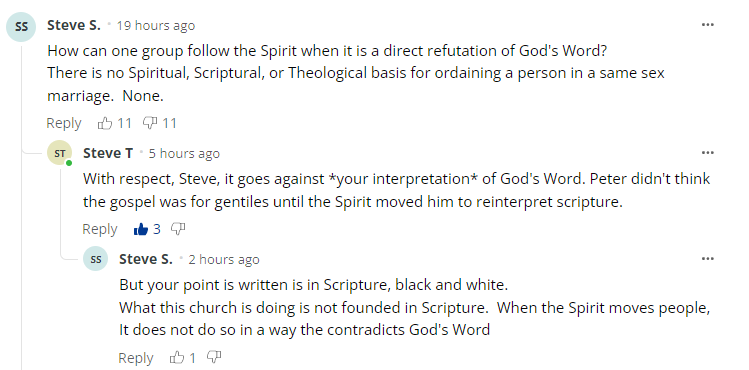
Steve S: “How can one group follow the Spirit when it is a direct refutation of God’s Word? There is no Spiritual, Scriptural, or Theological basis for ordaining a person in a same sex marriage. None.” Steve T: “With respect, Steve, it goes against *your interpretation* of God’s Word. Peter didn’t think the gospel was for gentiles until the Spirit moved him to reinterpret scripture.” Steve S: “But your point is written is in Scripture, black and white. What this church is doing is not founded in Scripture. When the Spirit moves people, It does not do so in a way the contradicts God’s Word”
I find Steve T’s position here very hopeful for the future of the Christian church. If more of us realized that we are all interpreting Scripture according to our own worldview and biases, we could have more productive conversations.
However, I am even more interested in Steve S’s second comment. He acknowledges Steve T’s point, but then he dismisses the idea that the Neland church council is doing the same thing Peter did, claiming that “when the Spirit moves people, It does not do so in a way the [sic] contradicts God’s Word.”
Peter’s Vision
For context, Steve T is referring to the story in Acts where a Roman Centurion named Cornelius was praying and saw a vision of an angel who told him to send for the Apostle Simon Peter. Just before Cornelius’ servants arrived at Peter’s house, Peter had a vision:
Peter went up on the housetop to pray, about the sixth hour. Then he became very hungry and wanted to eat; but while they made ready, he fell into a trance and saw heaven opened and an object like a great sheet bound at the four corners, descending to him and let down to the earth. In it were all kinds of four-footed animals of the earth, wild beasts, creeping things, and birds of the air. And a voice came to him, “Rise, Peter; kill and eat.”
But Peter said, “Not so, Lord! For I have never eaten anything common or unclean.”
And a voice spoke to him again the second time, “What God has cleansed you must not call common.” This was done three times. And the object was taken up into heaven again.
Now while Peter wondered within himself what this vision which he had seen meant, behold, the men who had been sent from Cornelius had made inquiry for Simon’s house, and stood before the gate. And they called and asked whether Simon, whose surname was Peter, was lodging there.
While Peter thought about the vision, the Spirit said to him, “Behold, three men are seeking you. Arise therefore, go down and go with them, doubting nothing; for I have sent them.”
Then Peter went down to the men who had been sent to him from Cornelius, and said, “Yes, I am he whom you seek. For what reason have you come?”
And they said, “Cornelius the centurion, a just man, one who fears God and has a good reputation among all the nation of the Jews, was divinely instructed by a holy angel to summon you to his house, and to hear words from you.” Acts 10:9–22
For a Jew like Peter, going into the home of a Roman was unthinkable. The idea that this Gentile could become a follower of Christ was absurd. It was against Scripture as Peter understood it.
In an act of great faith, Peter went to Cornelius’ house anyway, where many Gentiles waited to hear what he had to say.
Then he said to them, “You know how unlawful it is for a Jewish man to keep company with or go to one of another nation. But God has shown me that I should not call any man common or unclean. Therefore I came without objection as soon as I was sent for. I ask, then, for what reason have you sent for me?” Acts 10:28–29
In Peter’s mind, God had told him to do something that contradicted his understanding of Scripture. However, he was certain he had heard God’s voice, so he reinterpreted Scripture to fit this new revelation.
Peter stood in front of this crowd of strangers and said, “In truth I perceive that God shows no partiality.”(Acts 10:34) He was quoting Deuteronomy 10:17 and 2 Chronicles 19:7 here, finding something new in these passages to fit this new situation, reinterpreting Scripture on the fly to fit what was happening in front of him.
Peter continued, “in every nation whoever fears Him and works righteousness is accepted by Him.”(Acts 10:35) He was referring to Psalm 15 here, finding justification in the psalmist’s words to offer salvation to outsiders.
Peter then told them about Jesus, and “the Holy Spirit fell upon all those who heard the word. And those of the circumcision who believed were astonished, as many as came with Peter, because the gift of the Holy Spirit had been poured out on the Gentiles also. For they heard them speak with tongues and magnify God.”(Acts 10:44–46)
Before his vision, Peter would absolutely have said that preaching to Gentiles “contradicts God’s Word.” And the Jewish followers of Christ who came with him were “astonished.” All of them would have said the same thing, that this was contrary to Scripture.
Steve S asserts that this is “founded in Scripture” while ordaining a gay deacon is not because it “contradicts God’s Word.”
However, it is absurd to say that Peter was correct because Peter’s story is in Scripture. It was not in Scripture while it was happening. Peter couldn’t look to the Story of Peter’s Vision to decide what to do about his vision. That is circular logic.
New Revelation
In the same way, cannot Holy Spirit give new revelation today? Can we not reinterpret our understanding of Scripture as Peter did to allow for this?
Is there another great sheet (or perhaps, a giant rainbow flag) even now descending from heaven toward the church, full of everyone we still view as unclean? Do you hear the voice of God saying, “What God has cleansed you must not call common”?
“Can anyone forbid water, that these should not be baptized who have received the Holy Spirit just as we have?” (Acts 10:47)
In the meantime, I applaud Neland Avenue church for their decision. It is not easy to take such a stand, but I agree with them that it is the right thing to do.
Esther learned to read when she was four years old, and began writing shortly thereafter. She is a queer Christian poet, crafting with words to create art and music.
Enjoy my work? Buy me a coffee!


