
Stoicism and surroundings
What, if any, is the essence of Stoicism?
Are there some fundamental ideas in Stoicism that, if we let go of them, we are not doing Stoicism anymore?
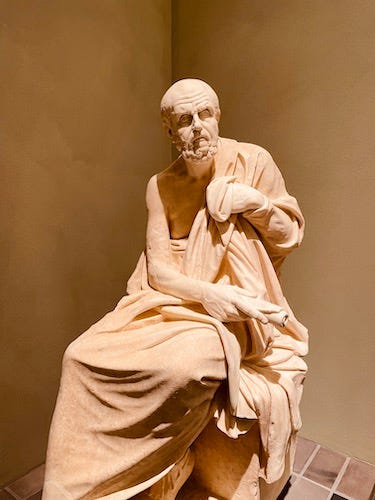
A few days ago my friend and co-author Greg Lopez and I co-hosted the 7th edition of Stoic Camp New York, inspired by the original Stoic Camp that another friend and colleague, Rob Colter, has facilitated for several years in Wyoming. It was an unusual edition of Stoic Camp, not only because it was the first one in person since the beginning of the covid pandemic, but because the objective was to trace the early origins of some Stoic ideas (Presocratics), to map the major direct influences on the Stoics (Cynicism, Megarian School), and to identity whatever distinctive features characterize Stoic philosophy.
As part of this exploration, I proposed to the students that we carry out an exercise. You may want to try it now before continuing to read this essay. Take a few minutes to make a list of ideas you think are fundamental to Stoicism and without endorsing which, in your opinion, one could not reasonable call herself a Stoic. Try to do this regardless of whether or not you yourself agree with said ideas.
Let me make clear that the suggestion — despite the title of this essay — is not that there truly is an “essence” of Stoicism. Socrates famously looked for precise definitions of concepts based on necessary and jointly sufficient conditions, but post-Wittgenstein we now realize that most complex concepts simply do not admit of such rigorous treatment. Concepts like “Stoicism” are inherently fuzzy, characterized by a number of intertwined strands, none of which, by itself, may make it or break it. Stoicism, then, becomes a family resemblance concept, an idea loosely defined by multiple interlocking dimensions.
Nevertheless, the question remains: how many (and specifically which) of these threads can one pull away before modern Stoicism loses its family resemblance with its Greco-Roman ancestor? This is a question that has been raised by several thoughtful authors of late, perhaps most prominently by Larry Becker, the author of A New Stoicism (see here for a multi-part introduction to the book, checked for accuracy by Larry himself).
Okay, ready to take a look at the results of my informal survey? I’m going to list the ideas that my students thought most characteristic of Stoicism, in descending order of number of votes received (out of 18 possible). Then we’ll discuss what we can learn from this exercise. So here they are:
Virtue is the only good (15) Four virtues (13 votes) Epictetus’ fundamental rule (aka dichotomy of control) (13 votes) Three disciplines of Epictetus (10 votes) Live according to nature (10 votes) Askesis (spiritual exercises) (9 votes) Logic and “Physics” are necessary to understand Ethics (8 votes) Knowledge is possible (for the Sage) (6 votes) Providential cosmos (2 votes) Unity of virtues (2 votes) The goal is a smooth flow of life (1 vote) We are all vicious (except the Sage) (0 votes)
The first thing to note is that not a single entry got all 18 votes and, relatedly, that there was overall quite a bit of heterogeneity about what truly counts as Stoicism. The students, I may remind you, were all fairly knowledgeable about the philosophy, so this isn’t a survey of the man in the street, so to speak.
This kind of heterogeneity was found among the ancient Stoics themselves. In book VII of his Lives of the Eminent Philosophers Diogenes Laertius tells us that Chrysippus disagreed with Zeno and/or Cleanthes, Aristo of Chios disagreed with Zeno, and some of the early Stoics even left the sect because of their doctrinal differences, such as Dionysius the Renegade, a student of Zeno. Moreover, the middle Stoics Panaetius and Posidonius were well known for their heterodox ideas. And Seneca tells Lucilius that he doesn’t think of those who came before him as his masters, but only his teachers (Letter XXXIII.11). Should he find a better way, he would follow it. So Stoicism has never been, nor is it today, a monolithic and rigidly defined philosophy of life. Which is a plus, in my book!
Now let us delve a bit more in depth into each entry above. “Virtue is the only good” is certainly a dominant theme of ancient Stoicism, though one that I have recently criticized. Cicero doesn’t buy that the Stoics are on that ground sharply distinct from the Aristotelians (Academica II.5), because after declaring virtue to be the only good the Stoics immediately tell us that other things (the so-called “indifferents”) have value. So there is room for negotiation therein. Moreover, the idea that virtue is the true good is not original with the Stoics, as it can be traced back to Socrates. (Then again, the Stoics did openly refer to themselves as “Socratics.”)
The four virtues are also not originally Stoic, as they are listed in Plato’s Republic (Book IV, 426–435) and are extensively treated in Aristotle’s Nicomachean Ethics. Moreover, later Stoics like Epictetus hardly use the word virtue at all.
The next two entries, the fundamental rule of life and the three disciplines of Epictetus, are actually innovations introduced by the sage from Hieropolis. One may, perhaps, find traces of the fundamental rule (“some things are up to us, others are not”) in earlier Stoics, but one has to squint really hard. And the three disciplines (desire and aversion, action, and assent) are definitely Epictetus’ invention.
Famously, the Stoics argued that we should live according to nature, but so did the Epicureans and many of the other Hellenistic schools. The idea is that there is a fundamental distinction between what Nature dictates and the variety of human customs. A good life is the result of following Nature, and only the Sophists rejected the primacy of natural law in favor of human custom.
Stoicism is a practical philosophy, so askesis, the idea that we should engage in exercises that help us improve as human beings, is indeed a Stoic characteristic. But as Pierre Hadot reminds us in his Philosophy as a Way of Life, it certainly wasn’t a prerogative of the Stoics only. Pretty much all other schools, from the Pyrrhonists and the Cynics to the Epicureans and the Neoplatonists, sported some form of askesis.
The tripartition of philosophy into Logic, “Physics” (i.e., natural science), and Ethics is again not a Stoic invention, but rather a common scheme adopted during the Classical and Hellenistic periods, though the Epicureans dropped logic and the Cynics dropped everything but ethics.
The Stoics certainly insisted on the possibility of knowledge (as distinct from opinion), though technically only the Sage would achieve it. In this they were criticized by the Academic Skeptics, but were in fact in line with the Platonists.
Surprisingly, the idea of a providential cosmos only received two votes in my group, though it surely was a fundamental aspect of ancient Stoic metaphysics. Most modern Stoics reject it, though a small group of self-identified “traditional” Stoics still think it non negotiable.
Also surprising is that the concept of the unity of the virtues, which derives from Socrates, got only two preferences. Even though the Stoics clearly incorporated it into their system, they disagreed on whether one or another of the four cardinal virtues was in a sense more fundamental than the others. Musonius Rufus, Epictetus’ teacher, for instance, claims that without temperance one cannot possibly practice any of the other three.
Next to the last in our list is the idea that the ultimate goal is a smooth flow of life. While likely unfamiliar to many modern Stoic practitioners, Diogenes Laertius (at VII.88) tells us that that’s one of the ways to interpret the phrase “in agreement with nature.”
Finally, none of my students agreed that the notion that we are all vicious (in the sense of prone to vice) is a tenet of Stoic philosophy, even though it is the third of the famous “Stoic paradoxes” about which Cicero writes.
So here is another lesson we can take away from this exercise: Stoicism borrowed a lot from a number of other philosophies, which means that it began as an eclectic philosophy of life. This should not be surprising. Diogenes Laertius tells us that Zeno of Citium studied with Crates the Cynic, but then moved on to Stilpo, a member of the Megarian school, a group of thinkers particularly interested in logic. He also frequented the Platonic Academy under Xenocrates and Polemo. Moreover, Zeno studied with the dialectician Diodorus Cronus as well as with another Megarian, Philo. While we nowadays think of Stoicism as a highly structured and internally coherent philosophical system, that’s more likely the result of a major cleanup carried out by the third Scholarch of the School, Chrysippus, which is why Diogenes Laertius says that without Chrysippus there would be no Stoa (VII.183).
Ironically, the most original Stoic ideas are the fundamental rule of life and the three disciplines, which are both due to Epictetus, a late Stoic who lived four centuries after Zeno! So let us do away with the sort of nonsense promulgated by some quarters according to which “if you don’t believe X then you are not a Stoic.” In perfect Wittgensteinian fashion, “Stoicism” is a dynamic philosophical entity, fluid through time, and with no sharp boundaries neatly separating it from other philosophies (especially Early and Academic Platonism, Aristotelianism, and Cynicism). If you agree with some, but by all means not all, of the characteristics listed above, then you can reasonably call yourself a Stoic.
Then again, what’s in a name? Cicero called himself a Skeptic, and yet also admitted that much of his philosophy, especially the ethics, was clearly Stoic in nature. So long as you understand those who came before you and spend some time reflecting about what you believe, the label you choose doesn’t matter. What matters is that philosophy helps you become a better human being and live a more fulfilling life.