
What I Write While the Sauce Simmers
A love of family, as told through a love of food.
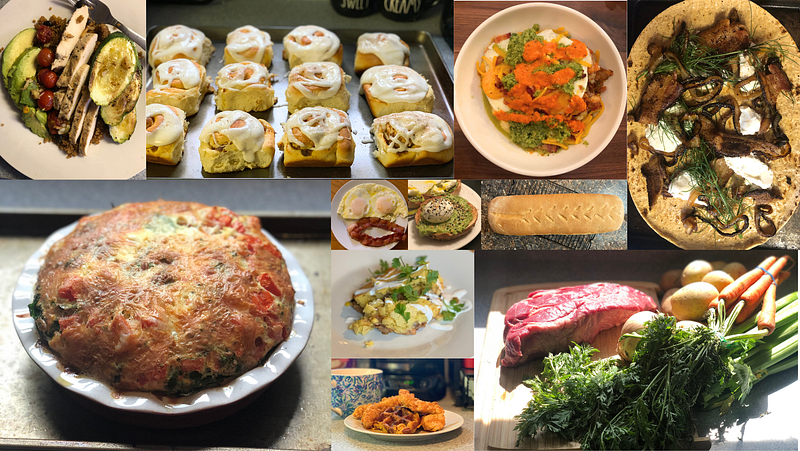
Stepping through the front door after taking out the dog, the warmth and fragrance of garlic, herbs, and baking bread immediately enveloped me.
I inhale and smile.
It’s the smell of home.
Cooking and writing, writing and cooking
Once again, an entire day flies by with my first opportunity to sit down at my keyboard, not presenting itself until dinnertime.
“Dinnertime” is getting pretty European around here lately, pushing 8 pm many days.
I love getting a lot done during the day, but dinner takes time when you cook real food from scratch.
First, the prep. If I were to type the meal plan meticulously, I could do all that in one day every week. As it is, I have a very ADHD habit of allowing my taste buds and inclinations to guide my daily cooking rather than a strict schedule.
Ergo, there’s some degree of prep every day.
On great days, I remember to start that bread dough around 1 pm so we can enjoy fresh bread with dinner.
Some days, the best I can do is start chopping an onion around 5:30 pm and figure something out as I go.
One of the reasons I always start with a fragrant sautéing onion is that it acts as a siren song, calling my sullen teenage children forth from their dark, LED-lit caverns into the warmth of the kitchen.
As they grab drinks, the clink of glasses and ice combine with their chatter about their day to fill the space with a pleasant hum of background noise as I finish cooking.
They sometimes lean over my shoulder or grab a little nibble of whatever I’m cooking, and I love watching their eyes close in appreciation of the flavor. It’s got to be one of my favorite feelings on the planet.
Some days I do so much in the kitchen that I override any time for writing. And yet, I don’t resent it. My time in the kitchen feeds my soul as much as it feeds my children’s bellies. If I didn’t have that time, I’m not entirely sure I’d have the inspiration to write.
One ‘feeds’ the other, you might say.
Cooking is such an immensely personal, intimate, and ancient way of showing love; passed down from woman to woman throughout history, the secret of most recipes is not so much the precise ingredients as the methodology, the process, the physical labor poured into the crafting of a dish whose flavors are so cerebral it is repeated throughout time and space over generations.
That is absolute magic.
I consider it an honor to feed my family and their guests. I suppose this makes me some sort of old-fashioned “trad wife.” I don’t really care what it’s called — I am the front line of defense for my family’s health and well-being, so I consider it my duty to feed them good, hearty, whole foods and do it around a big table with lots of conversation, laughs, and love to keep their bodies and their souls healthy.
That’s my job, and I take it very seriously.
Job vs Profession
Since my ‘day job’ is homemaker, where does my writing fit in?
My writing is my profession. I write out of a desire to connect with people and to connect people with one another. I hope to facilitate healing and growth. Therefore, as I’m not merely reporting the weather or writing corporate content, I put my heart into my writing.
Very similar to how I put my heart into my cooking.
Just as I will review the ingredients, the timeframe I have to work with, and what I’m just ‘feeling’ for dinner, when I sit down to write a piece, I contemplate my last few days or recent events, in my life or what’s in the news.
What irritated me? What made me happy? Which one evoked a stronger response? And then I write that thing.
Although we have little bumps in the road from time to time, our life is remarkably good, even-keeled, happy, and content. We all have good health. We have stable finances. My husband is at a good place in his career. I’m finding my way into this new world of writing, publishing, podcasting, etc.
Sometimes, it can even get what I can only think to call ‘mundane.’ Not that anything is ever truly mundane with a family of nine, but we are just on a really slow, steady, and safe path.
All of this to say — sometimes I wonder if the banalities of my domestic bliss are provocative enough to write about… again. I don’t want to be boring, or rather, I don’t want to bore my readers. I’m unbelievably okay with being boring.
‘Boring’ means no chaos, no drama, no loud fights, no passive aggressiveness, and no stressful environment for my children.
20-year-old me craved ‘boring’ but had no clue how to even begin finding it. 30-year-old me chased ‘boring’ but still had a bad habit of having to have the last word. 40-year-old me demanded ‘boring’ and basically eliminated anything that derailed it. No more chaos for me, thanks.
But ‘boring’ means writing another piece about food and family, and yet it’s so much more than that.
When I stand, in my slippers and apron, in front of sizzling onions, dicing vegetables, and reaching for ingredients, my hands going on autopilot after two decades in front of the stove, I feel complete.
I can think of far fewer tangible ways to show deep love.
So of course, I must write this.
Caveman to Housewife
It’s transcendent. It’s ancient — as old as humankind itself. From the moment we discovered fire, we have been preparing meals over heat to share with our immediate family. Humans have spent millennia tasting plants, seeds, and nuts to see what was edible and what wasn’t. We have been picking and plucking, stripping and juicing, roasting and grinding, and experimenting constantly as we explore our world through food.
When my family sits down at dinner, and we’re enjoying nutmeg, allspice, curry, and saffron, my children don’t really grasp they are tasting a millennium’s worth of sailing, voyaging, trading, exploring, and yes, enslaving and pillaging, for people with our skin tone to even taste those spices, much less have them in abundance in our pantry.
I can tell some of their friends have never had this kind of food prepared for them, and most of them tentatively try a nibble before scooping up more and digging in.
These meals also enable me to get their friends at the table, to ‘get a good look at you,’ as my granddaddy would say. It lets me interact with them, get a feel for what kind of kids they are, and keep my fingers on the pulse of who my children are hanging out with.
Meals spent huddled around a fire, eating freshly roasted meat and whatever nuts, berries, and vegetation were foraged are a far cry from family dinner now, but the core essence is the same.
Mealtime is a time for community, sharing information and swapping stories, telling jokes, discussing current events, and yes, eating.
Documentaries abound nowadays, on every streaming service, about food. About the history of food, the production of food, cooking food, food and culture, food and diet, food and family. If anything, they serve to remind me I’m not the only one out there who’s a wee bit obsessed…with food.
We have created trillion-dollar industries around food. The entire world of kitchen and appliance design evolves regularly. Restaurants are a culture all of their own. We must eat to survive so we have made it as pleasant, as nurturing, as rich as we can.
In my home and my family, food is central to our connection. The dinner table is a meeting place; not just used for meals, it’s seen board games, science projects, crafts, gift wrapping, and family meetings.
Our dinner table is our central hub, and I am the chief engineer.
The Tools of the Trade
As I washed my pots yesterday, I realized I’d had those pots and pans for 18 years. I realized they have cooked most likely over 10,000 meals for my family, and that is a low-ball estimate. Because I’m stringent about scouring them (and the set cost me nearly a full paycheck in 2005), they still look almost new. I haven’t kept a couch, table, or chair for that length of time (although I do have a couple of bookshelves that have lasted that long — clearly, my priorities are food and books).
And as I was washing those pots, I examined my hands. My skin is rough, my nails are short, and the backs of my hands are starting to show some of that telltale crepiness that comes with age and hard work. Even with a nice manicure, my hands look rough.
I wash with hot water every day, so my cuticles are in a perpetual state of crack and bleed.
They’re working hands. And a lot of my daily work is in the kitchen. These hands have made over 10,000 meals for my family. They’ve been sliced, burned, and grated. They’ve been plunged into scalding dishwater more times than I can count.
I wonder sometimes if my children will remember. If they remember my rough hands trying to stroke their soft little cheeks and they would say, “Mommy, you’re scratching me.” I wonder if they will remember my hands smelling of dish soap as I tended to a boo-boo, wiped tears from their eyes, or brushed their hair out of their face.
As I washed that last pot and my youngest son was in the kitchen with me putting away dishes, I mused aloud, “It’s weird to think these are just going to be in a landfill one day.”
My son turned around, shocked, and said, “Like we would let that happen. I’m taking them. I want to cook for my family with them,” and my heart melted a little bit in my chest. I know he means it, but he discounts the possibility of his future partner wanting a pretty, modern new set of cookware, one that they can pick out all on their own and use for all their meals for their family.
As they absolutely should.
I didn’t say that to cause a guilt trip or anything; I was merely commenting on the very transient and impermanent nature of our lives. These pots, which have been scorched countless times and sat on simmer for thousands of hours, that have been meticulously scrubbed and cared for, will one day be set aside, replaced by newer models. Eventually, they’ll find their way out of someone’s closet, attic, or storage space, and end up in a landfill.
That’s OK. I’m going to end up in the dirt, too.
For now, I’m here, and the pots are here. Living in the present means making a little bit of magic every day.
A little olive oil. A sweet yellow onion and a fat garlic clove, crushed and minced. Some fresh herbs. Vibrant fresh tomatoes. Semolina flour and a couple of eggs mixed by hand, kneaded, rolled out, and cut into thin strips. A sprinkle of sea salt, pepper, and shaved parmesan.
It’s love, baby, on a plate.
Just as my grandmama set out plates of fried chicken and peach cobbler and my father-in-law sets out plates of pasta and sausage and peppers, I set out plates that my children and grandchildren will remember long after me, and my pots, are gone.
It’s sort of comforting, knowing death doesn’t have to be the end. What I pour my heart into now will transcend this mortal coil and linger in the hearts, minds, and taste buds, of the people I loved while I was here.
Isn’t the thought delicious?

My name is Melissa Corrigan, and I’m a freelance writer/thought sharer/philosopher in coastal Virginia. I am a mom, a wife, a veteran, and so much more. I deeply enjoy sharing my thoughts and receiving feedback that sparks genuine, respectful conversation.
If you like my content, please consider subscribing… click here and follow along as I explore the themes of parenting, political ideologies, religious deconstruction, life as an adoptee, and LGBT allyship and family. Also, check out my two publications, adoptēre- to uplift the voices of adoptees, and Served- to uplift the voices of veterans of the US military.
If you love my work, consider buying me a coffee? Or further, become a member for exclusive content and more!


