
What I Learned From Writing A Song Every Week For Two Years
I gained these 20 insights through self-discovery and reinvention.
“Why isn’t my message sticking?”
I’ve heard this complaint a lot. And I get it, we can’t all be Don Draper. Studies have shown, people still need to hear your message seven times before it sticks, even after you’ve paired it down to its essence. The magical marketing Rule of 7 is being flipped on its head.
In 2007, two brothers, Chip and Dan Heath wrote Made To Stick: Why Some Ideas Survive and Others Die. The cover was bright orange with a strip of duct tape across the cover-they had me at duct tape — because, duct tape fixes everything.
Thirteen years later, the image is still embedded in my memory. Both the cover and message were sticky.
I had a vision of myself delivering a message in a song, the only problem was I had never written a song before. I had a vague understanding of how songs were structured; I knew music had the power to make your message sticky.
I had a working theory, not supported by any empirical data; I started noticing that hip-hop artists started weaving brands in their lyrics and it created an amazing tapestry. Shortly, thereafter Madison Avenue MadMen started using rappers to sell their products. Complex Magazine compiled a list of the 50 greatest rap commercials.
If a brand could use rap music to sell soap, why couldn’t I use it to sell hope?
If you’re at a crossroads in your life and you’re considering venturing into uncharted territory, it's normal to feel a little apprehensive or even foolish before navigating. I had no expectations when I started writing, I simply embraced my childlike curiosity and moved forward. Running helped pull me out of the darkest period in my life, I was grateful and wanted to write about my experiences. I wasn’t writing sad love songs. They weren’t even songs; they were poems, musings that helped me examine my past and chart a course for a new future.
What I share below are insights that helped me reconnect with my children after a horrible divorce, (which I was primarily responsible for), discover my voice, build an online community, launch a podcast, write skits, produce a running reality show, write and perform 104 songs, and produce the accompanying tracks for two years.

1. How to condense stories into 3- to 5-minute clips.
“Brevity is a great charm of eloquence.” — Marcus Tullius Cicero
It was lights on a Friday night when I arrived at St. Mary’s Children and Family Services in Syosset, NY at the start of my graveyard shift at the group home.
The lights were out, but music was playing, Mahagony by Rakim. The bass and snare coupled with Rakim’s flow captivated me. So, for 4:40, I stood in the doorway listening as the story unfolded, before I started negotiating with Harry to turn off his boom box.
I followed Eric B, Ebony, Rakim, and Mahogony from the Palladium in NYC where he performed that evening back to his hotel room for a nightcap with Mahogony. Writing a song forces you to prune unnecessary lines, you have to make every word count. One too many words in a line and you’re no longer on the beat and it becomes obvious to you, so you go back and edit.
2. How to edit movies on my iPhone.
“You can waste your lives drawing lines. Or you can live your life crossing them.” — Shonda Rhimes
Youtube is your friend, you can figure out how to make a face mask or teach someone how to lace up their AF1's.
We’re visual creatures, with that bit of information I felt confident learning how to use iMovie on my iPhone to edit movies.
The visuals were a critical part of my theory, they started off being a crutch, I wasn’t convinced people would listen to the music if their pictures weren’t included.
The extent of my musical expertise was limited to playing the radio, and pressing play on my iPhone when I headed out for a run. After completing a marathon, you start believing you can do anything. I was still relatively new to running. On October 13, 2012, I ran my first marathon after Miguel and Sean talked me into doing the Hartford Marathon in Connecticut. It took 5:25 finish, but it was official, I was a marathoner.
I was a wannabe DJ in Junior High School, who grew up during the era of rap music where DJs carried records in milk crates and hooked their equipment up to the street lights for power. I played the bass drum in high school, but this was a different era.
3. How to create tracks on my iPad during lunch.
“Document, don’t create.” — Gary Vaynerchuk
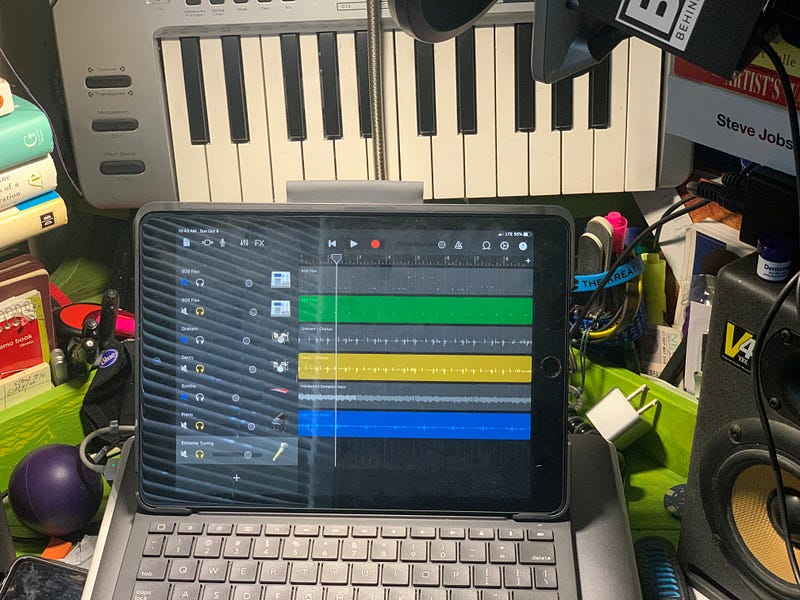
When I was married, living in Brentwood, New York, I’d retreat into a converted two-car garage on the weekends to experiment with Garageband with my kids huddled around the computer as they’d take turns recording/playing back their voices. Garageband is a FREE entry-level, but powerful DAW, that can be used on your iPhone, iPad, and MacBook.
I found a Caribbean restaurant in Stamford Connecticut on a dead-end street, where I’d bang out the beats and write out stories during lunch in a seat next to the window.
4. How to select the correct microphone.
“You either walk inside your story and own it, or you stand outside your story and hustle for your worthiness.” — Brene Brown
You can spend a lot of time and money obsessing over microphones and I did. Guitar Center, Sam Ash, and Facebook Marketplace are great resources for finding used equipment. I started recording a portion of one of my favorite track (Mystery To Me) laying on my back in my studio using a Blue Mikey connected to my iPhone. The next morning I finished the track using my Blue Yeti, the Yeti was more expensive, but I preferred the sound of the cheap Mikey.
You can have the best microphone, video equipment, and DAW, but if your content is trash it doesn’t matter.
Here’s a free tip your first drafts are going to suck.
It was liberating watching Gary Vee during the early episodes of Wine Library, with the poor lighting and seeing him, practicing what he’s still preaching today: document, don’t create.

5. How to find ideas on the go.
“Ideas come from everywhere-they come from what you see and hear and imagine.” — Judy Blume
Keep your eyes and ears open.
Ear Hustle, people watch, take a train ride to your favorite city, pay attention to details-don’t be afraid to experiment-paint outside the lines.
Be genuinely curious, childlike, ask questions with the intent of learning and not to respond. All of these activities are free, just don’t be creepy-look and look away. I found Sam Harrison ideaSPOTTING to be an excellent resource for sparking ideas.
6. How to produce weekly curated videos.
“Cry like a baby, fight like a girl, and change the world like a woman.” — Cynt Marshall
Every business has prep work that’s done during the downtime, pizza shops make the boxes in advance, restaurants prepare utensils and refill condiments; my favorite to watch was,
Chinese restaurant workers, cut scraps of cardboard into rectangles for the base of paper-bag.
The majority of my time was spent on the actual performance, 20% was spent hammering out and mastering the track, 20% was dedicated to writing the lyrics, 5% was devoted to scouring Facebook running groups looking for images/videos, 5% spent searching running #hashtags on Instagram for images/videos and 50% was spent in the booth recording.
7. How to incorporate news events into song.
“If you’re not careful the newspapers will have your hating the people who are being oppressed and loving the people who are doing the oppressing.” — Malcolm X
They’re common ingredients that run through rap music, misogyny, sex, drugs, violence, and luxury brands.
Knowing my audience, I knew that the recipe wouldn’t work with what I was trying to create. When I started this weekly writing project, the challenge was to see just how many songs I could create that incorporated running. Slowly, I started sprinkling current events in the lyrics and visual effect, I think it added a distinct flavor.
8. How to discover my voice.
“It is only by going through a volume of work that you will close that gap, and your work will be as good as your ambitions.” — Ira Glass
“Tryin to find my voice
through the pen!
No idea where I’m going!
Roaming round in my head.
In my head no map or chaperone.
Wandering around alone.”
On October 21, 2015, I wrote those words in the notes section on my iPhone and would later perform a cover of Mobb Deep’s Shook Ones. The exercise wasn’t futile, it helped me discover my voice. Artists, writers, rappers, and fashion designers start off imitating their heroes, and at some point they branch off and discover their voice.
9. How to advocate on behalf of marginalized groups.
“Fight for the things that you care about, but do it in a way that will lead others to join you.” — Ruth Bader Ginsburg
My mother struggled with her weight all her life — she was fat.
In retrospect, she accepted that she was overweight and never tried to manage her weight.
Mummy invested in girdles to keep things from jiggling, but she was my mother and I loved her. I noticed how people treated overweight people in public, they were the butt of jokes. A teacher once called my mother Casper The Friendly Ghost in front of the class, because he never saw her. The entire class exploded in laughter. At that point, I wished I was a ghost, in this way no one would see the tears creeping down my face with micro-expressions flashing between shame anger, and pain like railroad crossing lights.
Growing up I was a slim kid, who dressed funny.
I never spent a lot of time in the mirror. And why would I? I didn’t like the reflection that was staring back at me.
As my exterior features changed, my confidence and self-estimation increased. I noticed people started treating me differently, which made me suspicious because… I was the same person.
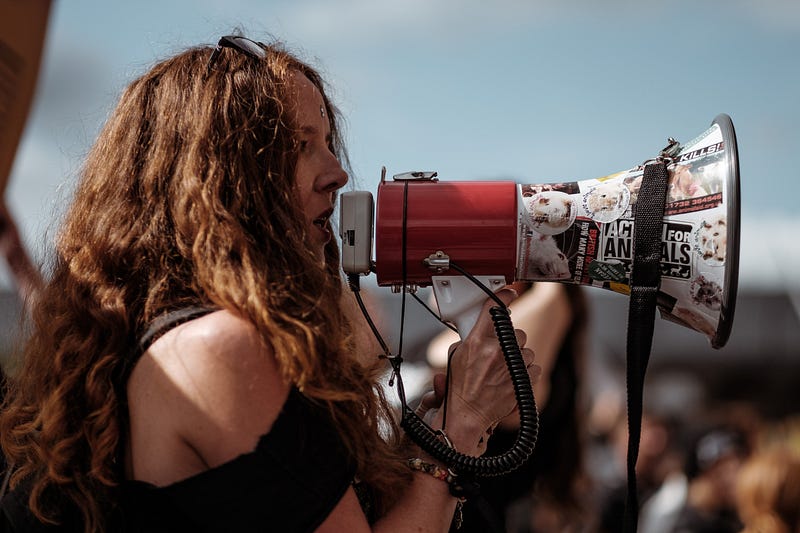
At an early age, I had a sense of right and wrong. I hated bullies and would speak out against injustice. Flash forward to when I started creating content for the running and endurance communities, I noticed marginalized groups were ridiculed and there was a lack of representation in the marketing material. I started using my voice to speak on behalf of those who didn’t have the same platform.
10. Sticking to a schedule.
“Much of the stress that people feel doesn’t come from having too much to do. It comes from not finishing what they’ve started.” — David Allen
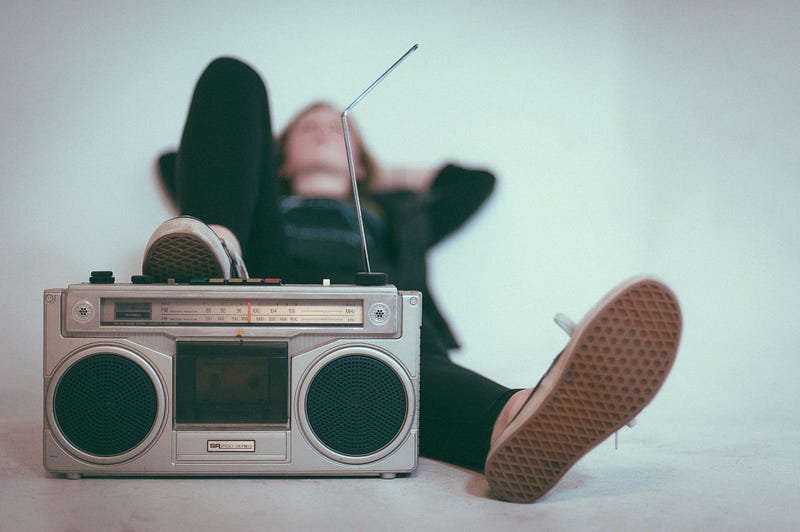
Medal Monday is a popular hashtag on Instagram and Facebook among marathoners and triathletes. After training all week, some athletes put their training to the test racing on the weekend. There’s a group that races for the camaraderie and health benefits. My goal was to post a video on Monday’s to coincide with this weekly ritual. Having a deadline is a tremendous motivator. The creative process is messy, and you can spend time agonizing over every minute detail, but at some point, you’ve press send.
11. That adults love participation medals.
“Hypocrites get offended by the truth.” — Jess C. Scott
Millennials get a bad wrap, they’re often criticized for being lazy and entitled.
Some adults take great pleasure in taking a dump on millennials, they talk about them as if they were aliens; they seem oblivious to the fact, they were their shoes not too long ago.
I salute millennials for not hanging around a company for 30 years waiting for a gold watch. We were called super predators. Soccer Moms insisted everyone got a prize, so no one’s feelings got hurt, which gave birth to participation trophies. I was excited to receive my medal after crossing the finish line 5:25 of my first marathon. But, it was clear to me this was a participation medal.
12. That we love public recognition.
“Praise in public; criticize in private.” — Vince Lombardi
Some people like the sound of their voice, so they’ll try to dominate the conversation and impress you with how much they know. I’ve learned to embrace the sound of my voice. My early recordings were trash and I was cool with that because the focus was on recognizing the athletes who were grinding during the week to perform on the weekends.
High performing professional adults would endure a bad rap song every week to see if they were featured in the curated videos.
13. How to build an online community.
“Don’t try to be the ‘next.’ Instead, try to be the other, the changer, the new.” — Seth Godin
Be kind, it’s not a strategy, it’s a way of life.
You’ve gotta care about the people you serve.
After posting the weekly curated videos, which I later called weekly race recaps, I spent time responding to every comment. You have to care about the people you serve.
14. How to establish a topic.
“Creativity is a natural extension of our enthusiasm.” — Earl Nightingale
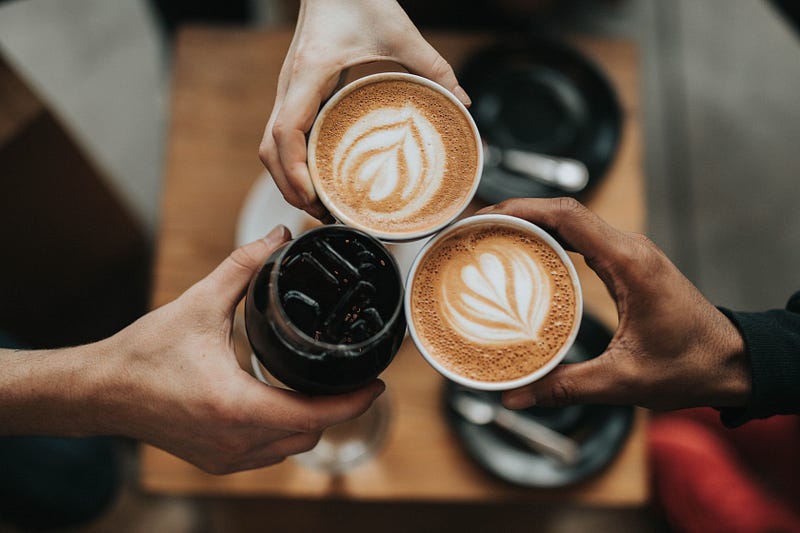
Each week I started with a blank canvas, with every passing day I started sketching out the story for the next week. A common subject that I used to entertain the community was running. So, I decided to marry the two words, running and entertainment became “RUNUTAINMENT.”
15. That skills improve with repetition.
“Practice isn’t the thing you do once you’re good. It’s the thing that makes you good.” — Malcolm Gladwell
According to Malcolm Gladwell, it takes four hundred and seventeen days or ten thousand hours of practice to become an expert or master performer in any field, that insight helped me relax and not beat myself up during the early days. With focused practice, I was making measurable progress in a reasonable time.
16. That if you enjoy doing something it doesn’t seem like work.
“If you are working on something exciting that you really care about, you don’t have to be pushed. The vision pulls.” — Steve Jobs
I hate cliches and knock-offs, but I can’t lie, if you enjoy what you’re doing it doesn’t seem like work, you can spend hours beating at your craft.
There’s a scene in Straight Out of Compton where Dr. Dre is trying to get Eazy E to say: “Crusin down the street in my six-four.” But, Eazy keeps coming in offbeat. Ice Cube and Yellow are in the studio laughing, once they leave, Dre provides additional direction and Eazy was able to nail the line. I’d spend hours in my home studio recording and re-recording lines, but it didn’t seem long at all. I’ve never been a time clock watcher, but when I did, it came with regret-wishing there was more time in the day to record.

17. How to launch a podcast (and selecting the right equipment).
“The best way to find yourself it to lose yourself in the service of others.” — Mahatma Gandhi
Tara is a sole sister from the running community who lives in Houston, Texas we’ve known each other for 5 years, but never met in person. Tara’s Uncle Eli was a marathoner, she’d share my weekly race recaps with him, Uncle Eli was the reason she started running.
When he contracted ARDS, pneumonia she asked me to dedicate a few miles for him when I ran the Vancouver Marathon-I did-It was a small ask. I ran a 5k in honor of Uncle Eli and Tara was grateful.
Around 2016, I reconnected with Gary Vaynerchuk’s content. I purchased Crush It when it first was published in 2009. But, it was during my rebellious phase before being hospitalized, losing everything, and hitting rock bottom.
When I started creating content online, I sought out voices online and Gary’s was one that resonated with me. While listening to a podcast he suggested documenting over creating, so I started documenting my morning commute to Dunkin Donuts. Tara used to tune in and started suggesting I do a podcast. When I finally purchased a proper microphone, after a year and a half of Tara’s constant nudging and she was the first person I told I was launching a podcast.
18. To build an in-home studio for rap, voiceovers, and podcasts.
“Vision is the art of seeing what is invisible to others.” — Jonathan Swift
According to Business Insider, podcasting will be a $1 billion industry by 2021. In 2007 I was Sr. Center Manager with FedEx Kinko’s, I pitched the idea of a podcast to upper management and they laughed.
But, podcasting seemed like an obvious low-cost training communication and marketing tool.
Ira Glass was blazing a trail with This American Life. Alex Bloomberg was one of the producers of the show, he’d later go on to produce Planet Money and co-found Gimlet Media which was later purchased by Spotify.
You don’t need fancy equipment to get started, AnchorFM eliminated excuses when they launched, all you needed was your cellphone and you could be on 10 platforms a few hours. AnchorFM was also acquired by Spotify.
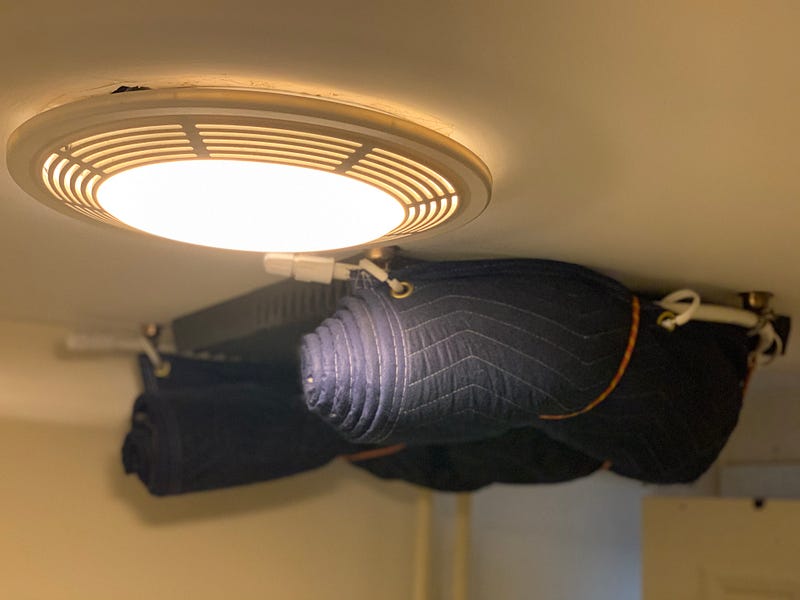
When I wanted to upgrade the quality of my songs I constructed a DIY recording booth in my bathroom, using moving blankets, I tweaked an idea I saw on YouTube. Lewin looks like a Mike Myers stunt double and knows a ton about GarageBand and beyond. I watched hours of Lewin’s videos every week.
19. That I’m not my past.
“I am not a product of my circumstances. I am a product of my decisions.” — Stephen R. Covey
52 weeks of consistently producing content I was gaining traction, which felt great.
I was starting to feel good about myself. I was connecting to my purpose, it felt as though I was making a difference in the lives of those I was coming in contact with.
Running, writing, rapping, and producing music helped me put the pieces of my life together. Running allowed me to reconnect in a meaningful with my children after the divorce and they relocated to Maryland. It was a dark period in my life; I was angry bitter and depressed. One day, out of the blue Chloe, my oldest daughter called me “I’m thinking about running a half marathon what do you think?” I think that’s amazing. She said: “if you’re available maybe you run with me” — I jumped at the invitation. Saucony sponsored our trip to Vancouver, this was our first vacation together.
In 2018 Chloe, Grace, Darius and I ran the Baltimore Half together. After the race we were taking pictures as we were walking along the boardwalk, fellow runners would stop, speak, and snap a selfie. At this point, I had been creating content consistently for 3yrs, so I knew a few people. After the 4th or 5th interruption, Darius’s friend said: “yo, who’s your dad?” That’s when I realized I wasn’t the same broken man that inflicted pain on his wife and children through his selfish actions.
20. To become a better version of myself.
“I will not lose, for even in defeat, there’s a valuable lesson learned so it evens up for me.” — Jay-Z
Running helped me write my way outta hell.
Writing skits, lyrics, podcasting, or producing music wasn’t anything, I thought of doing when I first laced up my Reebok’s and ran around a city block downtown Bridgeport Connecticut.
I faced demons out on the run and for the first time in my life, I confronted the man in the mirror and my head.
I left my parents home and got married, out of frustration and denial of my bipolar diagnosis I started running the streets. I don’t make excuses for the choices, I’m not proud of the choices I’ve made, but the lessons I’ve learned from those choices have shaped me into the man. I’ve become. I’ve asked my children for forgiveness and received it, but it took some time before I forgave myself.
Guilt and shame will try to keep you imprisoned. Running and writing has been a huge part of my mental fitness. It is my hope and mission to combat the stigma attached to mental illness.
Get access to Write Out Of Hell when it drops.