
What I Learned From Mailchimp Deleting My Account for Life
Random bans make me want to create a new type of user experience — one finally built on empathy

Last week, I was banished from my Mailchimp account that runs my email list, for life. After turning my $373 per month subscription back on to help two writers who asked to share their message to my mailing list, I received a bizarre message in morse code that made no sense.
This is what the message said:
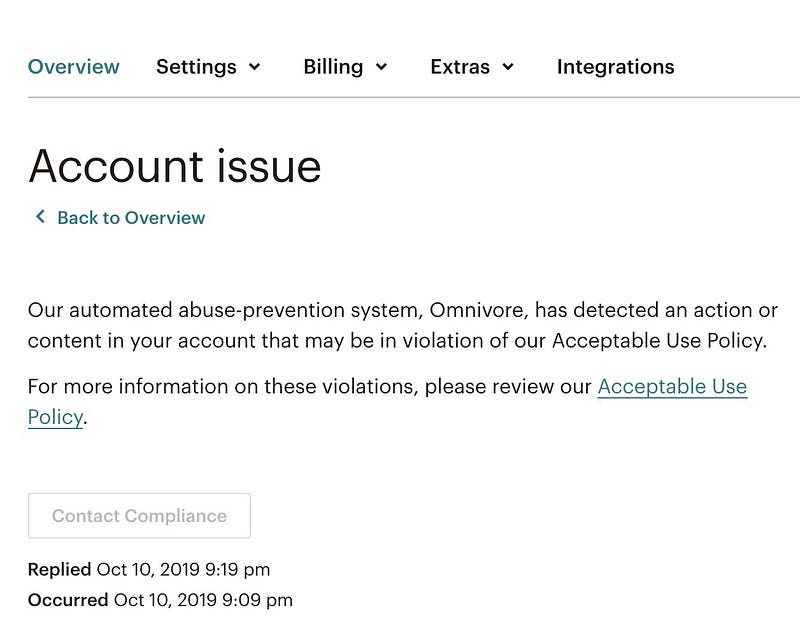
Now I realize that I’m nothing more than a rounding error for a huge company on a spreadsheet somewhere in Atlanta, but something felt wrong.
I’m still not exactly sure what went wrong when I tried to email a link to a Medium article to my email list. It caused me to be banished after being a Mailchimp member for five years without a hiccup previously.
Living in a world of rules you don’t know you’re breaking, hidden in lengthy terms of service documents that no one reads and that requires a legal background to understand, has become something that many of us have to deal with.
The purpose of this article is not to take down Mailchimp (put your pitchforks away). Plenty of companies make similar mistakes.
The real lesson from this experience is that any tech company can make this same mistake of banning a user without explanation when they don’t design their product for humans using a simple tool called empathy.
I want to start a new type of product design, customer support, and user experience. Here are the four new forms:
- Empathetic User Experience (EUX)
- Empathetic Customer Experience (ECX)
- Empathic User Interfaces (EUI)
- Empathic Customer Support (no acronym)
Basically, traditional product design forgets a keyword: empathy. If you’re designing a product for humans, empathy needs to be at the heart of the whole process. Otherwise, you end up creating something that turns customers away and forces them to seek products that are more aligned to their ingrained human needs.
These needs drive their decision to purchase, and in the case of Mailchimp, to keep their subscription. They also drive a human’s behavior to spread the magic gift of telling their friends, which generates the kind of free marketing that builds Unicorn Companies.
Empathic User Experience
When my Mailchimp account was shut down without me knowing why, I felt all kinds of emotions. Having a mailing list is something I’ve worked very hard for, and it’s taken me five years to build. (The subscription fee of $373 per month isn’t exactly loose change either.)
Out of desperation, I sent a message to customer support to find out what happened. Here was the response:
S***** (Mailchimp)
Oct 11, 9:05 AM EDT
Hi there,
Our automated abuse-prevention system, Omnivore, detected account content that violates our Acceptable Use Policy.
http://mailchimp.com/legal/acceptable_use/#section-prohibited-content
We have nothing personal against you or your business, but in order to protect all of our users and ensure the deliverability of everyone’s campaigns, we have to ask that you seek a new vendor for your email marketing needs.
For any billing related questions, please use this form to submit a request to our billing team: https://mailchimp.com/contact/
We appreciate your understanding in this matter.
A product with good user design principles that are based on empathy would include features that are built to empathetically deal with situations like this.
The design would see the potential for this to happen. It would seek to calm the human being down and assure them that the block is there to assist them. It would tell them someone will be in contact asap to explain the situation and advise if there’s a way forward.
Auto-blocking someone without the chance to investigate based on an automated tool picking up something suspicious in an email is not an empathic user experience design.
Empathetic User Interface
In the user interface of my Mailchimp account (see screenshot above), the “contact compliance” button is greyed out. The one path to helping me resolve my issue can’t be clicked.
As a user who’s banned for life, this only adds to the frustration of the situation. It’s a poorly designed user interface that lacks empathy for the human being who has parted with their money and was turned away at the front of the nightclub without knowing why.
This screen below leads you to believe there’s a way out to save the lifeblood of your business that you have worked so hard for, only to lead to a page that has a greyed out contact button that can’t be clicked.

The resolution is to design the user interface to be empathic to humans experiencing a critical meltdown with the product and make them feel like there is an easy way to work through the issue.
Empathetic Customer Support
Many users who use Mailchimp and other email list products are dependant on it to make a living.
Two writers I know from Medium both quit their jobs and write here full-time. They swear by their mailing lists as being the main tool they use to sell products and services to their audience. They couldn’t feed their children as single parents without their mailing list.
That’s not my situation, and my email list is nothing more than a recurring bad dream I’ve been procrastinating on for five years — but still, there are people who depend on them.
This is where empathic customer support makes an appearance. In my experience with Mailchimp, I felt like I was on my knees begging for my life in front of Joffrey, the king from “Game of Thrones.” What has happened to customer centricity when it comes to support in times of crisis?
I was guilty until proven innocent instead of the other way round — the empathic approach to customer support.
I attempted to contact support several times and only got one answer. The answer came after a few days had passed, and each time, there was no urgency or empathy in the response. The answer was typically, “Computer says NO!”
Customer support is run by humans, and so the way to avoid this problem is to train the people responding on how to use empathy. Empathy is not something we’re taught in school, and it’s definitely not taught in the business world either.
Putting support staff through empathy training will help businesses talk to their customers on the same level rather than talking down to them with a sword in hand, ready to chop their head off for an unknown crime.
Parting Thoughts
So, Mailchimp, if you’re reading, let’s be friends again. I miss your cute monkey ads and beautiful imagery. I missed the way you used to send out my emails with such precision while I patiently waited on the other end to see if the content I shared with readers was helpful.
We all make mistakes, including tech companies, and empathy can’t be taught until it’s practiced first.
That’s why it’s my goal to practice what I say. As a result, I have been asking myself after every article I write, “Was that piece of writing empathic towards the reader?”
The way to change User Experiences, User Interfaces, Customer Experiences, and Customer Support is to add empathy as part of the design.
Treat users like humans, be approachable as a company (especially during a crisis), offer to explain when someone breaches the terms of service and be specific, and remember that without humans, you don’t have customers. So treat them the way you’d want to be treated.
Empathy can transform technology forever and be a differentiator.


