avatarGill McCulloch

Free AI web copilot to create summaries, insights and extended knowledge, download it at here

3751

Abstract

3464"><img src="https://cdn-images-1.readmedium.com/v2/resize:fit:800/1*0PZU3Xg4sPwWgh1TN7DxKQ.jpeg"><figcaption>The author abseiling down the Whale’s Tail at Eldorado Canyon. Photo by Derek Hersey</figcaption></figure><h1 id="535e">Trust your instincts, face your fears, explore your limits</h1><p id="05b9">Allowing my inner voice to guide me, I silently acknowledged Derek’s calm confidence and climbing skills. Though we’d only known each other a few weeks, I felt confident to trust him with my life. With an encouraging smile and nod from my new mentor, I took a slow, deep breath. Holding the rope in a sweaty death-grip, I planted my feet on the rock and leaned back into thin, blue space.</p><p id="c459">As I began to walk, jump and swing my way (at times a little wildly) down the vertical rock face, the initial fear-filled, heart-pounding, adrenaline rush evaporated. In its place was a feeling of pure exhilaration and joy.</p><p id="8a26"><b>I would later recognize this day as one of the highlights of my life.</b></p><p id="9ca0">Exploring the outer edges of our limits, physically and mentally, challenges and changes us. Climbing the Whale’s Tail was one of the most exciting and memorable experiences of my life, and it gave me a whole new appreciation<b> </b>of the word ‘trust’!</p><h2 id="c342">Fast Forward Five Years</h2><p id="500d">On June 1, 1993, I was back in England at work. I picked up a newspaper in the lunchroom, and a headline about a climbing accident caught my eye. I was shocked and saddened to learn that my friend Derek had fallen to his death while attempting a solo free climb on the 7000 ft Sentinel Rock in Yosemite National Park.</p><figure id="b068"><img src="https://cdn-images-1.readmedium.com/v2/resize:fit:800/1*A6h8hko2DAiWR6iZuETv1w.jpeg"><figcaption>Photo by the author of a news story in the Daily Mail newspaper, June 1, 1993</figcaption></figure><blockquote id="dcb7"><p><a href="https://en.wikipedia.org/wiki/Derek_Hersey">Derek Hersey died on May 28, 1993</a>, in an accident while soloing the <a href="http://en.wikipedia.org/wiki/Steck-Salath%C3%A9_Route_(Sentinel_Rock)">Steck-Salathé Route</a> without protective gear, on <a href="http://en.wikipedia.org/wiki/Sentinel_Rock">Sentinel Rock</a> in <a href="http://en.wikipedia.org/wiki/Yosemite_National_Park">Yosemite National Park</a>. His body was found on a ledge 850 feet above the base of a cliff at Sentinel Rock in Yosemite Valley after apparently falling several hundred feet.</p></blockquote><blockquote id="b757"><p>In November 1991, a New York Times Magazine article described Hersey, as “one of the world’s great extreme free-solo climbers.” Hersey’s efforts to push the limits of his sport earned him the nickname “Dr. Death” He was featured in Climbing Magazine and posthumously in the film Front Range Freaks.</p></blockquote><p id="d8ea"><a href="https://www.nytimes.com/1993/06/02/obituaries/derek-hersey-climber-dies-at-39-in-cliff-fall.html">In a 1991 interview</a>, he said that what attracted him to free-solo climbing was not metaphysics but poverty:</p><p id="3b58" type="7">“I was about 13 years old, and I had no money for equipment, so while other kids were out playing cricket or whatever, I just went by myself and began scrambling over the limestone.”</p><figure id="c5a5"><img src="https://cdn-images-1.readmedium.com/v2/resize:fit:800/1*VbikJWUDtvDg46nhHZaRHA.jpeg"><figcaption>Photo from Wikimedia Commons: Downhill Racer, Froggatt Edge — geograph.org.uk — 1156915.jpg</figcaption></figure><p id="c547">Learning about Derek’s death was one of the saddest moments of my life. After reading the news article, I sat in shock with tears streaming, grieving for this fearless, fun-loving, generous soul. I had kn

Options

own that my friend was a talented climber, but now I discovered Derek was one of the world’s most renowned solo free climbers, a fact he had omitted to tell me during the time we’d worked together.</p><p id="a543">When you share a profound experience with someone, it touches your soul. If that person dies, you feel like you’ve lost a small piece of yourself, and the grief runs deep. Derek was a true free spirit, one of the toughest, funniest, craziest people I’ve ever met, and I feel honoured to have known him. Here are some things he taught me:</p><h2 id="f947">1. Keep focused on your dream life</h2><p id="b608">Derek was one of those rare individuals who lived his dream. He arranged his schedule around his passion for climbing and enjoyed every experience to the max. He would’ve heartily agreed with Robin Williams, who famously encouraged us all to “Seize the day.”</p><p id="8488">Life is short. Why not try to design your life around your dreams and spend time doing the things that make you feel alive? Do you have a goal? If not, set one and then do something about it. You only get one life, and it may not be as long as you think. Go out there, make your mark in the world and live.</p><figure id="b642"><img src="https://cdn-images-1.readmedium.com/v2/resize:fit:800/1*leU8ciXzIMaVeah_IYXNRw.jpeg"><figcaption>Photo by <a href="https://unsplash.com/@ianstauffer?utm_source=unsplash&amp;utm_medium=referral&amp;utm_content=creditCopyText">Ian Stauffer</a> on <a href="https://unsplash.com/collections/9297617/climbing/f25070c1785efa4c8d94d03982751282?utm_source=unsplash&amp;utm_medium=referral&amp;utm_content=creditCopyText">Unsplash</a></figcaption></figure><h2 id="ed3c">2. Be a mentor to someone.</h2><p id="a98d">A talented athlete with a generous spirit devoted a day of his life to give me a glimpse into the world of climbing. We all have at least one skill, some experience or knowledge to share that might benefit someone else. Think about the teachers and mentors you’ve had in your life. How have they inspired you or perhaps even altered the course of your life? Maybe you could be this person for someone.</p><h2 id="7057">3. Put your goals out there and see what unfolds</h2><p id="c936">If there’s something you want to experience or achieve in your life, make it known to the people around you. There is someone out there who can help you make it happen. Ask for advice and anything else you need; you have nothing to lose and everything to gain. Once we become clear about our goals, invisible cogs begin to turn, and the universe starts to assist.</p><p id="cba0">Keep focused on your dream life and, along the way, share your talents with others.</p><p id="8c3f"><b><i>I dedicate this to Derek Hersey, my friend for a season, my inspiration for a lifetime. RIP.</i></b></p><p id="a600"><a href="https://bit.ly/2QvV6eB">Derek Hersey on TV show Hard Copy</a></p><p id="fbd0">Please <a href="https://gill-mcculloch.medium.com/subscribe">subscribe here</a> if you’d like to get an email when I publish. You can find my full story index <a href="https://readmedium.com/gill-mcculloch-story-index-a4d6bdad2219">here.</a></p><div id="b507" class="link-block"> <a href="https://readmedium.com/gill-mcculloch-story-index-a4d6bdad2219"> <div> <div> <h2>Gill McCulloch — Story Index</h2> <div><h3>undefined</h3></div> <div><p>undefined</p></div> </div> <div> <div style="background-image: url(https://miro.readmedium.com/v2/resize:fit:320/1*-gaHET701jNyHJhsbOORew.jpeg)"></div> </div> </div> </a> </div></article></body>

LIFE

What I Learned From “Doctor Death”

How a skilled, humble friend taught me the value of being a mentor and why we all need to follow our passions
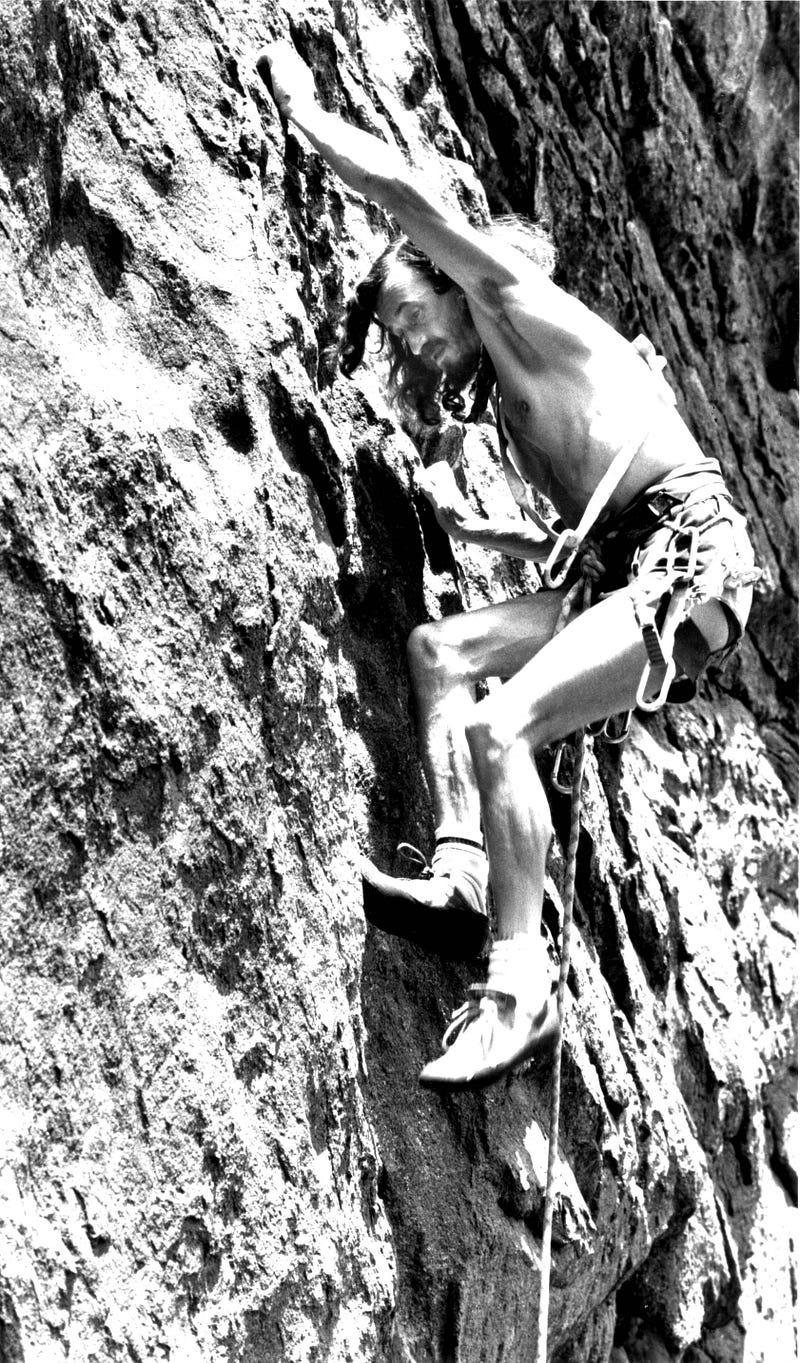
Master soloist Derek Hersey starts “The Bulge” in Eldorado Canyon, Colorado. Photo by Pat Ament.

As I stepped over the edge and into space, I knew I’d remember this moment forever.

We meet many people on our journey through life. Some we forget quickly; others remain with us for a while. And then there are those rare, exceptional souls who have a profound impact and help us to see life through a different lens.

For me, Derek Hersey was one of those people.

In the summer of 1988, at age 23, I spent three months working my way around the USA on a student visa. I travelled through 15 states and by the time I stepped off the Greyhound bus in Boulder, Colorado, I was running out of money. I checked into a hostel, found a job at Murray’s Delicatessen and worked there for six weeks to fund the rest of my trip.

One of my co-workers was a guy called Derek. Over several weeks working together in the kitchen making pizzas, I discovered that Derek had a passion for climbing. He especially enjoyed solo free climbing, where you climb alone without ropes or safety equipment.

Derek designed his life around his hobby. He didn’t have a steady job; he just worked in coffee bars, pubs and restaurants to earn enough money to pay for his next climbing trip and then off he’d go. He lived his life on the edge of rocks and poverty.

One day, after being thoroughly entertained by one of Derek’s crazy stories, I mentioned that I’d never been rock climbing before, and I’d love to try it sometime. He immediately offered to take me to his favourite climbing spot, Eldorado Canyon, a few miles outside of the city of Boulder.

Climbing at Eldorado Canyon

The next weekend Derek, myself and a couple of other friends headed out to the canyon, which Derek fondly referred to as his “office.” It was a beautiful day with blue skies and sparkling sunshine, and I was excited about doing my first climb.
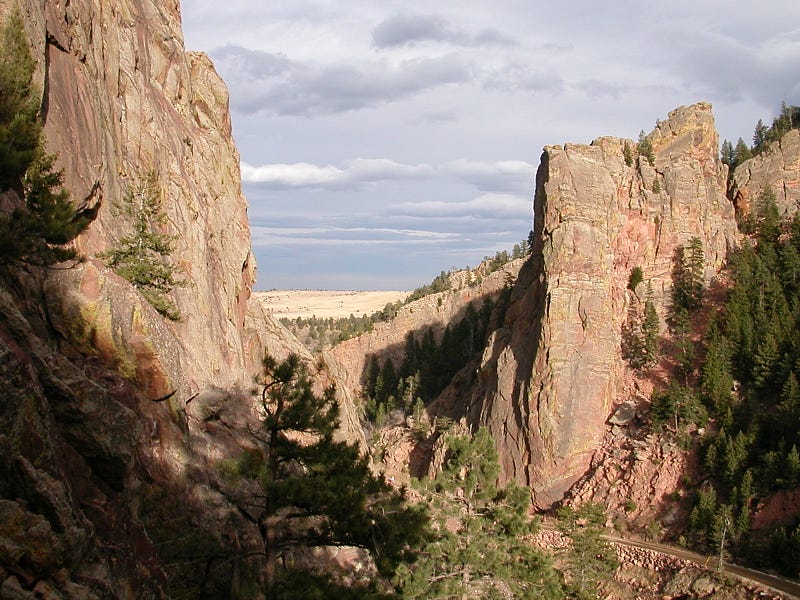
Eldorado Canyon. Photo by OMCV — Own work, Public Domain, https://bit.ly/357bS8O

The four of us climbed a rock called the Whale’s Tail. Derek went up first, and it was like watching Spiderman zipping gracefully up the side of a building. When he reached the top, he quickly secured the ropes, called out instructions and skillfully guided us up the rock.

There were moments during the climb when I couldn’t see how it was possible to continue upwards as there appeared to be no hand or footholds within my reach. Somehow though, straining muscles I didn’t know I had, and with coaching from Derek, I made it up.

The four of us stood at the top for a few minutes basking in the warm sunshine, admiring the magnificent view over the canyon and feeling rather proud of ourselves.

And then it was time to abseil back down.

Abseiling is where you descend a near-vertical surface using a rope that is coiled around your body and fixed at a point above you. Having never abseiled before, I was terrified!
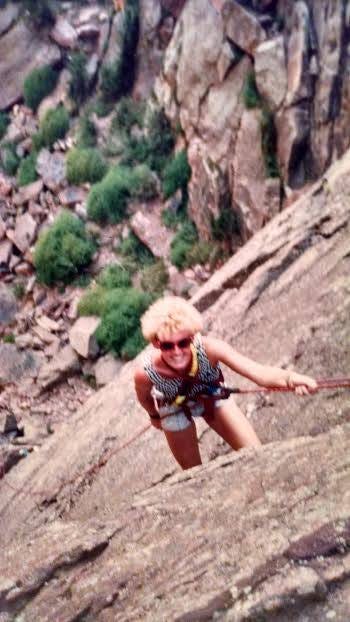
The author abseiling down the Whale’s Tail at Eldorado Canyon. Photo by Derek Hersey

Trust your instincts, face your fears, explore your limits

Allowing my inner voice to guide me, I silently acknowledged Derek’s calm confidence and climbing skills. Though we’d only known each other a few weeks, I felt confident to trust him with my life. With an encouraging smile and nod from my new mentor, I took a slow, deep breath. Holding the rope in a sweaty death-grip, I planted my feet on the rock and leaned back into thin, blue space.

As I began to walk, jump and swing my way (at times a little wildly) down the vertical rock face, the initial fear-filled, heart-pounding, adrenaline rush evaporated. In its place was a feeling of pure exhilaration and joy.

I would later recognize this day as one of the highlights of my life.

Exploring the outer edges of our limits, physically and mentally, challenges and changes us. Climbing the Whale’s Tail was one of the most exciting and memorable experiences of my life, and it gave me a whole new appreciation of the word ‘trust’!

Fast Forward Five Years

On June 1, 1993, I was back in England at work. I picked up a newspaper in the lunchroom, and a headline about a climbing accident caught my eye. I was shocked and saddened to learn that my friend Derek had fallen to his death while attempting a solo free climb on the 7000 ft Sentinel Rock in Yosemite National Park.
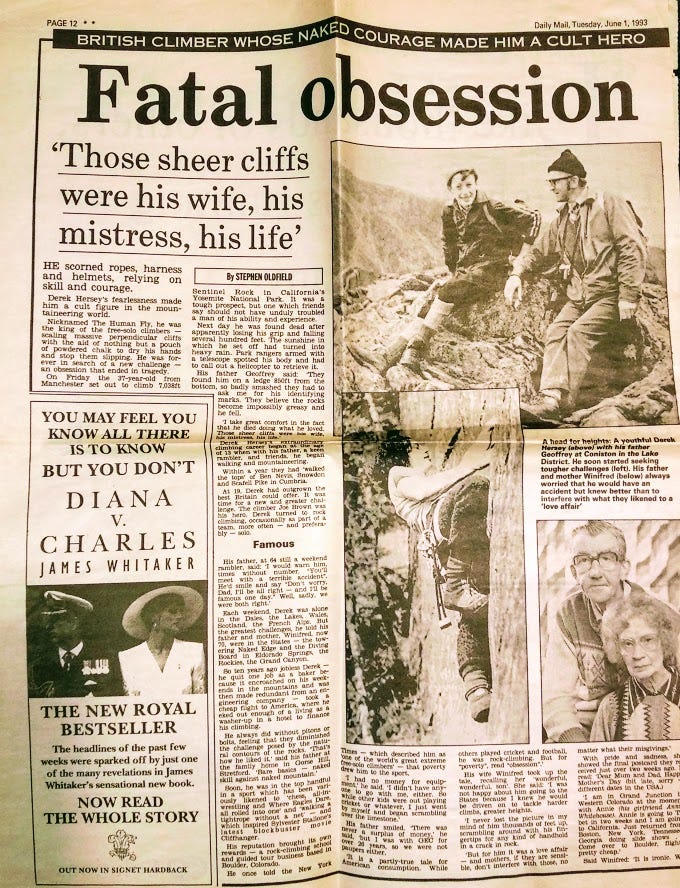
Photo by the author of a news story in the Daily Mail newspaper, June 1, 1993

Derek Hersey died on May 28, 1993, in an accident while soloing the Steck-Salathé Route without protective gear, on Sentinel Rock in Yosemite National Park. His body was found on a ledge 850 feet above the base of a cliff at Sentinel Rock in Yosemite Valley after apparently falling several hundred feet.

In November 1991, a New York Times Magazine article described Hersey, as “one of the world’s great extreme free-solo climbers.” Hersey’s efforts to push the limits of his sport earned him the nickname “Dr. Death” He was featured in Climbing Magazine and posthumously in the film Front Range Freaks.

In a 1991 interview, he said that what attracted him to free-solo climbing was not metaphysics but poverty:

“I was about 13 years old, and I had no money for equipment, so while other kids were out playing cricket or whatever, I just went by myself and began scrambling over the limestone.”
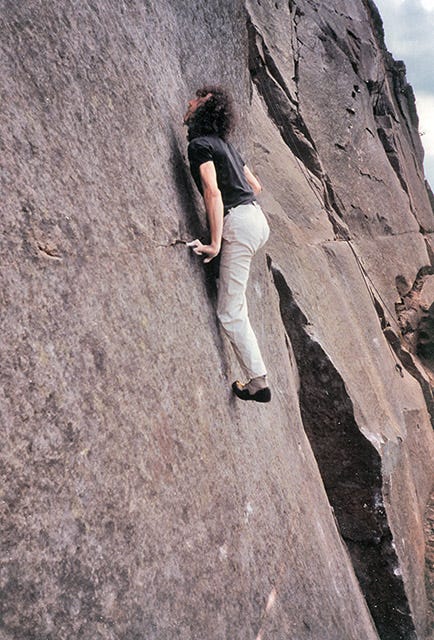
Photo from Wikimedia Commons: Downhill Racer, Froggatt Edge — geograph.org.uk — 1156915.jpg

Learning about Derek’s death was one of the saddest moments of my life. After reading the news article, I sat in shock with tears streaming, grieving for this fearless, fun-loving, generous soul. I had known that my friend was a talented climber, but now I discovered Derek was one of the world’s most renowned solo free climbers, a fact he had omitted to tell me during the time we’d worked together.

When you share a profound experience with someone, it touches your soul. If that person dies, you feel like you’ve lost a small piece of yourself, and the grief runs deep. Derek was a true free spirit, one of the toughest, funniest, craziest people I’ve ever met, and I feel honoured to have known him. Here are some things he taught me:

1. Keep focused on your dream life

Derek was one of those rare individuals who lived his dream. He arranged his schedule around his passion for climbing and enjoyed every experience to the max. He would’ve heartily agreed with Robin Williams, who famously encouraged us all to “Seize the day.”

Life is short. Why not try to design your life around your dreams and spend time doing the things that make you feel alive? Do you have a goal? If not, set one and then do something about it. You only get one life, and it may not be as long as you think. Go out there, make your mark in the world and live.
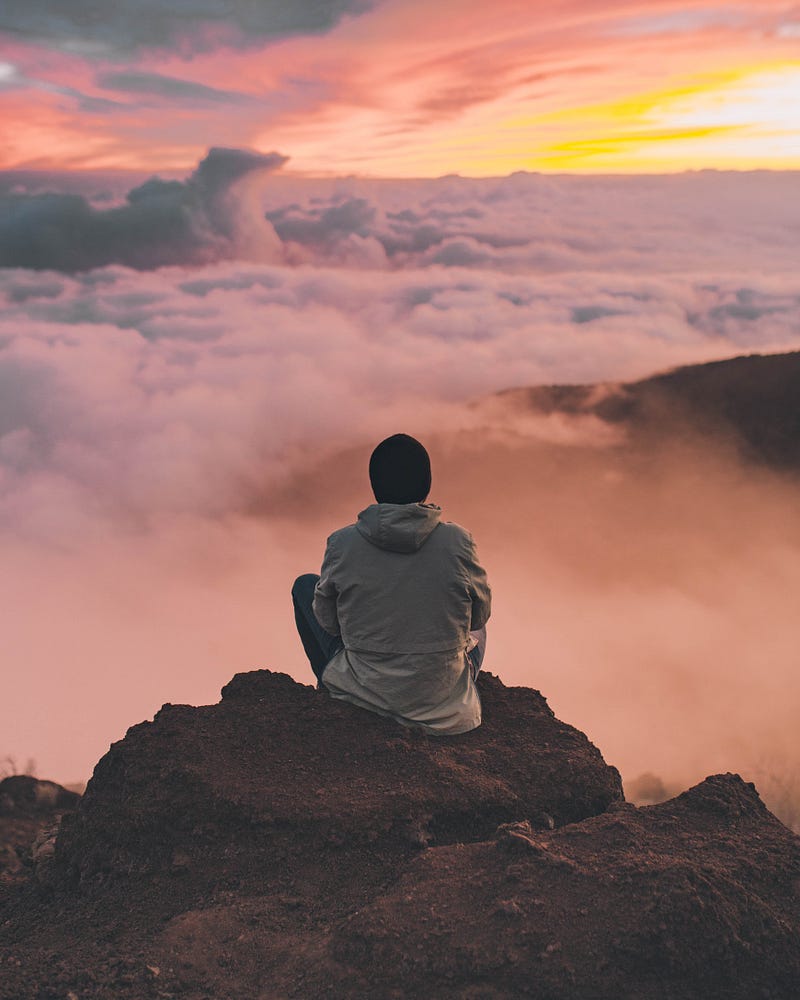
Photo by Ian Stauffer on Unsplash

2. Be a mentor to someone.

A talented athlete with a generous spirit devoted a day of his life to give me a glimpse into the world of climbing. We all have at least one skill, some experience or knowledge to share that might benefit someone else. Think about the teachers and mentors you’ve had in your life. How have they inspired you or perhaps even altered the course of your life? Maybe you could be this person for someone.

3. Put your goals out there and see what unfolds

If there’s something you want to experience or achieve in your life, make it known to the people around you. There is someone out there who can help you make it happen. Ask for advice and anything else you need; you have nothing to lose and everything to gain. Once we become clear about our goals, invisible cogs begin to turn, and the universe starts to assist.

Keep focused on your dream life and, along the way, share your talents with others.

I dedicate this to Derek Hersey, my friend for a season, my inspiration for a lifetime. RIP.

Derek Hersey on TV show Hard Copy

Please subscribe here if you’d like to get an email when I publish. You can find my full story index here.

Climbing
Passion
Goals
Life Lessons
Mentorship
Recommended from ReadMedium