
What I Learned From 100 Hours of Live Streaming
Being live on camera for 100 hours is something I would do again, even though I didn’t earn a cent
I’ll never forget the burning sensation.
My mouth was burning uncontrollably, and I wasn’t sure if I could drink the water. I felt like I had made a terrible mistake on my first trip to Mexico, all from taking a bite of habanero paste that I mistook for tomatillo salsa.
The tortilla chips were thick and had a flavor best described as cardboard, but I was starving. So, I eagerly took a giant scoop of the diced salsa and started chewing the leathery corn chip.
My mouth exploded like never before. The burn didn’t stop for over 30 minutes, and I had trouble feeling my lips for the rest of the afternoon. My mouth never really recovered, and now I love spicy food.
Let’s just say that when I try things, I like to try them all the way, and that’s the same approach I took to live streaming.
I started my live stream at the end of October by going live eight hours a day every weekday, so I streamed over 100 hours live in my very first month.
Along the way, I learned some important lessons about personal branding and how to succeed with video content online.
Why I Started Streaming
With the advent of Twitch, YouTube Live, Instagram Live, Facebook Live, and many other platforms catering to live streamers, we’ve seen streaming move from being an obscure niche for eSports into an important marketing channel for many individuals and brands.
As a writer and web developer, would streaming help my brand? My friend Brad Garropy has seen success with his Twitch stream about programming, and he had encouraged me to try it out, but I was hesitant.
As a technical writer about JavaScript and web development, I’ve received over one million views on my articles (now close to two million views) and earned over $6,000 from my blog, as I’ve discussed in Better Marketing.
After I lost my dream job due to COVID-19, I relocated to Mexico to focus on my technical writing about JavaScript while enjoying a lower cost of living. After all, $6,000 a year isn’t a lot, even for someone used to freelancing.
Once I had settled into my new apartment, streaming seemed to be the next logical step for self-promotion, since I’d been wanting to record YouTube videos for my JavaScript tutorial articles since day one.
What got me to actually go live was when one of my students in the online web development boot camp that I teach mentioned looking for videos.
Since I’d gotten comfortable teaching virtually using my webcam, I decided to start streaming my entire workday as a writer, with some additional segments for course commentary and online games that teach programming.
Twitch offers Programming Live Streams, so I decided to jump in the deep end. Ultimately, in my first month of streaming, I streamed well over 100 hours, and I produced seven tutorial videos while live on the stream.
Here’s what I’ve learned in my stint as a full-time streamer.
Preparation Is Key
We take for granted that when we tune into a professionally produced television show, we’ll see flashy graphics and professional touches.
When I started streaming, I had nothing but a blank template, and I had to prepare everything myself:
- The show’s concept
- The show’s branding
- The show’s schedule
- The show’s soundtrack
- The show’s social media
Since I live in a beautiful tropical climate with a view of the beach, I wanted to offer up a relaxing show about programming, which I called Chillhop & Code.
After making my logo and getting authorized to use Chillhop Music as my background music, I still had a lot to learn about the XSplit Broadcaster software I would be using. Another popular software for streamers is called Open Broadcasting Studio, but XSplit seemed a bit easier to use.
I chose to use both my Logitech webcam and my Android phone as a second camera with the help of a great app called Droidcam. That meant that I had to build out an entire professional set of scenes in XSplit for my live stream that would cover my two-camera set up in different configurations.
Plus, I had to research and buy a microphone on top of reading and learning about how to stream on Twitch.
Then, once I actually started going live, I had to figure out how to move my content from Twitch to YouTube, while extracting a one-hour-long segment as a separate video. Suddenly, I was working many extra hours as my own video producer and brand guru, on top of streaming eight hours every weekday.
All in all, preparation is key — the more you have everything prepared and know how to do everything you need to, the better your stream will go.
I would have felt less stressed by the process of launching my stream if I had started with a few hours a week, but I knew I wouldn’t take the plunge without a big commitment.
Lighting Is Everything
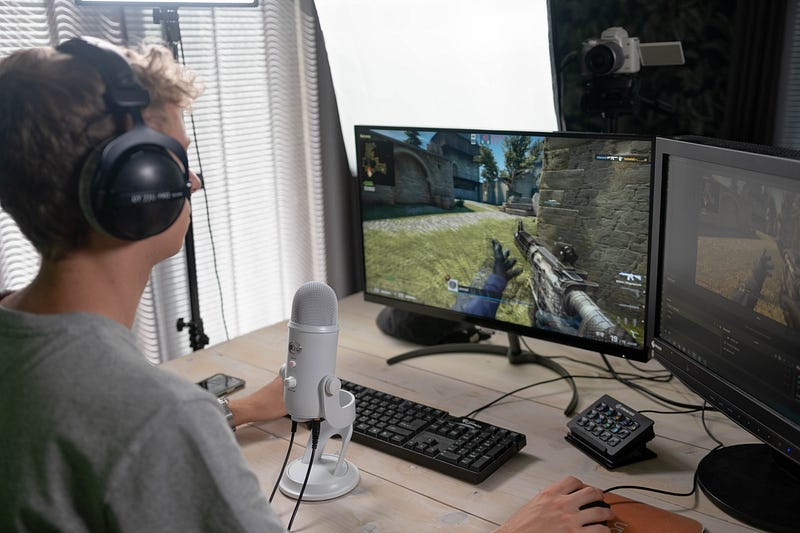
The first thing I learned when trying to set up my stream is that lighting really is that important, especially if you have back-lighting. While you would think that a year’s worth of Zoom meetings would have taught me something about using my webcam, I forgot that I was in a brand-new locale.
With my beautiful view out the window, I was basically invisible on camera my first day. I used Amazon Prime to order up some lighting, and I ended up needing even more lighting units.
When you’re streaming, it’s easy to overlook how you actually look on camera in terms of picture quality. What I can say is that lighting and a nice camera (like the one built-in to your cellphone) make a big difference compared to a basic webcam with no additional illumination.
At times, it can be a little fatiguing to be working on a computer surrounded by lighting equipment and a microphone on a boom arm. It’s definitely an experience, so I take lots of breaks and stay hydrated.
I actually don’t mind having the lights on, though, because I get tons of bright, blue light during my workday, and then I shut them off when I finish streaming.
Since my goal with going live has always been to post videos to YouTube that would support my blog, I am glad I learned about lighting the hard way. With a stream, it’s never going to be perfect, because it’s a live show. I’ve just kept showing up every day and going live, and I keep learning more.
The Numbers Won’t Be Great (and That’s OK!)
For the Programming niche on Twitch that I mentioned, the top daytime stream at any given time only has about 100 viewers, with about a dozen other streams averaging ten or more viewers.
You can imagine that your smaller personal brand or niche might not get very many viewers at all the first time you go live, especially if you do so spur of the moment instead of as a regularly scheduled program.
As with most things online, the title is everything — looking at the programming streams as I write this, “Building an OnlyFans Competitor” and “Open Source Python Programming” is more popular than “Lurkzone” and “Java.”
However, even with a catchy title, streaming is naturally going to attract order-of-magnitude fewer views than on-demand video content — and that’s OK!
With streaming, viewer engagement is much higher. The magic of live streaming is being able to chat with your audience in real-time.
However, watching other people chatting on a live stream doesn’t make for great evergreen content. Be aware that unedited live streams are not going to do great on YouTube and other platforms, even if you take the time to spruce them up with a custom thumbnail. Viewers on YouTube tend to be looking for short, punchy, well-edited, professionally-produced videos.
Again, I like to think about my streaming as a separate way of reaching my audience, one that trades breadth (my viewership reach) with depth (how deeply I can connect with any individual viewer.)
In a sense, it’s like when I write a beginner’s guide for all programmers, compared to sharing my personal experiences in PT school.
The beginner’s guide is super useful, great content that is going to net me more views and earnings. But I’ve had many physical therapists reach out to me to share their experiences after reading the other article, especially PTs considering a career change to tech. It’s a deeper connection.
Should You Stream?
Do I think everyone needs to live stream? No. In fact, I think most people, even developers like myself, should skip streaming for self-promotion.
Since we all have a limited amount of time available for marketing and promotion, not to mention budget constraints, the pay-off is going to be better when you create evergreen content online that provides lasting value. Old episodes of your live stream just won’t hold up as well as edited content.
Instead, focus on where you can best build your personal brand, whether it’s your blog, LinkedIn, Facebook, YouTube, Medium, or another platform. That’s the approach I would recommend for individuals and content creators — unless your content needs to be live (gamers), then consider other avenues.
If you’re like me, then streaming could be what gets you creating the video content that you’ve always wanted to try to make. Having your own live stream will teach you a ton about video production and being on camera.
However, if you’re already comfortable recording a video, editing it, and sharing that content, then maybe think again. A one-time live streaming event is going to have less lifetime value than just skipping straight ahead to a professional video posted to YouTube, Instagram, Facebook, or LinkedIn.
For me, streaming was a wonderful means to an end that has got me to try out different content live and actually create video content for YouTube.
For marketers, live streaming can be a fantastic tool in your toolbox in order to truly connect with your top customers. After all, our most loyal fans are usually the ones who make the most difference for the bottom line.
As they say, “video rules engagement” — but you also need to remember that live streaming in order to build an audience is a commitment that comes with a regular schedule. In that sense, it’s the same as starting a podcast, and I think we’ve all listened to podcasts that just disappeared one day.
Wrapping Up
It’s been a whirlwind to be live, on camera, in front of the lights, talking into a microphone for over 100 hours during the last month.
As you can guess, streaming didn’t earn me anything. I don’t qualify for Twitch’s Affiliate program where I could offer paid subscriptions to my live stream. That’s because I’ve never maintained an average of three viewers while live, the minimum necessary to become a Twitch Affiliate.
More than anything else, streaming has made me comfortable on camera. Last year, I did some background acting on a Showtime show called The Good Lord Bird. I was on set for 11 days of shooting, and I was on camera nearly every day — not a common experience for first-time TV extras.
In that world of TV production (pre-COVID-19), I became comfortable on set and filming, but it really isn’t the same as streaming by myself, alone in a room. Now, I feel super comfortable creating professional video content and posting it online. That makes 100 hours of streaming worth it.
Will I keep going? For now, I’m tweaking the format of the show to prioritize my blogging, and I’ve been learning a ton of great stuff along the way. I love interacting with viewers, and I often get to answer great questions on the show. Those are the parts that I love about streaming.
If I kept up with full time, I’d be really curious to see how fast my viewership would grow, and how my video content does on YouTube. After 2 months, my top video had 100 views. For 100 hours of streaming, that’s about one YouTube view per hour of streaming. I’m doing better than that on Twitch, as I got about 250 views in my first 100 hours of being live.
Since I enjoyed streaming and meeting my goal of making YouTube videos for my JavaScript tutorials, I’ll consider streaming on Twitch again in the future. However, my experience was that live streaming a type of volunteer work for my personal brand — with few results in terms of generating traffic to my blog.
All streams have a hard time getting subscribers and followers along the way to building a regular viewership, and educational content is particularly difficult. In the future, I’d consider making YouTube videos with great editing instead of live streaming.
Live streaming seems ready-built to promote awesome video content, instead of the other way around. Tangerine Travels is an excellent example of a brand that uses live streaming to support a YouTube channel, instead of the other way around. They even use a pay-per-question model where viewers buy questions for $5/each during live streams! But their audience comes from their well-edited travel videos that they publish weekly.
I think streaming is best done occasionally (on a regular schedule). Plus, the more entertaining you are — the better! Boring content does poorly.
I’ll always be glad I took the plunge by going live! It’s been a memorable experience, and I’ve learned a lot. Good luck out there!
Dr. Derek Austin is the author of Career Programming: How You Can Become a Successful 6-Figure Programmer in 6 Months, now available on Amazon.


