
What I Learned Completing a Toastmasters Track
If you want to get better, you have to put in the effort
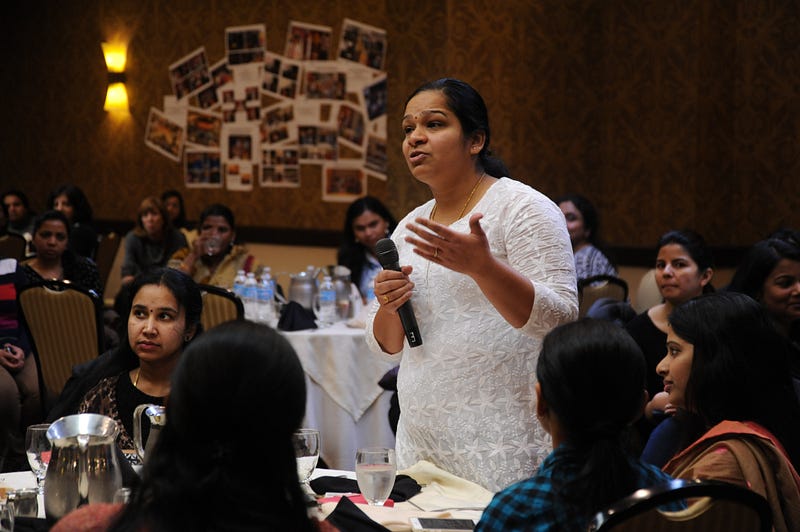
Ever wonder why Toastmasters is so renowned as a leadership development organization? Leadership is a skill, not a talent. Therefore, we all have it in us to develop leadership if we want to.
From my experience, there are three reasons leaders are made through involvement in Toastmasters. First, as a Toastmaster you will get the chance to take leadership roles in every session. Secondly, you can learn some valuable lessons through the courses that are a portion of any prepared speech assignment. And finally, after making countless speeches on themes related to these topics, one gets to know their strengths and weaknesses as a speaker, developing the ability to recognize the quality of their speaking and find inherent qualities in the speaking of others as well.
Let’s look at each of those areas in more detail, starting with opportunities to lead. Every Toastmasters session has a Toastmaster of the Day that facilitates the meeting. A Table Topics Master leads the group in a series of short talks, nominating members to speak one by one for a minute or two on a theme the Table Topics Master has chosen. There is a General Evaluator. They facilitate the feedback sessions in the second half of the event and make comments on the quality of the meeting as a whole. That is three roles in every meeting that go beyond making presentations and help to develop leadership skills.
As I made my way through the Presentation Mastery track there were many interesting courses. I learned how to balance compelling stories with decisive facts to present more persuasively. Some people like to hear the hard numbers and statistical proof that backs up our claims. Others are more easily persuaded by stories that draw connections to present experiences and recommendations while pulling out emotions. Therefore, to make a good presentation, you should include content for both audiences. Choose your preferred method of presenting and then add some spice with stories or data that support your case.
Speaking of how to present, I learned about four fundamental ways people deliver their ideas: Initiating, Supportive, Direct, and Analytical Communicative styles. I tried my hand at all of these styles when taking on more advanced assignments in my Toastmasters Presentation Mastery track.
Initiating Communicators are entertaining and speak casually. They can talk for a long time on the topics that interest them. One of my mentors would describe Initiating Communicators as a mile wide and a foot deep. I naturally used this style in the past. However, it does not lend itself to demonstrating subject matter expertise because initiators rarely delve deeply into their topics. Digging deep is what analyticals do.
Analytical Communicators rely on facts and supporting evidence that can be proven and quoted. If you want to get the attention of an Analytical Communicator, cite your sources and have your facts straight. Analytical Communicators go a mile deep and a foot wide on topics. Understanding in great-depth topics that interest them. I recently added stats about mobile security issues to a training I did for engineers. Their comprehension of the entire talk improved. It just took a simple tweak to enhance their comprehension of the entire topic for them.
Similar to Analytical Communicators, Direct Communicators like everything laid out in a straight line. From beginning to end, make sure that you’ve dotted your I’s and crossed your T’s when dealing with a direct communicator. One missed detail, and you will have a difficult time reestablishing your credibility. As you can imagine, Initiating Communicators will have trouble persuading Direct Communicators. They see the path forward in vastly different ways.
Finally, Supportive Communicators want to ensure their points are understood so those can be acted upon. The supportive communicator is likely to change their communication techniques to fit their audience. Supportive communicators are diplomatic and want to give people opportunities to interact. They think participation leads to better results. So, they are good at handling questions and adjusting on the fly to the needs of the audience.
The last thing I got better at through Toastmasters was sharpening my ability to provide quick analysis and useful feedback as a prepared speech evaluator. You’d be surprised how helpful feedback beyond ‘that was good’ goes to someone who has spent time preparing for speaking to any sized audience.
Roles like Grammarian, who is tasked with listening for the effectiveness of members’ grammar and vocabulary throughout the meeting, and the Umm Counter, who listens closely for filler choices like umm and ahh, need to listen to the day’s talks for constructions and delivery fluidity rather than content. That takes a lot of concentration.
Toward the end of my track, I got to practice leading discussions, facilitating panel topics, and handling difficult groups. While it seemed like the skills I learned were merely tools to add to my belt, I recently discovered a heightened sense of awareness of the variety of techniques and approaches to presenting that I’ve acquired, and because of that, I have become more adept at changing up my delivery on the fly to suit the needs of my audience.
That really shocked me.
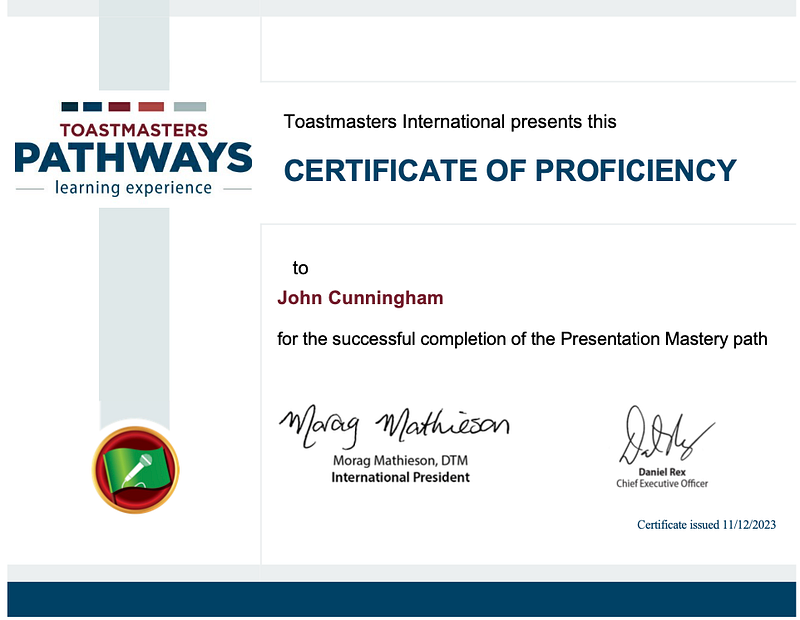
My goal in joining Toastmasters was to become an accomplished presenter worthy of delivering keynotes and motivational talks professionally. In August, I presented a talk which I originally did at Toastmasters. This talk was transformed into a workshop for a group of 60+ salespeople in Australia. Last month, I presented seven two-day seminars in India to a total of over 150 people. The work, and my ability to motivate, allowed me to visit amazing places like the Taj Mahal, and make new friends in my company’s Melbourne, Australia; Gurugram (near Delhi); and Kochi, a city in Southern India perched on the Arabian Sea. I have also had the opportunity to meet people in person whom I have collaborated with virtually, further strengthening those relationships.
As I speak more and more I have become aware of the need to become a skilled presenter. I mean, if you want to get your ideas acted on, you are going to have to present those to a wider audience; like your team, your boss, or even your boss’ boss. Understanding your audience, their needs, and their communication styles will help you, the conscious presenter, to convince your audience of the viability of your ideas. Personally, that would not have been possible without participation in my local Toastmasters club.
…
Want to check out Toastmasters? — You can find a local club here
Want coaching on being a more effective speaker? You can book a complimentary consultation with me here.
Thanks for reading.