
WOODSTOCK WAS A TRIP AT AGE 20
Sex, Drugs, Rock ‘n Roll? A friend’s haircut was the ticket….
One wild summer weekend in 1969 wouldn’t have happened if my friend Paul didn’t cut his long hair to borrow a car.
Paul was determined to go to this rock festival. His father, a ranking military officer, said he could borrow the car.
On one condition. He pointed at his son’s hair. “Get a haircut.”
Paul was likely the most determined person on the planet to hit Woodstock and party hearty. Short hair be damned.
When he asked us if we wanted to go, nobody hesitated. None of us owned a car. We sprang for gas.
That weekend’s history has blended fact and fiction There were no babies born there, for instance. Here is what I recall from more than a half century ago:
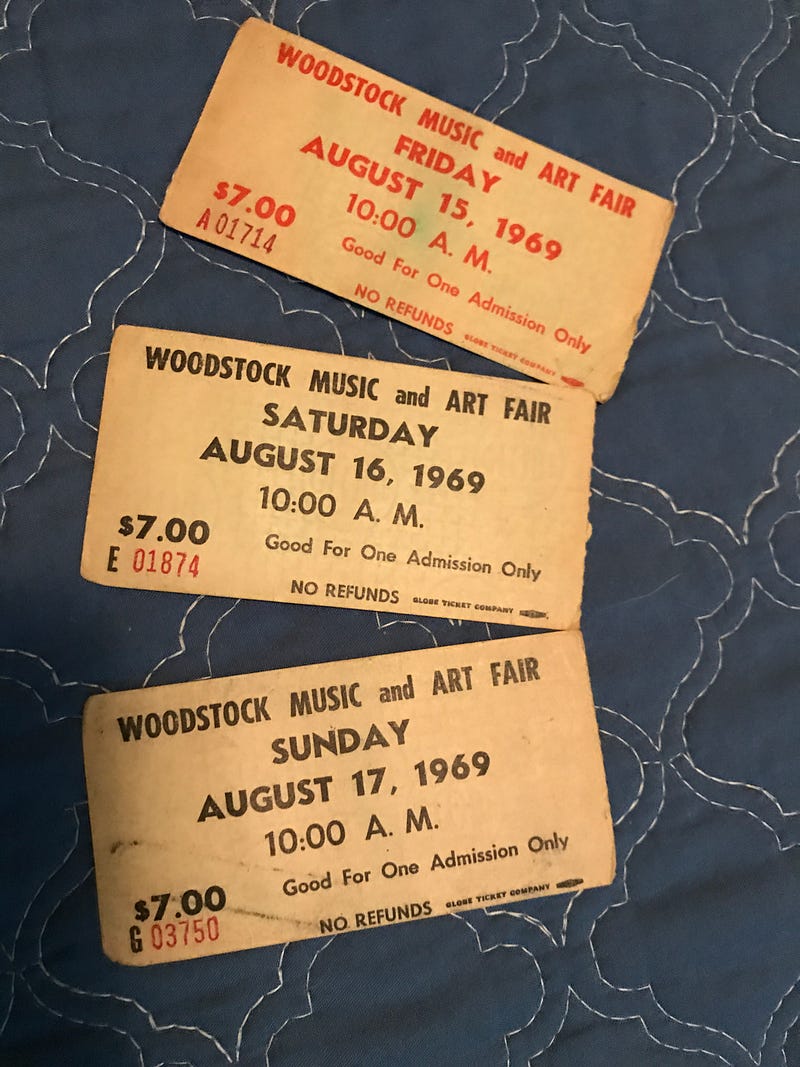
We bought Saturday and Sunday tickets, as we worked weekdays in a factory on a 450 degree rubber injection mold making Converse All Star © sneaker soles.
But already, news reports warned that crowds from Europe and California were arriving at the concert site in rural New York. We bought Friday tickets to set up camp early and called in sick Friday.
That’s why my Friday ticket is red and the others black. We managed to get an early spot in the vast array of tents, hippie vans, trucks and station wagons. (Yes that was a thing.)
Our destination was unclear as we left Boston. Turns out it was a 600 acre farm in Bethel, NY. We soaked up rock music on the Ford Torino tape deck. The Amboy Dukes were on replay.
We considered ourselves rock festival veterans, loaded up with tent, sleeping bags, food, beer, and other stuff.
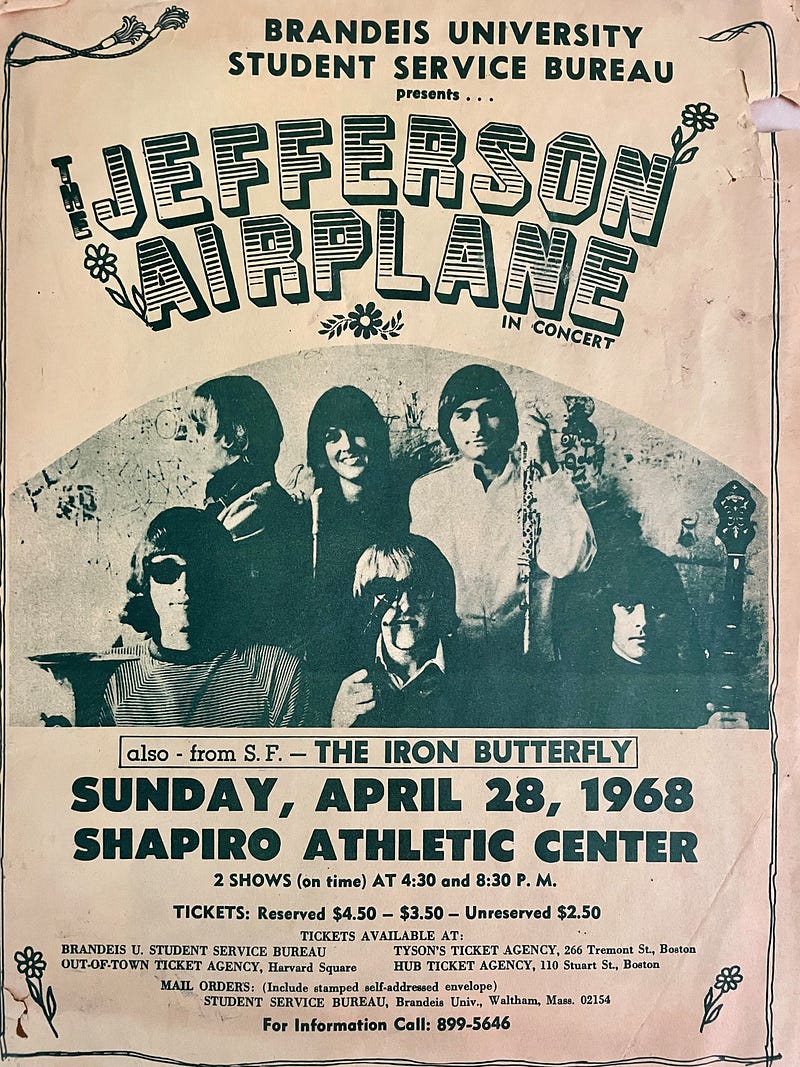
While still on the Massachusetts Turnpike, radio reports said the NY State Thruway was jammed. But Paul knew back roads near the site.
So with Thruway exits closed, we rode by farmland and fields. The radio reported Woodstock fences had been breached. It was now a free concert.
A paper map led to a long and winding side road. We rolled slowly until traffic stopped and pulled off into a field. Other tents were in the distance. I erected my old canvas Army surplus tent and rolled out my sleeping bag.
Two of us were former Boy Scouts. “Be Prepared” was the Scout motto, however nobody could imagine what awaited us.
We had been to Newport (RI) Jazz Festivals and were ready for walking, overpriced food and general craziness.
We thought we were ready. But not for this. The music fest turned into the third largest, if ad hoc city in New York State.
There were 186,000 tickets sold. At least 450,000 people showed up.
There were no ticket takers, and concert food was already gone.
Thankfully, Hank, one of our crew, had insisted we pack food with the beer. Row upon row of Porto San © outhouses were perched on an open area. A few hoses led to cubicles to for showers atop the hill above the concert site.
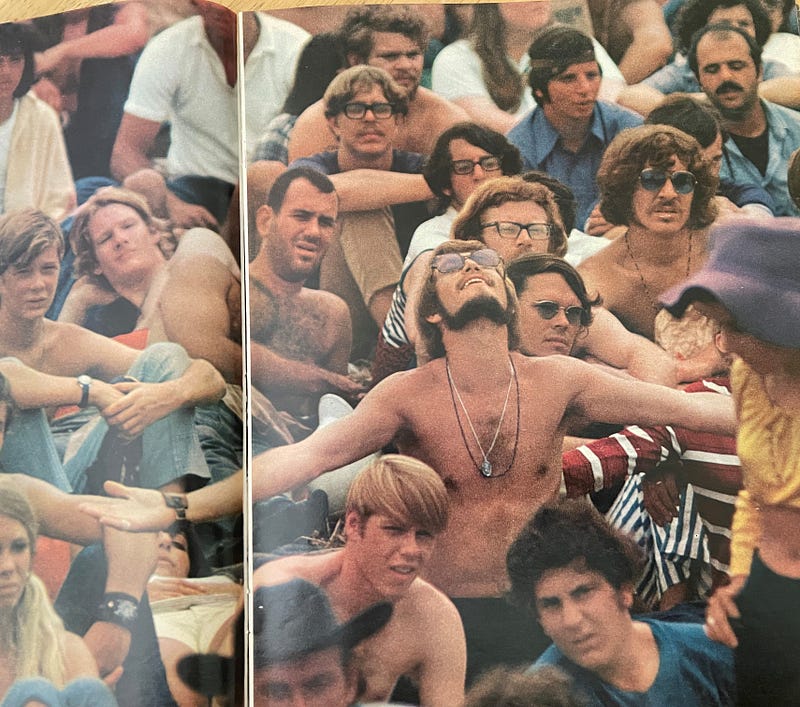
We wandered late afternoon along a two-lane rolling back road. In 1960’s parlance, this was a “freak zone” as far as the eye could see.
We followed the crowd until we heard the faint sound of music and the lines of walkers grew ever larger.
After a few miles we were closer as a loudspeaker and a distant bass filtered through trees.
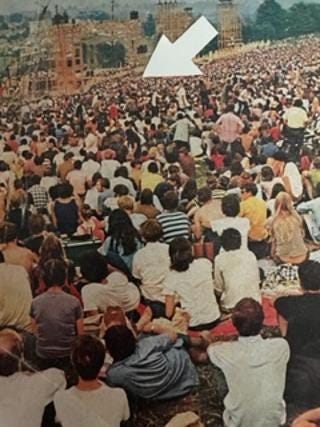
We soon stood at the edge of a massive field, a bowl spreading below us filled with rock fans passing joints, beer and wine down long rows extending past the lighted area to left and right.
It was a huge pasture owned by a farmer named Max Yasgur.
The alfalfa field had a reddish clay dirt. It stained everything, turning to mucky, smelly mud in the rain. Which happened a lot.
The scene was unlike anything we had seen, and could likely have shown up on a satellite shot from space. We all wandered in different directions, trying to take in the huge concert scene and outlying support facilities.
The tickets were in my jeans back pocket. All these years later they are stained and wrinkled.
Fifty four years later, so am I.
THERE WERE NAKED PEOPLE WALKING AROUND
We awakened groggy on Saturday morning to find cars, tents and festival goers had arrived all night and early morning.
Saturday morning I was at a spot fifty feet from the massive wall framing a giant stage. The stage was so high and I was so close I couldn’t see the band from San Francisco that nobody had ever heard of.
This band started up with a Latin beat on conga drums, then a drum cymbal, then a rhythm guitar, then Carlos Santana’s searing, hanging lead guitar chord. I had never heard of Santana, never mind “Soul Sacrifice”
A very tall long haired man in his early 20’s walked the row a few yards in front of me. He had a great tan- noticeable because the hippie guy was completely naked. Nobody seemed to notice. Except a photographer.
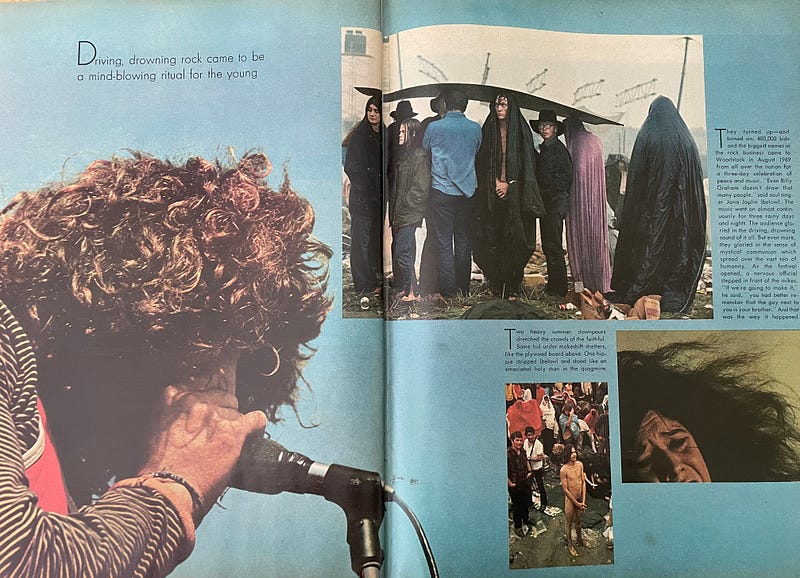
Everyone just started swaying. (The crowd, not naked hippie guy, well probably naked hippie guy, too. I don’t want to imagine that.)
I met up with one of my friends, and we walked to Philippine Pond near the Hog Farm where hippies were skinny dipping.
It was like something out of a movie to a 20 year old.
The walking was slow, incredibly long. Once started, you were likely to stay either near the stage bowl or back at your car or tent. Many people slept right in the concert bowl under plastic sheets.
Day and night an endless line of cars and people traveled the back roads.
Water and toilets were difficult to find, and residents near the jammed roadways set up water hoses for the constant flow of people. A few tiny stores were completely sold out.
In the midst of all the cars on the road we spotted the brother of one of my friends riding on the hood of a car in the middle of hundreds of people. He smiled, waved and kept going.
There were funny signs hanging on trees with arrows — “weed”, “acid”, and other forms of chemical provisions. Peace symbols abounded.
Food ran out, the National Guard was brought in, there were helicopters overhead and the hippie Hog Farm and Ken Kesey’s day-glow bus of Merry Pranksters helped feed everyone.
There were yurts and carnival tents. VW buses and converted school buses parked in fields.
If our driving partner ever made it to the bowl, I can’t recall. But we learned he was very busy with some female friends he met back at the campsite, sharing our beer and wine.
Three of us had summer jobs working in the factory Monday.
So we left Sunday and missed Jimi Hendrix.
We had no idea how big an event it was until we were driving home and listened on the radio. (The first cell phones were invented in 1983)
Woodstock was an experience where nearly everything that could have gone wrong did, but there was no violence.
People managed to get along, despite the circumstances- rain, lack of food and medical support.
There was a sense from everyone you saw, met, talked to, walked by, that this was a generational thing. It was a place where everyone loved rock music, weed and zoning out.
The average age seemed late teens up to late 20’s. All this was taking place while half a world away some friends were serving in Vietnam.
CIVIL RIGHTS; VIETNAM; NIXON; WEED; JFK, RFK, MLK DEATHS; MOON LANDING and WOODSTOCK WERE TOUCHSTONES OF THE 1960's
Looking back, after working in media for decades, fixing Woodstock into context was simple.
The Sixties were a dramatic departure from tranquil, suburban oriented TV shows reflecting society in the 1950’s - I Love Lucy, Leave it to Beaver, Father Knows Best, Gunsmoke.
The Woodstock Music and Art Fair was a major inflection point marking a decade of transition.
Social change, including the Civil Rights Act of 1964 banning segregation and discrimination by gender, race and religion was the most dramatic change.
In major sports, including the NBA, racial discrimination persisted.
Yet vast racial divides continue even today in the US.
COLOR TV CHANGED EVERYTHING IN THE SIXTIES
Any 1960’s perspective must include the impact of color TV in every home. The nation saw the bloody Vietnam War firefights and flag draped caskets of dead American soldiers.
Civil War photographer Andrew Gardner’s photos of slain soldiers on Antietam Battlefield a century before shattered the Romantic view of the conflict.
So too a century later did vivid color bring events into our living rooms, memorializing changing times.
Police clubbing black Civil Rights workers in the South; a street corner execution of a captured Viet Cong fighter by a Vietnam ally; Jackie Kennedy’s bloody pink dress after JFK’s assassination.
Woodstock never defined who I was. It was entertainment, expressive of the generation that symbolized the 1960’s. Its youth awakened to social issues, assimilated somewhat, demanded change.
OH, AND ONE MORE THING
Whenever one of us swaps tales of rock concerts, when you casually say “When I was at Woodstock…” You’ve got the floor.
Final thoughts: A few weeks after Woodstock, President Nixon began drawing down the first 25,000 troops from Vietnam. The war would finally end in 1975. A few weeks before Woodstock, US Astronaut Neil Armstrong was the first human to walk on the moon. The Beatles’ last formal paid concert was August 29 in San Francisco. Hendrix would be dead in just over a year, Jim Morrison of The Doors, and Duane Allman in 1971.