
What I Learned about Race as a Child
How our earliest memories determine a lifetime of relationships
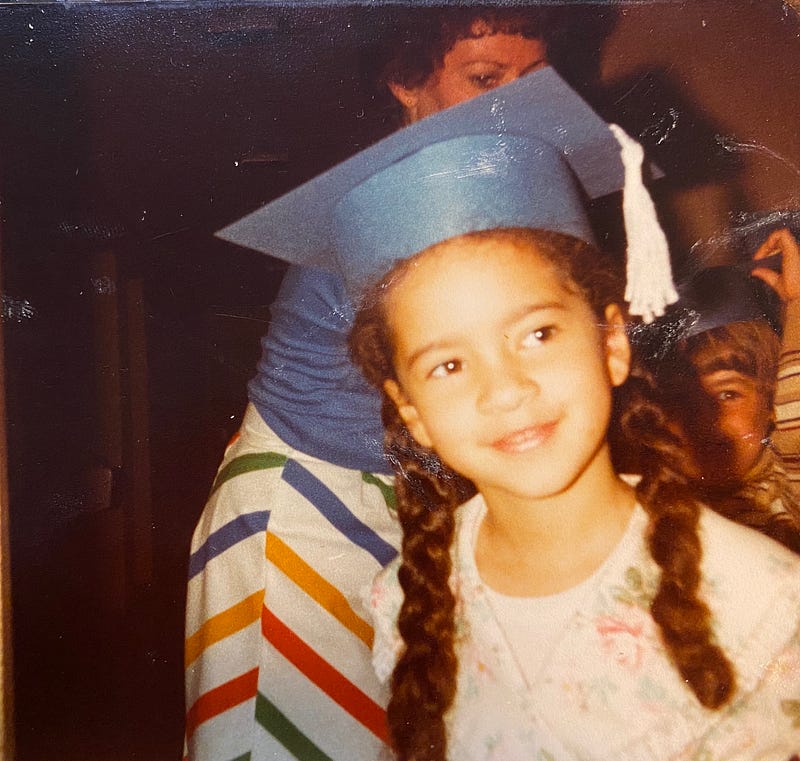
When I was in first grade, a boy came up to me and asked, “What are you?”
I was standing in the lunch line, lollygagging with my first-grade classmates, when the question took me by surprise.
I shifted to my back foot, subconsciously creating a physical distance between me and his inquiry. I was new to the school, slowly making inroads with the girls in my class, and I cast a furtive glance to catch their reaction. They were patient but unhelpful; standing motionless, their silence neither supported his question nor confirmed my confusion. I felt boxed in.
Unsure of how to respond, I said, “What do you mean?”
It felt as if everyone else was in the know and only I was missing the key to unlocking the hidden meaning.
Perplexed, I took the question home that afternoon.
“Mom,” I said “I didn’t know how to respond. What am I?”
My mother moved to the U.S. in the 1950s at the age of eighteen; she was no stranger to the perplexities of race in America, herself having navigated the no man’s land of racial ambiguity. I suppose she had been waiting for the day when I too would have to be introduced to a society founded in shades of black and white.
Up to that point, I had remained blissfully unaware of the world outside my home, as the youngest and fairest-skinned child of a multi-racial, multi-cultural, and multi-national family, I assumed people came in all shapes, sizes, and colors. It had never occurred to me to differentiate between these individual characteristics — we were all alike in that every one of us was different.
Having spent summer vacations with my respective grandparents, I was accustomed to seeing the spectrum of browns, yellows, whites, and pinks in their countries. I was unaware that, among my Italian cousins, I was the swarthy child with untamed curls, or that, in the small Caribbean village of my mother’s childhood, I was béké — the Antillean Creole term now colloquially used to describe White foreigners.
Even in Indiana in the early eighties, it seemed inconsequential to me that I was a different color than my predominantly White classmates. That is, until this little boy wanted to point it out.
What My Mother Told Me
I could tell you I remember the conversation — what my mother said, what I asked — but I’d be lying. I can assume she told me what the child likely meant and why someone in our Midwestern town might ask, but the contents of the conversation, the individual words, have long been cast away.
I know she tried to explain a shapeless social phenomenon that had no taste, smell, or texture but was ever-present and would follow me in everything I would do.
I know she also told me how I should respond to that boy and anyone else who would ask — that my identity was mine and mine alone to define.
I know what I took away was a vague, childlike understanding of how things are in the world. From that point forward, I would walk out my front door “in the know”, complicit in accepting that what it is, is tacitly shared among us all.
I think about that boy. I imagine his genuine curiosity, looking at me through the eyes of a child, wanting to understand why I was different. Perhaps he didn’t know how to ask the question on his mind or perhaps he was parroting what he heard from his parents.
I think about me, that little girl. I remember feeling confused and lonely, like I was an alien, not flesh and blood like all the other snot-nosed kids. Only weeks into a new school year, all I wanted was to feel like I belonged.
Because of that one small act by one small boy, I now knew racial anxiety. I built a defensive wall around me, powered by exclusion, doubt, and distrust.
Only my mom and I know what happened to me that day. That’s the intangible nature of race and racism. My friends might look back at their time in school and say “race was never an issue” or “I grew up never really seeing problems with people of different backgrounds,” while I was standing next to them, being singled out because of race.
Recently it occurred to me it was my defining race moment — my earliest experience with race that, to this day, still informs how I navigate relationships and situations where race appears to be a factor.
We all have a story about when we were first introduced to race — taught about race as a social construct and inducted into a system of race as a mechanism for social determination. Most of us are taught about it at such an early age, we may not even realize when our opinions on the topic were first formed.
When we talk about race now, it’s from our well-entrenched positions, steeped in lived experiences. It is worthwhile to remember, however, we were not always like this. We are not born race-aware or racist. Race is not an inherently natural idea. We have to be taught about it as part of the social norms of our society, much like many other of our cultural mores.
Like most of my peers, children of the ’80s and ’90s, I was taught to accept the social constructs within which we live. I did not question why we would draw defining lines based on skin color or why I would experience both the privileges and disadvantages associated with being racially ambiguous within our hierarchical society.
I simply, for many years, assumed that our systems — political, economic, and social — were designed with all of us in mind and were so enshrined in history that change was neither necessary nor possible.
Now I know better.
I also know it is possible to break down the walls that have been constructed within us and between us. It is possible to build connections and create empathy, by sharing early memories and real, personal stories — stories unique to the individual but universal to the human experience.
By sharing the stories of when we first learned we are all different, we find the common thread that shows us how much we’re all the same.


