
What I Learned About Life (And Myself) From Biking in Copenhagen
When the going gets tough, just keep pedaling

While taking time to digest the devastating events unfolding back in Europe, I wanted to distract myself, and my readers, by reminiscing about one of the most uplifting and happy experiences of my life — becoming an avid cyclist in the European city that runs on bikes. Here’s my story.
I like riding a bicycle as much as any other grown-up kid. But while living and biking in New York, I was all too familiar with the dangers of commuting on two wheels.
To limit my exposure to angry drivers, my biking was restricted to occasional park rides. Scared by the death and injury statistics, I would never pick cycling as my main commuting option in America.
And then I came to Copenhagen, the city built for and around bicycles, where as much as 62% of the population commutes by bike every day.
I fell in love with the country, regularly voted among the happiest places on Earth, and its quiet capital. It was everything I expected it to be and more.
One of the biggest adjustments upon my arrival to Copenhagen was embracing the idea of everyday cycling. Yet by doing so, I was able to learn a few things not just about bicycles but about life in general, and myself.
It literally pays to be brave
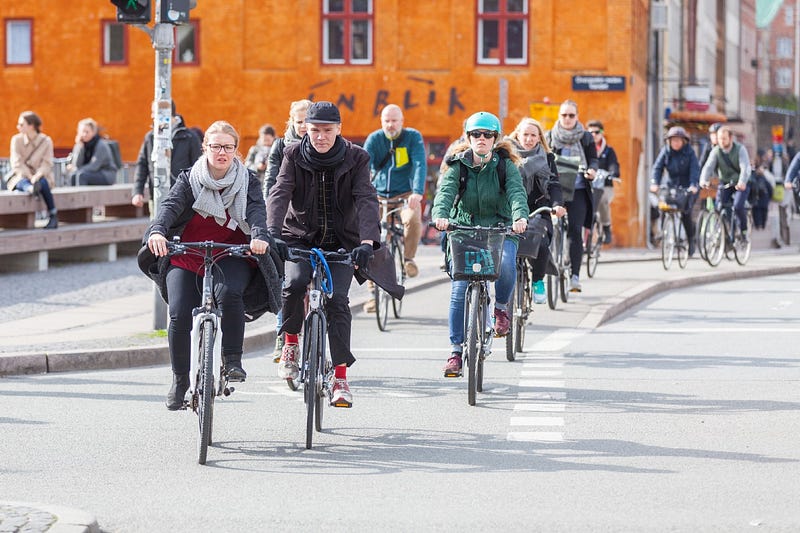
For the first two weeks in Copenhagen, I watched the bike crowds nervously, worried that I’d never be one of those brave people. Instead, I’d be forever stuck on the bus with the tourists and the elderly, paying nearly $4 one way.
Still, it’s not the cost that made me overcome my fear, but a desperate desire to fit in.
There’s nothing like telling your date that you can’t join him at a cool bar a few miles away because you’d have to walk there. Or heading for the metro when your favorite colleagues bike home together.
There are no yellow cabs or Uber in Denmark. And biking is not a lifestyle choice, it’s a norm. So out of a great need to be normal, I sucked it up and rode my metal horse to my co-working office one winter morning, surviving just fine and saving $8 in the process.
No matter what your motivation is, I can confirm that fortune favors the brave.
Keep calm and cycle on
Biking in Copenhagen means you’re almost always surrounded by other cyclists, and it’s up to each one of you to keep the steady flow going.
If your foot slips off your pedal, you keep cycling with the other one. If you lose your balance, you snap back as soon as you can and keep going.
There’s no time to stop, reflect and feel sorry for yourself. You shake it off and keep going.
And same with life. Don’t dwell on the small things. Everyone slips.
Life is easier when you follow the rules
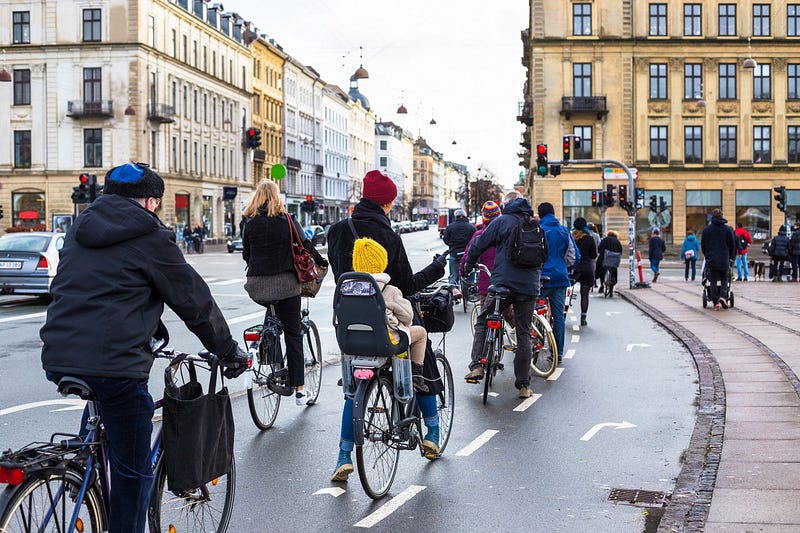
I quickly learned that biking in Copenhagen was easy and safe. Forget the bike lanes. They have bike roads. Meaning there’s a slice of curbed pavement dedicated to bicycles, running alongside most city streets.
Those lanes are usually wide enough to allow two or three cyclists to bike next to each other, yet no one does that. That’s because Danes know that one must always stay on the right side, to allow others to pass.
It’s one of the many rules to follow during your bike commute in Copenhagen, and the ever rule-abiding Danes follow them religiously.
You’re also expected to look over your shoulder when changing lanes, use hand gestures when turning or stopping, have two functioning lights, white and red, and stop for bus passengers to unload.
Unlike on Manhattan sidewalks, where failure to comply with the unspoken walking rules will have you cursed if not crushed, in Denmark, you won’t get as much as an f-word. Still, most people obey the rules just for the sake of it.
It’s this collective silent agreement to do the right thing that makes biking in Denmark so stress-free.
So I exchanged my “Get out of my way” New York attitude for a “Let’s get there safely and stress-free” one.
And I must say, life is easier when you do the right thing.
There is no bad weather
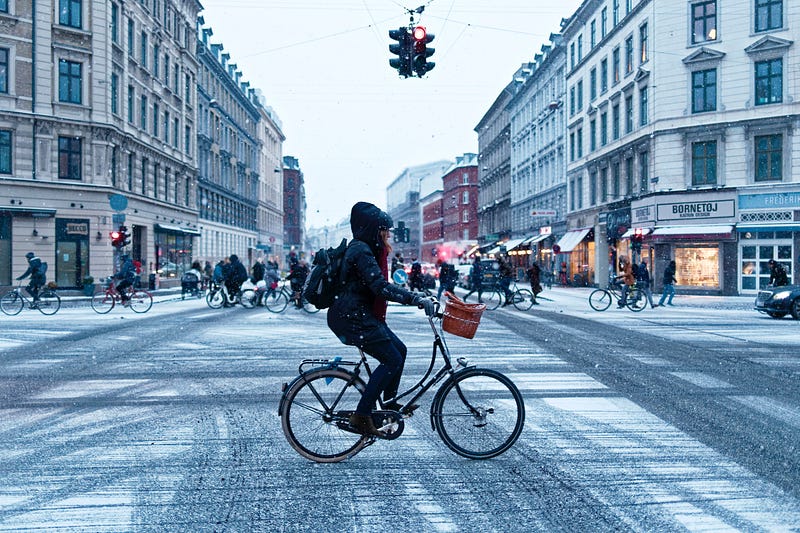
The famous phrase “There’s no bad weather, there’s only bad clothing” originated in Denmark. To that I would add, “There is no bad weather for cycling, there’s only bad clothing.”
Sure, mild Copenhagen winters don’t compare to the snowstorms and freezing temperatures of New York in January. Still, my hat is off to Danes who never seem to be fazed by rain, wind, slush, or a hangover.
It helps that in Denmark, you can find a piece of clothes or gear to go with any weather. If you’re too cold or wet to bike, you probably didn’t do enough shopping.
After much whining about the cold, I gave in and bought a raincoat to go over winter jacket and cycled into the rain.
As any Dane will tell you, there is no bad weather. There are only excuses.
Don’t complain
Likewise, Danes never complain about cycling in the cold.
Having biked with rain, snow, and wind blasting in my face, in a raincoat over my winter coat, with tears running down my cheeks, I burst into my co-working office one morning, like a superhero, waiting for someone to compliment me on my achievement, only to be met with “Rain, eh?”
What I call building character, Danish people call commuting.
After all, you don’t walk into an office in New York and announce: “Subway sucked!”
After a while, I learned to accept my winter commute with dignity.
After a winter in Copenhagen, I learned that when everyone is in the same boat, no one gets to complain.
Pick a mentor to follow
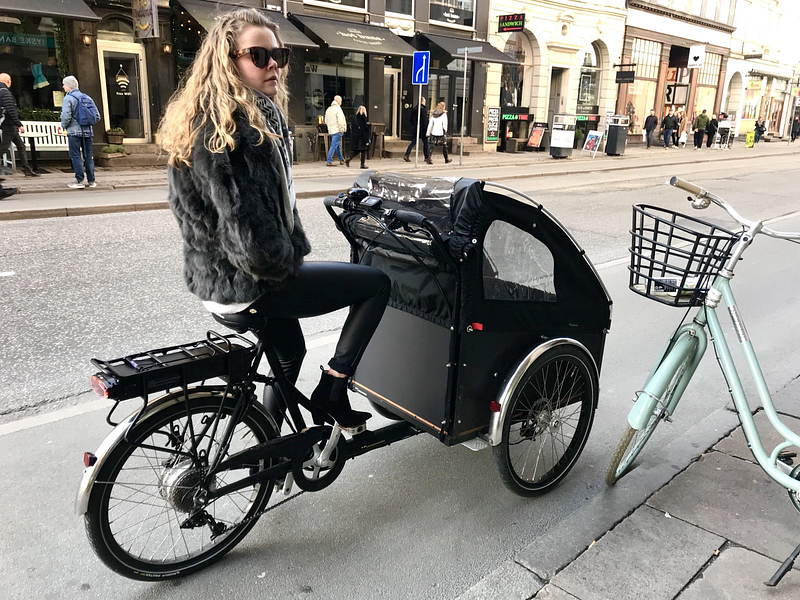
Because there are so many rules and tricks to biking in Copenhagen, I often found it quite comforting to pick a well-skilled and responsible local cyclist and follow him or her, observing how they stop, start, pass, signal, change lanes, and tackle other various situations.
I called them my road mentors.
I think we could all use one of those sometimes, on the road or in real life. The key is to pick the right person.
And remember that no matter how good your mentors are, they will eventually part ways with you. After signaling properly, of course.
On the road and in life, be ready to fly solo.
And trust people
To really enjoy cycling in Copenhagen you need to trust that other cyclists and drivers will do the right thing at all times, to keep each other safe.
Trusting people is one of the hardest things in life but, as an experiment, I gave it my best there. And I must say, cruising through the intersections has never been easier or more pleasurable.
By trusting others, I even became more trustworthy myself.
I realized that our lives could be transformed if we remembered that we truly are all in this together.