What Happens When the Supreme Court Tries to Send American Women Back to the 1950s?
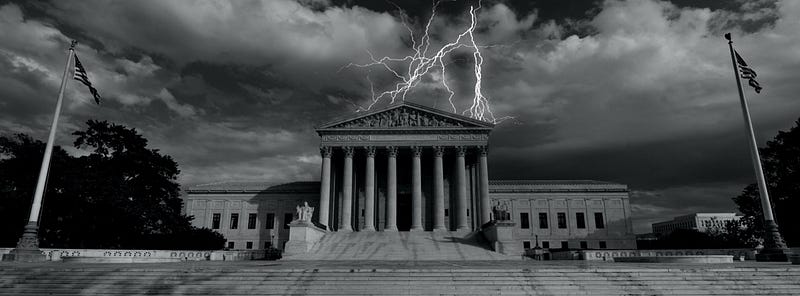
Recently, I wrote about five ways the coming Republican Revolution might fail. In this article, I discuss a sixth way it might fail: SCOTUS gone wild.
As things stand today, the Republican Party is on a clear path to take over both Houses of Congress in 2022 and the Presidency in 2024. Should this occur, the GOP intends to suppress and subvert Democratic voting in every state it controls to guarantee that Democrats never again hold majorities in Congress or occupy the White House. Its goal is unambiguous: to establish an authoritarian, minority-rule American government untethered by any concerns about electoral accountability. However, the Republican Party has one problem standing in its way: itself.
The Republicans who play-act being “representatives of the people” in Congress and State Houses around the country are not really the brains of the operation. That should be obvious from the mind-numbing idiocy that regularly spews from the mouths of Kevin McCarthy, Jim Jordan, Marjorie Taylor Greene, and the rest of the Republican “office-holding” clown car. These folks are shills, paid entertainers whose job it is to distract the public and feed the base with an ongoing Reality TV show titled “We Own the Libs!” If you look at it as performance art, not governing, it all starts to make perfect sense.
Meanwhile, the real brains behind the Party do the real work. And what is that work?
A big part of it has recently reached fruition — stacking the Supreme Court with an unbeatable majority of right-wing ideologues who will enthusiastically enact the “conservative” agenda they share with the dark-money donors and benefactors who patiently invested millions of dollars over decades to put them where they are today.
The Supreme Court is vested by the US Constitution with a superpower: it can decide what the Constitution means. And that power is how the wealthy elites who operate behind the dark-money curtain expect to achieve their goal: rolling back popular and hard-won rights that have been the bedrock of American democracy since the New Deal.
The point I want to make in this article is not that this hard-right conservative agenda is cruel, selfish, unjust, and unfair, which of course it is, but rather that it is empirically bankrupt, proven by years of objective research and actual experience to be futile and dangerous, disruptive and damaging, and unlikely to result in anything remotely like the outcomes their proponents imagine for it.
In other words, completion of the conservative agenda is unlikely to result in a “Father Knows Best” world of docile wives, polite children, lily-white neighborhoods, and minorities who “know their place” at the bottom of the social order.
You might imagine this would be obvious to anyone with a basic understanding of human nature, history and science. But that’s not how ideological warriors think. To understand that mindset, let’s take a closer look at how the new Republican supermajority in the Supreme Court is navigating one of the most controversial and consequential issues the Court has taken up this term: abortion rights.
- Who are these people who now control every decision the Supreme Court makes?
- How did they get where they are?
- What are they planning to do about abortion rights in America?
- What consequences are likely to follow from their decisions?
Who are these people?
The current conservative supermajority consists of:
- Two very old, very angry, very racist men: Samuel Alito and Clarence Thomas , one of whom happens to be black,
- a shiny young Chief Justice, John Roberts, who earned his position by being an unapologetic proponent of corporate greed over individual rights, and
- three fresh faces: Neil “trucks are more important than people” Gorsuch, Brett “who paid off all my debts?” Kavanaugh, and Amy “I am not a partisan hack” Coney Barrett, hand-picked by the Federalist Society and jammed through hasty confirmation processes by Mitch McConnell.
Compared to the many fine jurists who have occupied SCOTUS seats before them, these folks are hardly the A-Team. Maybe not even the B-Team. The reason for this is quite deliberate. They were all chosen not for their judicial qualifications, which are thin at best, but for their political allegiances. For example, Roberts, Kavanaugh, and Coney-Barrett were all worker bees in the G.W. Bush campaign’s legal battle to block the Florida recount and install Bush in the White House in 2000. Gorsuch joined the Bush Justice Department a few years later and helped defend the Bush-era torture and detention policies. Prior to helping the Bush v. Gore team, Kavanaugh earned his stripes assisting Ken Starr in his ill-fated pursuit of Bill Clinton. And so on.
Beyond their political loyalties, our new supermajority’s qualifications become more murky, especially with regard to judicial “temperament” and personal “integrity”. Thomas and Kavanaugh have both been credibly accused of serial sexual misconduct. Kavanaugh has also been credibly accused of lying to Congress. Coney-Barrett is a lifelong member of a fringe religious cult that embraces “traditional” gender roles and believes homosexuality is an abomination before God. She was also unwilling to acknowledge the existence of climate change in her Senate confirmation hearings and broke a basic ethics rule within weeks of joining the Court when she declined to recuse herself from a big climate case involving Shell Oil, where her father had worked for almost three decades.
All appear happy to embrace the pretzel-logic at the core of conservative “morality” — that it is acceptable to deny American women the right to decide when and where to have children, but not acceptable to deny any American the right to own and openly carry a weapon of war that has no practical purpose other than efficiently killing large numbers of human beings in the shortest possible time.
These are the great judicial minds now entrusted to tell us what the US Constitution really means.
How did they get there?
There’s a short answer and a long answer. The short answer is: The Federalist Society. The long answer is, well, the money behind The Federalist Society.
Democratic Senator Sheldon Whitehouse of Rhode Island has made it his personal mission to expose the network of anonymous money that has funded The Federalist Society and other right-wing political organizations and lobbying groups focused on the Supreme Court over the last several decades. Writing in the Harvard Journal of Legislation in 2020, in an article titled “Dark Money and U.S. Courts: The Problem and Solutions,” Whitehouse observes:
“It is slowly becoming clear how the so-called conservative legal movement has been secretly bankrolled by corporate interests which benefit from that legal movement. It is even sometimes frankly admitted. Describing his efforts to stock the federal judiciary, Donald McGahn, the former White House Counsel and early architect of the Trump administration’s judicial selection efforts, did not even try to hide the connection: ‘There is a coherent plan here where actually the judicial selection and the deregulatory effort are really the flip side of the same coin.’ In other words, the ‘plan’ is to groom and select judges who will then support the Republican political effort to roll back unwelcome laws passed by Congress and unwelcome regulations developed by independent agencies.”
Further on, Whitehouse explain how “the plan” operates:
“Select carefully vetted judges who embrace the desired pro-corporate world view. This is done by giving a controlling role in judicial selection to an organization to which the interests give millions of dollars (the Federalist Society);
“Unleash millions in dark money supporting the nominee (or opposing him in Judge Merrick Garland’s case). This is done through an organization (the Judicial Crisis Network (“JCN”)) that uses anonymous donations to fund political advertising campaigns for (or against) nominees;
“With their judges in place, tee up strategic cases and inundate courts with amicus briefs — best understood as lobbying documents. This is done through a flotilla of closely related front groups. These front groups sometimes appear as the litigant, behind a plaintiff of convenience; and sometimes among a flotilla of “amici curiae” signaling in harmony how the influence machine wants the court to decide.”
And that’s how our current squad of legal-eagles found their way onto the United States Supreme Court.
How is the plan working? Again, Whitehouse provides the box score:
“The hard proof is in the numbers. As I have documented, from the 2004 through 2017 Terms, the Roberts Court issued 73 5-to-4 partisan decisions benefiting big corporate and Republican donor interests. By partisan, I mean that it was all Republican appointees making up the five. The benefits to Republican donor groups are not hard to discern. They include allowing corporate interests to spend unlimited money in elections, hobbling pollution regulations, enabling attacks on minority voting rights, curtailing labor’s right to organize, and restricting workers’ ability to challenge employers in court. In its 2018 Term, the Court added seven more of these 5-to-4 partisan decisions to this tally.”
What are they planning to do about abortion rights and what consequences are likely to follow?
With the recent announcement of Justice Stephen Breyer’s retirement, there has been renewed interest in the ideological predispositions and likely legal trajectory of the new SCOTUS supermajority, if only to remind us that the replacement of one liberal Justice with another is not going to have much of an impact on where the 6–3 Court is heading.
With regard to abortion rights, SCOTUS has already allowed one blatantly unconstitutional abortion law to remain in effect in Texas (Whole Woman’s Health v. Jackson), and it is now favorably mulling over an even more egregious bill from Mississippi (Dobbs v. Jackson Women’s Health Organization). Following the procedure outlined above by Senator Whitehouse, these cases have been gestated in the states and brought before the Supreme Court for a single purpose: to provide an opportunity for the supermajority to roll back 50 years of precedent protecting women’s right to seek a safe and legal abortion anywhere in America up to the 24th week of pregnancy (the Roe v. Wade standard).
What the super-majority wants to do about abortion
When the Supreme Court recently heard oral arguments in the Mississippi abortion case, we got a glimpse of how the supermajority is thinking about abortion. Of the six, only Roberts appeared interested in a compromise solution that could retain the notion that abortion is a constitutionally-protected right, but move the threshold at which that right expires from the Roe standard of 24 weeks to the proposed Dobbs standard of 15 weeks. But the other five seemed more fixated on the “originalist” argument that Roe was wrongly decided and must be overturned completely because there is no explicit right to abortion contained in the Constitution.
Whether the final ruling on this case follows the Roberts compromise or overturns abortion rights altogether, it will signal the end of Roe v. Wade as a constitutional precedent. If the radicals get their way (and they don’t require Roberts’ vote to do so), they will set a new precedent that the US Constitution offers no protections for women’s reproductive rights. Such a ruling will then allow each state to legislate and criminalize women’s reproductive choices as it sees fit, up to and including forcing its female citizens to carry unwanted pregnancies to term against their will.
Welcome to “The Handmaid’s Tale: American Edition”.
What the real-world consequences are likely to be
The moment Roe is overturned, the legality of abortion will become a state-by-state issue. Currently, laws are on the books or ready to be passed in at least 24 Republican-controlled states that will immediately ban or severely restrict access to abortion within their borders. As each of these new laws comes into effect, women across America will be reminded once again that a right they have enjoyed for 50 years is being taken away from them. Local and national media will document every step along the way: the anguish of desperate young women, the inequities, the cruelty, the medical dangers, the ethical contradictions, the barely-concealed underlying misogyny.
The medical costs of banning abortion are well documented: abortion bans do not save lives, they cost lives. In Mississippi, for example, which ranks last among the 50 states in terms of women’s, infants’, and children’s health, a woman is 75 times more likely to die from giving birth than from undergoing a pre-viability abortion. Across the country, states with more abortion restrictions have higher rates of maternal and infant mortality than states where abortion rights are supported. Perhaps the most perverse impact of abortion bans is this: they do not result in fewer abortions. Instead, they compel more women to risk their lives and health by seeking out unsafe abortion care.
Politically, how is this wholesale revocation of an established right — accompanied by an utter lack of concern about its known detrimental effects on health outcomes for both women and infants — likely to play out in the American public as voters contemplate their choices in the 2022 midterms?
First, the decision will directly contradict public preferences on the issue. According to recent polling, only 27% of Americans agree that SCOTUS should overturn Roe v. Wade. Sixty percent believe it should be upheld, including 82% of Democrats, 58% of Independents, and even 42% of Republicans. More broadly, 75% of Americans say abortion access should be left to women and their doctors; only 20% say it should be regulated by law. That’s a pretty substantial consensus for the Court to act against. But the Radical Five are unlikely to be deterred; they are ideological warriors, not pragmatists.
Second, the decision could become a powerful weapon in the upcoming midterms, both as a talking point for Democratic candidates and as a recruiting tool for mobilizing grassroots activists and convincing otherwise low-frequency voters (like young women) to vote. As one commentator has summed up the potential threat:
“If the Supreme Court overturns Roe either formally or functionally (by allowing states vast leeway to curtail abortion rights) the Court and the Republican Party may see just how much of a minority abortion opponents actually are, how crucial abortion and contraception are for American women to be free, and how angry women (and those who love them) will get when our rights to our own bodies are taken away by five or six conservative judges who are unaccountable to the voting public. The GOP face a guaranteed backlash if the anti-abortion movement gets what it wants, and the Court faces a potential loss of public confidence.” (emphasis added)
In other words, a SCOTUS decision to overturn Roe v. Wade might become the kind of lightning-rod issue that could change everything in a midterm election. Beyond the judicial malpractice it directly represents, it very vividly exposes the darkness that underlies the modern Republican worldview: the cruelty, the bigotry, the misogyny, the refusal to acknowledge facts and evidence, the arrogance. However the Court decides to decapitate abortion rights (formally or functionally), it may be setting up an unanticipated collision with an American public that (a) likes its liberties and (b) is, by and large, pro-abortion.
Where does the revolution go from here?
Abortion is not the only issue the new SCOTUS supermajority intends to take up before the 2022 midterms. It has lined up a long list of pesky liberties and rights it wants to strike down. For each issue, following the “plan” described above by Senator Whitehouse, the Court has accepted a case or cases that will allow it to codify into federal law the wishes and biases of its extreme rightwing benefactors. In each case, it will check off a box on some rightwing wish list, but it will do so at a significant cost — making America less free, less safe, less equal, less fair, and less just. Here are four areas to watch:
- Affirmative action. Cases from Harvard and the University of North Carolina will allow the new supermajority to kneecap one of the most effective ways disadvantaged minorities can gain a foothold in America’s economic elite. If you want to make sure every elite university remains a safe space for entitled white kids, this will be a great help.
- Gun rights. A case from New York State will allow SCOTUS to further expand gun rights by forbidding any restrictions on carrying a weapon in public. If you think you have a right to walk around in public without being intimidated by a moron waving his AK-14 in your face, you are sadly mistaken.
- Separation of church and state. Expect the Court to use a case from Maine to make it illegal to withhold state funds from church-affiliated schools. Maybe you don’t like having your tax dollars spent to fund someone else’s religious training? Too bad for you.
- Judicial deference and the Administrative State. Perhaps the most consequential case on the docket this year is not Dobbs v. Jackson Women’s Health Organization, but American Hospital Association v. Becerra, a case hand-picked to give the Justices an opportunity to strike down a precedent that the right has hated for decades, the so-called Chevron deference rule, which requires the Courts to defer to a federal agency’s interpretation of an ambiguous or unclear statute that Congress delegated to the agency to administer. This case, although ostensibly about Medicare and how much hospitals can charge for prescription drugs, is all about the newly radical SCOTUS giving itself the power to second-guess and undo any federal regulation it doesn’t like. Using this self-assigned superpower, SCOTUS could effectively halt any government regulation it wishes, for example, any regulation that might impose costs on the fossil fuel industry to address climate change. The potential damage from such rulings could be devastating and irreversible.
To summarize: the supermajority in the Supreme Court is now a fully-complicit partner in the Republican Plot to Destroy America. Its agenda is radical, unpopular, and dangerous on multiple fronts. It has become, as Amy Coney-Barrett recently tried to deny, “a bunch of partisan hacks.” While Donald Trump remains the biggest wildcard for Republicans heading into the November midterms, the now-unchained supermajority in the Supreme Court is quickly becoming a close second.
How many shocks can the new supermajority inflict on the American public between now and November? Nobody knows. But a blatantly partisan, unelected Supreme Court, methodically wiping out long-held rights and protections, often using secret “shadow docket” rulings that don’t even expose the Justices to oral arguments, is likely to be noticed and, once noticed, is likely to sit poorly with the American public.
But the SCOTUS supermajority is unlikely to be deterred. It has a job to do and it intends to do it: completing the Republican agenda it was put in place to complete. If that requires sending American women back to the 1950s and America as a whole back to the pre-New Deal 1930s, so be it.
Perhaps even more than the narcissistic machinations of Donald Trump, a string of precedent-busting SCOTUS rulings over the next few months may finally awaken a critical mass of Americans to what the upcoming Republican Revolution really is all about: lost rights, blind obedience to corporate interests over human interests, capricious decisions based on flimsy pretexts, science denial, potentially fatal delays in climate action, and partisan hackery … so much partisan hackery.
Maya Angelou famously observed: “When someone tells you who they are, believe them the first time.” Is America listening?