
CATS IN CRISIS
What Happens When Someone Dies in Their Home and Their Cats are Locked Inside
A cat rescue like no other — a tale of feline resilience and survival
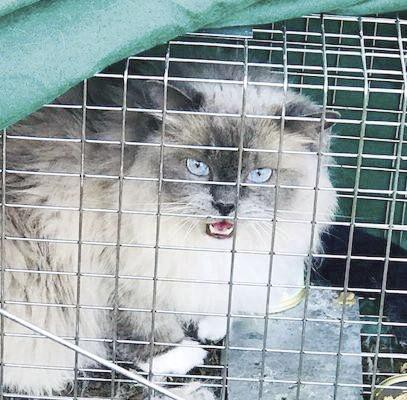
My husband and I have participated in numerous cat rescues over the years, but nothing comes close to what happened a few years ago following the death of my long-time friend and sorority sister.
Gina, we’ll call her, passed away in her home during a July heatwave in Memphis. She suffered from various ailments, which unfortunately she wouldn’t address aggressively, as those of us who knew her had begged her to do.
Her three cats were the joy of her retired life. After some reflection, I believe it was her fear of being away from them in the hospital that ultimately resulted in her death.
During our occasional lunch dates Gina showed me their photos on her iPhone. Like me, she had more cat pics than photos of friends and family. She purchased the cats from an out-of-state Ragdoll breeder, but we agreed to disagree about that detail.
My lifelong philosophy is “adopt, don’t buy,” but we didn’t go there. Naturally, I was captivated by the angelic faces of her new fur babies who she named Sugar, Taffy, and Sweets.
Gina and I were friends for more than 40 years. I was her big sister in our college sorority and we stayed close through my divorce, her romances, my living in three foreign countries, her successful battle with cancer, and my remarriage.
And there were other countless events that chronicled our lives.
Gina, who lived alone with her cats, was a friend I could laugh and be silly with. But we could also debate serious issues, and usually did. With age, our political, religious and social differences widened considerably.
As she became more hardened with her beliefs our interactions — though still friendly — slowly abated over time. Lunch dates became infrequent, and we often went weeks without speaking on the phone.
But despite that, I still considered Gina one of my best friends. We had a fun, often crazy — maybe even a little dangerous history, and we knew all of each other’s Big Life Secrets.
Or so I thought.
I was notified the day Gina’s body was found. I was her executor and power of attorney, and I was also an acquaintance of the lawyer who created her will. Both his and my contact information were in her nearby cellphone. We were both called and when we spoke, we pieced together what the police had told us.
She was discovered by a neighbor who was disturbed by the lack of activity from her house. Her car hadn’t moved for two weeks and the mailbox looked overly full. He was worried, but on the other hand, he described Gina as an eccentric loner and was initially hesitant to disturb her.
After the initial shock of learning of her death, my thoughts flew to her three cats. Where were they? Did anyone find them? Did they survive being in that house for two weeks, alone?
A few years back Gina made me promise to look after her cats if anything should happen to her. I assured her she would certainly outlive the trio, but I gladly gave my promise just the same.
Michael and I jumped into the car that day and hurried over to Gina’s house. I spoke with the neighbor who’d contacted the police, and he confirmed that no one left the house with a cat carrier. He handed us her house keys, which one of the policemen had asked him to deliver to us once we arrived.
Was it even possible they were still alive? Her air conditioning was also out, the neighbor added, with dark significance.
While reeling from this information, the biggest surprise was yet to come.
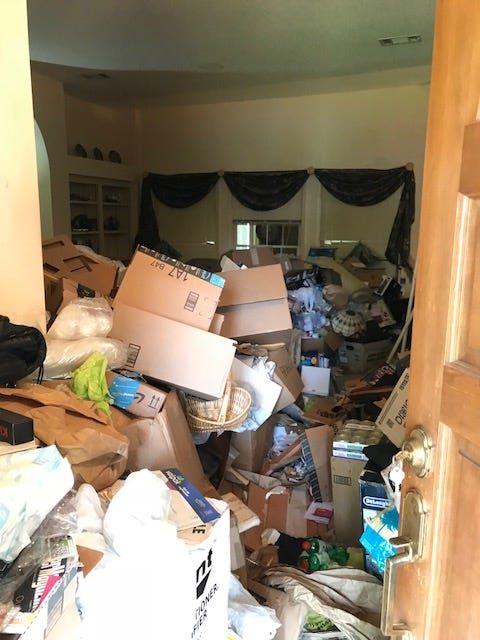
Michael opened the front door, and we were paralyzed with shock. My friend had become a hoarder. A serious hoarder, like the ones you see on TV documentaries. Her spacious three-bedroom, two-bath brick house was unrecognizable.
I flashed back to the past several years. Gina had stopped inviting me to her home for dinner or a drink. We began meeting at restaurants or at my home, never hers. Now I understood why.
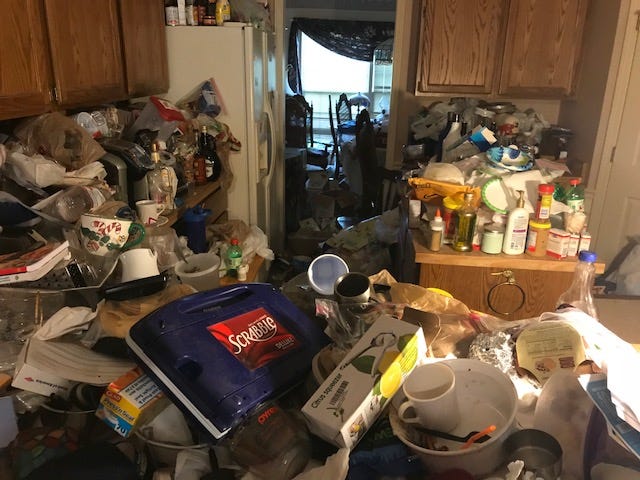
We discovered, mercifully, her hoarding didn’t include animals. It was just things. Stuff spread out and stacked up everywhere over 2,700 square feet of what looked like an industrial garbage dump.
Stuff piled upon stuff. Useless empty plastic bins and food containers were juxtaposed to unopened Amazon Prime boxes. Bags of still-sealed mail and dated magazines littered the floor along with miscellaneous items ordered in duplicates, triplicates, and quadruplicates.
The magnitude of the hoarding was overwhelming, but the pressing question was: where were the cats?
But on this first day of seeing the work before us, we had to get out of the house immediately. My husband had the good sense to know we shouldn’t be standing there in the living room.
We were right in the middle of an active biohazard zone.
Outside the house I searched the web for a remediation company. I called a business called BioOne, and the owner agreed to meet us at Gina’s home within an hour.
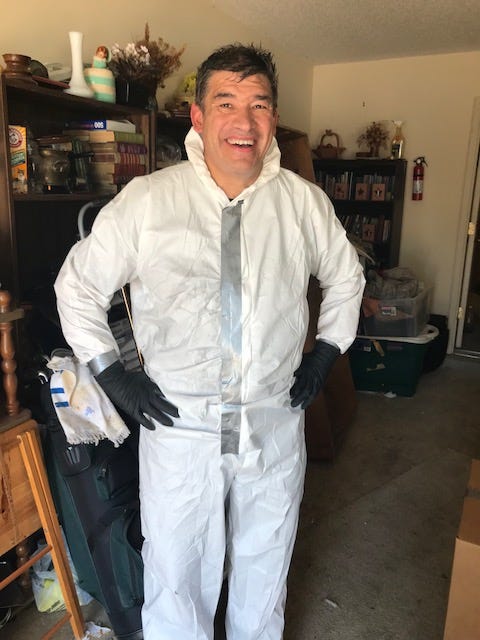
He commended us on not going further into the house. He explained the dangers associated with human decomposition, and said he would supply biohazard suits for us if we wanted to look around once he and his team began their cleanup.
Since I’d never encountered anything like this, I naively assumed the police would somehow “take care of” a situation like this. Wrong. It’s up the family — or, in this case, the executor — to clean up after a body has been removed.
As an only child of parents who were only children themselves, Gina had no living family members.
The challenge of rescuing her cats was now magnified by the fact a large part of her house was a Class A biohazard.
With fingers crossed, I contacted a local animal rescue organization. This particular one is known for handling difficult rescues, and receives up to 50 calls daily for help according to Serena, its founder.
Serena is the toughest, no-nonsense cat rescuer I’ve even seen or heard of. I knew she’d probably dealt with hoarding situations before, but what about operating in these conditions?
As I suspected, she wasn’t fazed. Serena said she’d be over with traps as soon as she could. Although I secretly feared none of the cats survived, I was relieved to see her van pull up with three traps and cans of wet food for bait.
A small nugget of useful information was gleaned from one of the policemen who’d been at the house earlier. He hadn’t seen any cats but had noticed open sacks of dry cat food and large bowls with some water in them. There was also a leaky faucet in the guest bathroom.
Maybe there was a chance.
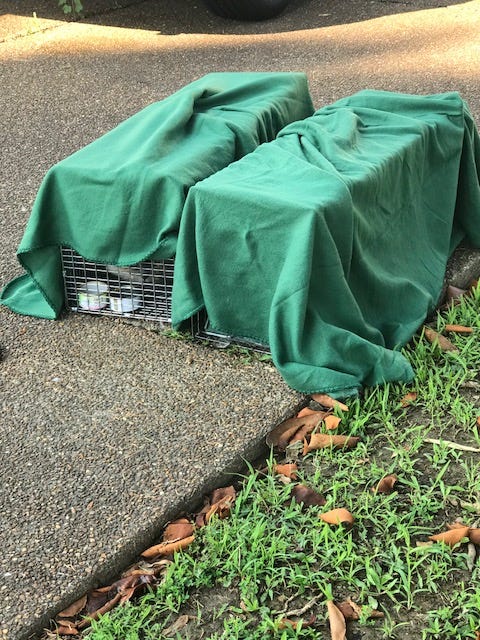
The owner of the remediation company donned himself and Serena in hazmat suits and heavy work gloves. They quickly and carefully entered the house and laid down the traps.
Together they sealed the inside food containers and removed all water sources. If still alive, the cats would be forced into the traps for water and nourishment.
Meanwhile, I tasked a friend with the daunting challenge of finding the cats’ veterinary office. With hundreds of clinics in the region and no clues as to where Gina took them, it was the proverbial needle + haystack conundrum.
My friend came through. After hours of telephone calls— beginning with the immediate area — he hit pay dirt with the name and address of the veterinarian where Gina had taken her cats the last seven years. Michael and I drove to the clinic to retrieve their files.
There was more good news that first evening.
Tim returned to the house several hours later to find two sprung traps and two frightened, whining felines. But the third trap remained empty.
The two Ragdolls were health checked by City Kitty’s vet and were placed into a temporary foster home. Serena arranged for them to be transported the next week to a Nashville-based breed rescue that agreed to accept them.
A City Kitty volunteer offered to drive the cats and deliver them into the hands of the rescue organization. We later learned they took up residence at the popular Mewsic City Cat Café.
I was delighted to learn the pair was adopted together within a week.
It was amazing these cats had survived in that ungodly house for over two weeks. And with the rising temperature and lack of air conditioning, it was a miracle there was sufficient water to keep them alive. They had also been able to scratch open the sacks of dry cat food which littered the floor.
That their beloved guardian was dead and decomposing no doubt was traumatic. Sheer instinct drove them to retreat to the far ends of the house, saving them from becoming ill by the dangerous, putrid biohazard.
The absence of the third cat cast a pall on our happiness. As the work continued with the clean-up the men were told to watch out for the body of the little long-haired cat named Sweets.
But then, ten days later, another miracle occurred.
Michael received an excited call from Tim, who said Sweets had been discovered. Alive! He breathlessly recounted their spotting the feline huddled in the back bedroom closet. It was an area they’d not yet been able to gain entry due to the wall-to-ceiling clutter.
Sweets didn’t want to be caught, so Michael advised them to leave dishes of food and water, and simply close the door until he got there.
But, he had no more luck than Tim and his guys. Sweets was holed up under a mountain of boxes, clothes, and bags of unknown items. She couldn’t be coaxed out — in fact, Michael couldn’t even detect her presence.
Were they positive Sweets had been spotted? They assured him that yes, the cat was in there, but was elusive as a ghost. Meanwhile, I contacted Serena with the good news and in no time she redelivered a trap.
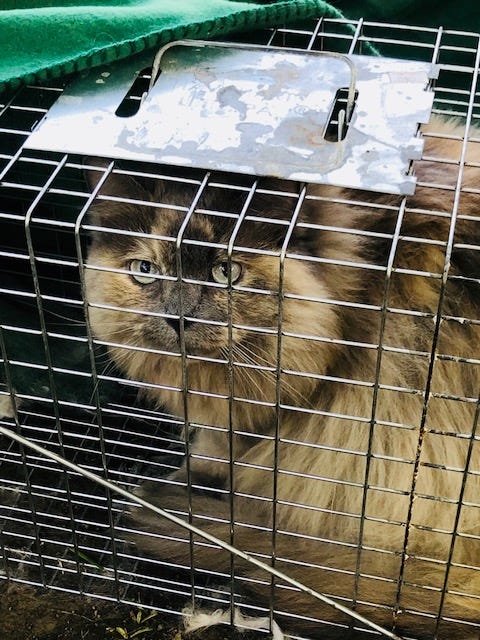
Michael baited it, removed the food and water bowls, and closed the door. The next morning — bingo! Sweets had slipped into the trap.
Michael drove the loudly complaining Sweets to the vet’s office, and later Serena picked her up. Like her sisters, she was taken into a foster home, and one week later was on her way to Nashville.
This story has been one that has forever changed me. I still mourn the loss of my dear friend and have replayed in my mind numerous scenarios that might have led to her death.
I struggle with guilt, wondering if there were cues I’d missed, or if there had been something I could have done that would have led to a different outcome.
And the hoarding — I had no idea.
The medical examiner ruled her death “by natural causes,” but something unnatural was going on her in life undetected by all of us around her.
I thought I knew my friend well. I didn’t. I thought after all these years I would have had a grasp on any major disturbances or problems she may have been experiencing. I hadn’t.
I, along with a few others, had strongly encouraged her to see her doctor, but she’d refused. Maybe I could have pushed harder. But, like Michael said, you can’t force grown people to do something if they don’t want to.
The only thing I know truthfully is that she had three cats she loved, and that I fulfilled my promise they would be cared for after her death.
Beyond that, many mysteries still remain today.
Like reading my stuff? If so, use my referral link for unlimited access. Maybe you’d like to write on Medium yourself. Your $5 monthly membership fee supports me and all Medium writers. https://medium.com/@deborah.camp/membership
OR
You’re already on Medium? Just follow me at: https://[email protected]. I write true stories on a range of interesting, sometimes quirky, but hopefully entertaining topics!


