
What Happened When My “Progressive” Neighborhood Decided to Have a Meeting About Racism
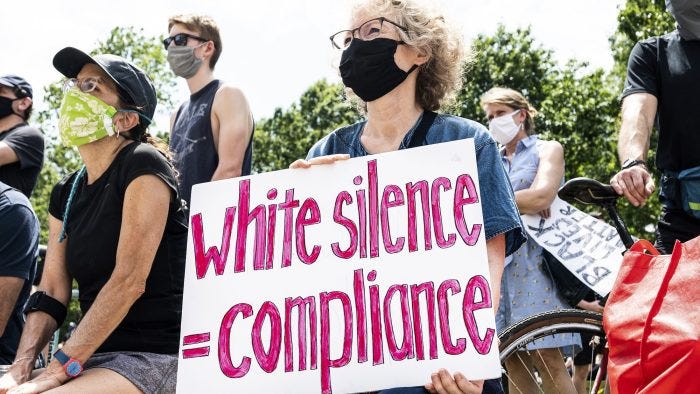
Twenty-five of us had gathered in the school parking lot — the majority of us white. We congregated to discuss safety, anti-racism and problems with the police. Introductions were made, light banter was had and we were ready to do this. We didn’t quite know what “this” was, but we were going to figure it out.
And then a Black woman pulled up in her car and all hell broke loose.
Let me back up a second, though. I live in South Minneapolis. This is the neighborhood that holds the annual May Day Parade that is full of old hippies, punks riding tall bikes and families marveling at floats that call for the dismantling of capitalism.
The Indigenous dance group, Kalpulli Ketzal Coatlicue, are a highlight. The parade ends with a Tree of Life ceremony featuring an orchestra, elaborate puppets and a call for peace. Sixty thousand people attend this thing every year.
Lawns are filled with Bernie Sanders signs all year round. Every other house has a Black Lives Matter or an All Are Welcome sign in the front yard. We want you to know that we are certainly NOT racist. We welcome diversity and love our neighbors.
This is also the area of Minneapolis where George Floyd was murdered on May 25, 2020 by Derek Chauvin of the Minneapolis Police Department. The terror of that moment infiltrated all of us. Our post office and several locally-owned small businesses were destroyed. The Target, Walgreen’s, Arby’s and Wendy’s are now gone. An apartment building for low-income families, mid-construction, was burned to the ground. And then the Third Precinct was set ablaze.
During the chaos, neighbors showed up and sprang into action. We looked out for one another and took turns staying up all night to make sure garages weren’t set on fire. We kept in contact on Signal and named block captains. Us white people were going to SAVE THE NEIGHBORHOOD!
Okay, now we’ll get back to the Black woman in the car.
She stopped on the street outside of the parking lot, filming us with her phone. Several of my neighbors began yelling at her, “WHAT DO YOU WANT?! WHO ARE YOU? WHY ARE YOU HERE?!”
After an invitation from our level-headed meeting facilitator, she pulled her car around and parked. She got out and sat with us in the parking lot, listening. Quietly observing. Her kids remained safely in the car with another adult. We carried on with the discussion.
And then white people went nuts.
A man started filming her kids in the car. She asked him to stop. He continued. She demanded that he stop. He continued. He finally backed off.
A white woman suggested that this Black woman go check on her kids. This woman was worried about the kids, after all. “I’m sure you’re a fine mom!” the white woman said. The Black woman told her to mind her own business.
The tension was heavy. A lot of suspicious glances shared. What was she doing here? WHAT DID SHE WANT? WHAT ARE WE GOING TO DO?
She eventually stood up and spoke. She explained that during a time of heavy white supremacist presence in the area, a group of white people gathered in one place concerned her. She wanted to make sure that she was safe. That her community was safe. That her kids were safe.
She had been protesting George Floyd’s murder for days and she was tired. She was tired of being forced to do the work of fighting to be listened to AGAIN. She said that if we think that having Black Lives Matter signs in our yards is doing something, we better think again. Yard signs are performative. Meetings are performative. It’s all performative.
“DO something,” she said. “Educate yourselves. Dig deep. Think about how you were treating me today. I was not welcome here.”
Just as quickly as she came, she left. We never got her name or knew where she was from, but we learned from her and we were grateful.
Or so I thought.
As the meeting continued, a white woman called for the creation of another group to process her white trauma. A Black neighbor suggested the the BIPOC from the neighborhood form another group to discuss what they need to feel safe in the neighborhood. A white woman spoke up and said, “But if they’re in a different group, we won’t be able to hear what they’re saying!”
There were head nods and whispers. I felt like I was watching a movie where the stand-ins are in the background, whispering and having overexaggerated conversations that weren’t real. I felt like it WASN’T real. How could this be happening? We were good, progressive, nice Minnesotans. Right?
I’m willing to bet that you know the reason for me telling this story: We all have implicit biases.
Just because we may not be flat-out racist, it doesn’t mean that we don’t harbor unconscious biases. The thoughts we have about others don’t often align with what we say to be true. Your friend Kate might have a Black Lives Matter sticker on her car, but she might still hold her purse tighter when a Black man is walking towards her.
Because our thoughts determine our behaviors, these thoughts can lead to discriminatory and harmful behaviors. You know, behaviors like filming a Black woman’s children and assuming that she pulled up in her car to in order to inflict harm.
It takes a lot of work to rid yourself of these biases. After all, you most likely don’t even know that you have them.
You can start by making a genuine effort to connect with members of a different racial or ethnic group. Pay attention to and challenge stereotypes that appear in the media and personal telationships. Instead of being colorblind, work on understanding people as individuals rather than lumping others together into one racial identity.
I realize that these ideas are basic. I could write several articles on the subject. I trust, though, that if you are interested in learning more, you can find anything you want in books and on the world wide web.
Since this meeting occurred, neighborhood meetings are still happening. However, there are now less people attending, including less BIPOC neighbors. Our “progressive” neighbors have now returned to normal life. The desire to be active in making change has waned.
I know that most people want to do the right thing. They want equity, they want to eliminate racial bias. Unfortunately, it just doesn’t happen.
You have to DO something.
For more of the good stuff, follow Fourth Wave, where we’re changing the world for the better, one story at a time. Got one of your own? Submit to the Wave!
For more by this author, try:


