
What Happened When Emily Moved to Germany
A comparison of living in the U.S. vs. Germany
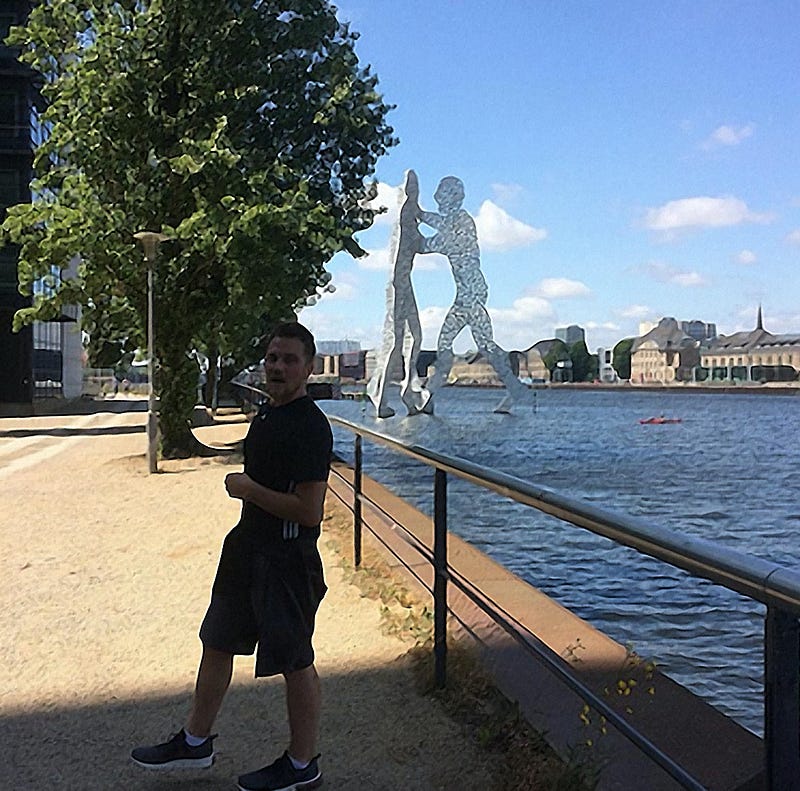
My son’s friend Emily used to share an apartment with him in San Francisco. Then she met a German woman at a bar and fell in love. She went to Berlin to visit. Eventually, she decided to marry and stay. She’s been back in California these past few weeks visiting family. I sat down with Emily to ask what her life is like in Berlin in comparison to San Francisco.
Here are my questions and her answers. If you have questions of your own, put them in the comments. I’ll forward them to Emily and hopefully get you a response. For me, this interview confirmed what I learned when reading The 1619 Project: that the United States practices a particularly brutal form of capitalism. We’re taught that this is the greatest country in the world and that we’re lucky to live here. But how much of that is propaganda, designed to keep us happy with our lot?
Here’s my story summarizing the second essay of The 1619 Project, followed by my interview with Emily.
Emily Interview Feb. 22, 2021
Describe your apartment in San Francisco vs. Berlin
The apartment in SF, when you walked in the front door you were immediately standing in the kitchen and had two smaller bedrooms and one bathroom — no living room.
In Berlin, when you walk in the door there’s a hallway leading to the living room, a bedroom off the living room, spacious kitchen, and full bath downstairs. Upstairs has two bedrooms and a half bath. The price for the apartment in SF was $2,400. In Berlin, it’s 870 Euros. There’s a park right across the street. To the right is a canal. In front of the house are dirt patches, owned by the city, which we turned into a garden. It’s spacious.
The downside is we are still on coal heating so it can get pretty cold. We buy our coal — it comes in 25kg packets — and have to put it in the oven and stoke the fire. Both places are situated in convenient neighborhoods, but in San Francisco, it was a quarter of the size of what I have now. Also, we were on the first floor in San Francisco so had no natural light. It was always quite dark. The windows looked into an allyway with another building right beside us.
Compare your job and your pay
It gets a little tricky because a minimum wage job in SF was $12 an hour but now it’s $15. If you worked in SF you were probably working two to three of those jobs just to get bills paid and didn’t have health insurance. All the jobs were less than full time. In Berlin, with a minimum wage job, you can pay the bills working under 40 hours a week. You can cover your expenses and have a little pocket money. It’s not fighting tooth and nail to scrape by from paycheck to paycheck. (In Berlin Emily cooks breakfast for the people staying at a nearby hotel and helps in her wife’s bookstore two days a week. In SF, she worked a variety of jobs including barista, retail sales, and construction.)
Also in Berlin, your employer is required to pay half your healthcare cost. No matter your job, you have health insurance. You have to pay half yourself, which comes directly out of your paycheck. You never see that money. If you don’t have a job, you have health care given to you by the state. They give you 450 a month from the government, pay your rent, and you have health care, if you are unemployed. We have some homeless people in Berlin, mostly due to psychological issues. They have shelters. You can have your own apartment if you meet the criteria — aren’t on drugs, fill out the paperwork.
There is the state healthcare system which means you can go to any hospital, pharmacy, small physician. There’s also private health care you can pay into. For the state system, it costs more for people who make a lot of money. Anne owns her own bookshop. The more she makes, the more her healthcare increases. It’s 873 a month as a small business owner; but if you go private, it’s a set fee, and doesn’t increase depending on your income.
I make about 1200 a month and pay 120 for healthcare which I never see; it just comes out of my check, and my employer pays the other half.
Compare your taxes
This is also tricky because I don’t pay the taxes. Anne pays because we’re married and she makes more money, but the more money you make the more you pay, just like in America. We always get a tax refund because I make less money.
What percentage of your income did you spend on your apartment in San Francisco vs. Berlin?
I pay 25% in Berlin. I make 1200 and pay 300 in rent. I paid a little less than half in SF. I paid 1200 rent and had 3,000 in income working three jobs.
What percentage of your income did you spend on food?
I’d say that 70 percent of my disposable income in California went to food; it’s 25 percent in Berlin.
How much disposable income do you have? How much is left over after bills are paid?
My bills in Berlin are 300 rent, 300 food, 600 extra, so what I have left over is half my income. In SF, I paid 1200 in rent. I’m not sure what I spent on food. But while here, I just went to an organic grocery store and spent 197 dollars for three dinners for two people. In Berlin, spending that much on groceries would last 10 days. I can’t totally remember how much I spent in SF, but a lot.
Describe your access to health care in both countries
I have total access in Berlin — vision, dental, everything. In SF, I didn’t have health care. I just never went to the doctor. In SF, if I had an accident I would have to go to SF General and get a bill for $100,000 which you never pay and spend the rest of your life worried about. In the beginning in Berlin, I was upset about having to pay healthcare out of my paycheck, but then I had a cyst that needed to be removed and everything was paid for. Now I love it. I’m fine.
Describe your access to education in both countries
In California, I started going to Community College and wanted to go to a nursing program, but there was a wait. So I started to take prerequisites, but then I couldn’t pay the bills any longer so school became not an option. Even with FAFSA, the expenses around school and trying to support yourself made it impossible.
In Berlin, just recently I’ve been accepted to a paid apprenticeship in a hospital. You get to jump directly into the workforce. It starts in a school setting for four months. Then you also work in a hospital. It’s a three-year program, a full-time paid position. Also, if you want to go to University, as a German citizen or permanent resident, it’s free. And there are paid apprenticeships for multiple jobs, in multiple sectors. After three years, you’ve got your dream job.
Being back here now, it’s disgusting, honestly. The price of living is ridiculous; homelessness has quadrupled; food prices are outrageous…
Describe the surgical technician apprentice program you’ve been accepted to. How much will you be paid for the apprentice program?
The first year I will get 1200 euros a month, the second year 1300, third year 1400 — after that I’m certified and will make anywhere between 1800 and 2400 a month.
How difficult was it to immigrate to Germany?
When I first got there, I was on a traveling visa. You could sign up for a language course and if you signed up for one year and had 10,000 in a savings account, you could get a language visa. I got a language course visa for one year. It was hard to get another visa; I tried freelancer, artist, university — all denied. Eventually, I had to get married. That’s how i have my visa.
Our friend Magda got sent back to Chile. She was denied due to lack of knowledge of language. But she’s been taking language courses in Chile and now she has a learning visa and came back.
One way to get a visa is to find someone who employs you who is willing to sign a piece of paper that says they want you to be there, but it’s only valid as long as you work there.
Someone with a visa has the same benefits as a citizen, except they can’t vote. I do not want to become a German citizen. I would have to give up my American citizenship if i wanted to become a German citizen. So Anne has her German citizenship and I have my American one and we can go back and forth.
What’s the LGBTQ culture like in Berlin?
You can marry the same sex. It used to be called a life partner, but two years ago it changed so they just called it marriage. You have all the rights of a hetero couple.
The gay and queer scene is 10 fold compared to that of SF. The community is huge and way more accepted. I know more trans people now then I’ve ever known in my life. Sometimes I feel like I’m living in the 90s — the way people dress, its’ so laid back, so relaxed. You can be yourself and it’s not looked down upon.
In Berlin, you don’t have to fit into a niche. It’s the way it is everywhere. You don’t show off with fancy cars. Everyone rides a bike. It’s so relaxed. It’s not about what you have over there, not at all. When I first got there, I would dress a little more dapper, and I felt out of place. I stuck out. I thought my tee shirt had to be clean and my sneakers had to be white. Not anymore.
Are there any other comparisons you’d like to make?
Overall, there is greater acceptance of people and their differences in Berlin. Coming from SF, I thought I knew what it meant to be free, but it was really just about conforming into a niche. Maybe it was different in the 70s? In Berlin, there’s a huge drug scene — not that I’m condoning using drugs — but there’s a huge club scene, party scene, art scene. All the buildings are spray painted; it’s an art attack. Nudity is welcome; you are free to take your top off and hang out on the grass, play frisbee, go to the beach. Here I was at the beach and I wanted to go swimming but didn’t have my bathing suit and I thought, “I could go to jail for this.” In Berlin it’s total freedom. It’s a trip
There’s live music on the streets in the summer whe the days are long and it stays light. People are out all night long. Liquor stores are open 24/7 and you can drink legally outside. There’s beat poetry. It’s fun. You’re allowed to be free.
There is a police presence, but no one’s allowed to own a gun. The cops have guns, but I’ve never heard of one using one. They just stand around and watch what’s going on.
It is wonderful. Now that I say it out loud and talk about it, I’m realizing how much. The only thing missing is the beach.
You should come to Berlin in the summer.
Interviewer’s Note
Emily’s mention of “fitting into a niche” reminded me of a thought I had when visiting a friend in England. As much as America likes to stress individualism, ala the rugged Marlboro Man, it isn’t really very accepting of individuals. There is much more pressure to conform here, and lack of acceptance of eccentricity, than in some other countries.
I had the thought while hearing about an old woman in a prom dress playing the drums in a band at a pub. Is that a sight I would ever see in the U.S.? I don’t think so. And if I did see it, I doubt she would be appreciated or even accepted. So how many stories about America and the American character are fairy tales we are telling ourselves? What would happen if we admitted the truth?
It seems to me that we have a once in a generation chance now, right this moment, to change our governmental systems to actually serve the people instead of the corporate overlords. And if we all felt more secure, less on the brink of ruin, maybe acceptance and generosity could follow.
For more of the good stuff, follow Fourth Wave, where we’re changing the world for the better, one story at a time. Got one of your own? Submit to the Wave!