avatarJulia E Hubbel

Free AI web copilot to create summaries, insights and extended knowledge, download it at here

5582

Abstract

alcoholics, for reasons yet obscure, have lost the power of choice in drink. Our so-called will power becomes practically nonexistent. We are unable, at certain times, to bring into our consciousness with sufficient force the memory of the suffering and humiliation of even a week or a month ago. We are without defense against the first drink.</p></blockquote><blockquote id="b97c"><p>~ The Big Book, page 24.</p></blockquote><p id="2733">I mumbled something about doing more therapy sessions to stay in touch with my baseline feelings, but my new sponsor was having none of it.</p><p id="e1c9">‘This isn’t an emotional issue!’ he said, cutting in. ‘This is a memory issue that no amount of therapy you chose to throw money at will solve.’</p><p id="1800">He even suggested that the mental blank spot could be similar to a form of amnesia or dementia that science hasn’t picked up on yet.</p><p id="4ad6">‘But why hasn’t science picked up on it?’ I asked, holding the phone tightly.</p><p id="26fb">‘Probably because this blank spot only happens at certain times. Most of the time, it lays dormant.’ he replied before warning,</p><p id="337a">‘And unfortunately, this dormancy feature gives us an illusion of power. We think we’ve got sobriety now because our memory and willpower function normally again. Until, the condition randomly comes back online, and we relapse, leaving us totally baffled as to why it happened.’</p><p id="a3e9">My new sponsor sighed deeply.</p><p id="f455">‘It’s heartbreaking,’ he said softly. ‘Especially if you’ve relapsed after being multiple years clean. But it is sadly needed to show you that you are genuinely powerless, regardless of how much you desire and want to be sober.’</p><p id="969d">My head was spinning. Every sentence felt like the jolt of an electric cattle prod.</p><p id="8e0a">Later that day, I looked back at my recent relapses. I found no real conscious memory of consequences before any of them.</p><p id="352f">It appeared relapse was happening to me, not by me.</p><blockquote id="8aba"><p>As soon as I regained my ability to think, I went carefully over that evening in Washington. Not only had I been off guard, I had made no fight whatever against the first drink. This time I had not thought of the consequences at all. I had commenced to drink as carelessly as though the cocktails were ginger ale. I now remembered what my alcoholic friends had told me, how they prophesied that if I had an alcoholic mind, the time and place would come — I would drink again. They had said that though I did raise a defense, it would one day give way before some trivial reason for having a drink. Well, just that did happen and more, for what I had learned of alcoholism did not occur to me at all. I knew from that moment that I had an alcoholic mind. I saw that will power and self-knowledge would not help in those strange mental blank spots. I had never been able to understand people who said that a problem had them hopelessly defeated. I knew then. It was a crushing blow.</p></blockquote><blockquote id="93f7"><p>~ The Big Book, page 41.</p></blockquote><figure id="7922"><img src="https://cdn-images-1.readmedium.com/v2/resize:fit:800/0*n4r4HuNFWSnCD_WU"><figcaption>Photo by <a href="https://unsplash.com/@alicealinari?utm_source=medium&amp;utm_medium=referral">Alice Alinari</a> on <a href="https://unsplash.com?utm_source=medium&amp;utm_medium=referral">Unsplash</a></figcaption></figure><h2 id="287c">A Belief That It Will All Be Alright.</h2><p id="baea">Sadly, the ‘blank spot’ wasn’t all that was happening.</p><p id="7c3e">My new sponsor later explained that something else was happening in my mind, a kind of twisting of my thinking that I couldn’t see either.</p><p id="02a0">This is the other main feature of the relapse condition.</p><p id="da70">The Big Book explains it as follows:</p><blockquote id="f067"><p>But there was always the curious mental phenomenon that parallel with our sound reasoning, there inevitably ran some insanely trivial excuse for taking the first drink. Our sound reasoning failed to hold us in check. The insane idea won out.</p></blockquote><blockquote id="4ad8"><p>~ The Big Book, page 37.</p></blockquote><p id="da58">Anytime the ‘good idea’ of relapsing suddenly popped into my head, part of me would start to minimise the lunacy of this thought.</p><p id="e2c7">I would begin to rationalise this catastrophic idea with excuses and reasons why it would be, in fact, okay to relapse despite being in recovery.</p><p id="432a">No matter how insignificant and non-sensical those reasons were, they quickly became plausible and seemingly rational.</p><p id="6997">At the same time, the urge to want to relapse would start to surge.</p><p id="cdc4">A fear of missing out would relentlessly come crashing in like waves rolling in and out of my consciousness.</p><p id="b225">Thoughts and narratives of why it would be okay this time would dominate my thinking.</p><p id="fe2d">Finally, a tidal wave of justification would smother me into deep unconsciousness.</p><p id="c65b">Convinced of my rationale, I would carry out my plan, only to revert back to type and do everything I said I wouldn’t do, and again, find myself powerless to stop once I started.</p><p id="34a2">This twisted thinking was nothing more than a lie, but I believed the lie and didn’t see the flaw in the logic in light of my track record with partying.</p><p id="888a">To any average person, this kind of thinking and decision-making would be termed irrational, unsound, or even insa

Options

ne.</p><p id="d880">The Big Book calls this thinking an <i>‘obsession to beat the game’</i>.</p><p id="9087">Whether it’s a vague idea that this time it would be different, that I would do it differently and party like a gentleman.</p><p id="b075">Or the well-loved excuse that this will be my last relapse. After this final time, I’ll be done for good. I’ll get on with my life.</p><p id="be67">But, it never was different and that last time never did happen.</p><p id="149d">My new sponsor would remind me often,</p><p id="a62b" type="7">‘You aren’t changing your mind when you’ve decided to give in and party; your mind has been changed for you.’</p><h2 id="4c19">It Centers In Our Minds</h2><p id="f0e7">Of course, there is a body element for the addict.</p><p id="86b6">Naturally, as a consequence of the constant extreme usage of powerfully addictive substances and processes that are designed by their very nature to make you want more and more, addicts have developed a sky-high tolerance.</p><p id="2d70">But there’s this annihilation approach to our acting out and using once we start, which the Big Book describes as the <i>‘phenomenon of craving’</i>.</p><p id="01c2">In the Doctor’s opinion in the Big Book, Dr. Silkworth calls the phenomenon of craving an ‘allergy’, but my new sponsor wasn’t too keen on that idea.</p><p id="10af" type="7">‘If it’s an allergy, then why doesn’t the phenomenon of craving happen every time?’</p><p id="ae75">Regardless of whether it is an allergy, the body part becomes irrelevant, as most people with a severe peanut allergy don’t tend to keep repeating the total lost cause of trying to have another peanut to see if they will react differently.</p><p id="2e48">They don’t touch or go anywhere near peanuts because they remember how terrible it was last time.</p><p id="436a">Once or twice is enough.</p><p id="3796">Not so with the real addict because of the first two features of the disease; they will not only be back gorging on peanuts, but they will eventually take up residence in a peanut factory.</p><blockquote id="e3f6"><p>There is a complete failure of the kind of defence that keeps one from putting his hand on a hot stove. The alcoholic may say to himself in the most casual way, “It won’t burn me this time, so here’s how!” Or perhaps he doesn’t think at all.</p></blockquote><blockquote id="d5e6"><p>~ The Big Book, page 24.</p></blockquote><p id="5cb9">That’s why the Big Book says the real problem ‘centers in our mind’, not our bodies.</p><p id="22d4">‘What will happen now,’ my new sponsor forewarned, ‘as the relapses get worse, the time between them will get shorter and shorter.’</p><p id="6f0b">This condition is progressive.</p><p id="e8f1">Therefore, the blanking and twisting will naturally grow in scope and reach until you can no longer differentiate the true from the false.</p><h2 id="869b">Turning To Something Else</h2><p id="922a">If you believe in the disease concept of addiction, that this is a disease, a fatal illness precisely like any other life-threatening condition, then you have it for life.</p><p id="a2d8">There is <b>nothing </b>you can do to change that.</p><p id="d5f6">If you constantly can’t remember why or how you relapsed despite your honest desire not to.</p><p id="9aaf">Or if you continually relapse, believing some trivial reason or silly excuse to relapse while dismissing the genuine consequences, then you are a real addict.</p><p id="a47a">You have this relapse condition.</p><p id="840d">You <b>crossed a threshold </b>where, at certain times, your inability to use reasoning and rational thinking won’t even register for you.</p><p id="d8c6">The tragic truth is that once that threshold has been crossed, you have <b>no choice</b> but to relapse.</p><p id="0564">A compromised part of your brain will always fire the thought of using or acting out. That will never change. It’s wired like that for life.</p><p id="5fb0">There is no cure.</p><p id="fcca">Even this information won’t save you, as at certain times, you won’t be able to recall any of it when it matters.</p><p id="7fc5">So, let go of trying to change that.</p><p id="59f9">Let go of any old ideas around fighting it and instead get out of the way and <b>trust in something else</b>.</p><p id="b722">After all, that’s all you’ve got.</p><p id="5065">There’s nothing you or anyone else can do to stop this relapse condition.</p><p id="d1dd">But there’s everything you can do about everything else.</p><p id="5e51">There’s everything you can do about building a <b>spiritual dimension</b> to your life, by giving back, helping others, living in genuine faith and trusting in something greater than you.</p><p id="3096">There’s everything you can do to improve your awareness and intuition, raise your consciousness and develop another part of your brain.</p><p id="7598">And let this part of your brain grow bigger and stronger than that addictive part so that it can embrace and look after that compromised part.</p><p id="d2e3">Just like a bigger and wiser older sibling can care for and comfort a much younger upset sibling by giving that stressed child a big hug.</p><p id="da93">There’s everything you can do about deciding to take on a new attitude, direction, and way of life that will keep this condition dormant one day at a time.</p><p id="e415">If this article speaks to you, please follow, share and subscribe to me for more.</p><p id="fc50">Click <a href="https://twitter.com/TheDarrenJames">here</a> to follow me on <a href="https://twitter.com/TheDarrenJames">X</a>.</p></article></body>

What Happened to These People?

Photo by Eric Ward on Unsplash

An experiment in disappeared followers, ghosts and people I once cared about- and still do

“I haven’t seen anything from you in a long time.” That was the second time I’ve heard this from someone who sees my work on Twitter. Their name used to pop up in my comments regularly. Not for months.

Yesterday, Shannon Ashley reached out to me, having found a comment of mine on a story we both read. She hasn’t seen my stuff for a long time either. What a pleasure to reconnect with her in real time and see that yes, she’s still here.

Linda Caroll wrote this story the other day (which is where Shannon found me, I suspect):

I wrote a lengthy response to Ev, not only because I am genuinely exhausted with what happened to what used to be our collective online oasis for committed writers (not Ponzi schemers, trollers, plagiarists and hate-mongers) but also because I wanted to make public to him personally where I stood. I seriously doubt he gives a shit.

A number of folks reached out to me and asked why I had said that I was having issues with my follow button, and I responded. Oh, they said. Apparently what happened to me is not universal, as with so many issues it’s sporadic, unpredictable and unfortunately, with seriously bad side effects. It’s what happens when you put a thousand thoughtless, unplanned, reactionary patches on a system that you systematically tore to shit.

As in, not too many folks see my work, as some explained, they have hit the follow button for my articles and nothing shows up. ‘Course, since I write and publish pretty much every single day, that does beg questions. I’ve submitted said questions, and those people’s queries to Medium since last summer, nobody answers, to which I say to Medium…….well, I’ve already said it plenty.

So this past week I decided to try an experiment. For some reason I had gotten in the habit of following people, just because they had done that for me. That led, over the years, to an awful lotta people. Almost as many as I have followers myself. Overload. So, given that Medium tells us we can change who and what we follow, I decided, since it’s spring, to do some pruning.

A LOT of pruning, to see if that would make any kind of difference.

With the same feckless enthusiasm with which I typically punch out a workout, I have steadily but surely, so far, un-followed some three thousand people. I am hardly halfway through, it takes forever. Green to white, repeatedly, scroll, rinse, repeat. It’s taking one hell of a lot of time but I am learning a lot as I do it.
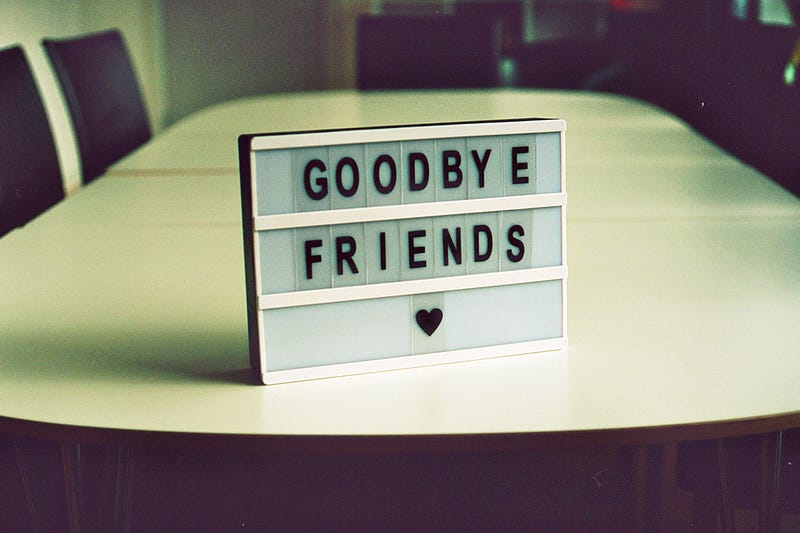
Photo by Jan Tinneberg on Unsplash

I’ve learned some things by doing this.

  1. A LOT of people have left the platform. Their profile states so. More on this below.
  2. A LOT of people have simply disappeared off my radar. These are folks whose words, wisdom, feedback and kindness were mother’s milk to me. I have no idea where they are. I have no idea whether they now assume I too have left the platform.
  3. A great many of the folks whose support I both enjoyed and returned have either gone silent or gone away. It’s impossible to tell. The few folks who found me on Twitter now read and highlight my stuff again. So, while I am quite sure some folks jumped ship from my writing for other reasons, not all of them did. We just went invisible to them, and in doing so, we lost revenue. For some of us, a great deal of revenue. No eyeballs, no income. But that’s not all.
  4. I miss those people. Why? They were my community from the beginning. I’m deeply indebted to them for helping me better craft stories. For the highlights that I have religiously used to teach me what folks want to read about. So much more: they made me laugh, made me think and grow and write better and evolve. That’s priceless.
  5. The other thing I am learning is that how people decide to describe themselves has a lot to do with whether I continue to follow them. Every single time someone makes me spit my coffee into my keyboard, I keep them on the follow list. Humor works, most especially right now. Something for all of us to consider. In other words, I am far less interested in whether or not someone is Medium royalty than whether they have a wit and a take that’s interesting. Something to that.

Perhaps my biggest disappointment was that so many folks left because of what they perceived- accurately, in this case- was a serious drop in writing quality, a proliferation of mediocrity and the tsunami of badly written get-rich-on-Medium-quick articles. They were sick of it. I hardly blame them. It didn’t improve last year when those same folks, who came to many of us for what we hoped was funny, sane, thoughtful writing could suddenly not find us. Or, they had to jump through flaming hoops and crawl under barbed wire to track us down.
Photo by mana5280 on Unsplash

Nobody I know who suffered through Covid last year was particularly motivated to be forced to do that to find favorite writers. I sure as hell didn’t. We all had our own battles to fight, losses to mourn. In many cases, as familiar names dropped off my comments and favorite writers vanished, I had to accept that other things had pulled them away for one reason or another.

What some people do not seem to realize, and my fellow Illumination writers most certainly do, is that my greater anger at Medium for all the losses was hardly restricted to the gutting of exceedingly necessary income last year.

I lost friends.

A few people and I have formed friendships off line, and in some cases they have flourished in surprising ways. The people I am mourning here are those that Medium cost me due to their inane, idiot tinkering, all in the name of forcing, and I mean forcing, other writers ( or posers) to be more “relational.”

That’s like trying to force your feline hating-BF to love your cat. It’s not going to end well, and it didn’t. You cannot force people who don’t give a flying shit about people other than how much money they can suck out of their respective wallets to care about other writers. In the same way you can’t legislate stupidity, you can’t force people to care.

But they tried, and in trying, they pried apart longstanding reader/writer connections which had been forged over months or years. The reason I know this in my own world is that is this, from my stats:

Your stories

Kindly, that last stat is staggering (given the amount of international travel and other work I do, not just write for Medium). In three years that means I have averaged six comments per day, some of them long and rambling, others brief. Six per day, steadily for three years. That means I read one hell of a lot. And I care enough to comment, invest time and thought and interest in other writers.

That, kindly, is what engagement looks like. I left funny comments, made gentle suggestions, poked folks in the ribs, got into lively conversations. I owned my shit when I fucked up, apologized publicly when appropriate, gave lots of credit and links and support.

THAT is why people followed me. It wasn’t just my writing. I built connections.

It would be fair to say, given my corporate background in teaching networking skills, that I am absolutely THE example of what being relational, and being successful at it, looked like on Medium. That is why, back a year ago, I was not only enjoying a very lively and engaged community but also making almost a real living from it.

Which is why Dr Mehmet Yildiz and I were a perfect match when he began last year, and why I am still writing for his publications, and a major fan. Dr. Y and I both watched people, eyeballs and engagement fall off a cliff. A lot of those folks I haven’t heard from for at least six months.

We Illumination writer regulars, particularly those who have been around from the beginning, thrived in part because of the multiple outlets (Slack, et al) that Dr. Y created for us and that the generous editors and volunteers continue to support. Yet even in the brightly-lit corridors of Illumination’s growing mansion, we have suffered losses. Some of this is to be expected.

As I continue to unfollow- not unkindly, just as an experiment- it’s a history lesson in my own time on Medium. Walking back through those names is an object lesson in what I lost last year. While yes, I am annoyed about the lost revenue, I am far more pissed off that Medium cost us relationships in the name of trying to force relational values on people who frankly, my dear, didn’t give a damn.

Many of us did. And we lost.

A fair number of those who followed me stated plainly that they were sick about what had happened to their favorite site. I wasn’t the only writer they loved. They just couldn’t find us any more, and again, they were bombarded regularly with crap, pap, and HOWIMADETENGRANDAMONTHONMEDIUM and by the way sign up for my writing program here.

THAT, Medium, is part of why we’re so mad. It’s also why publications like Illumination, which were created to establish a safe place for diverse voices, is where the most important friendships I have made arose. For that I am deeply indebted both to Dr. Y and to the many talented folks who have stuck around.

There is a very good reason that other publications look over the proverbial fence with envy, and why some folks take pot-shots when our fine publications outperform the established Medium institutions. We care about our writers, develop our writers, and care about our readers. That’s what Medium used to do, and why folks stream on over to us like someone moved the honeycomb to a new beehive.

I will stick around awhile longer, as we limp along on our reduced incomes, and struggle to figure out how, with 8k followers, we barely get 15k views in 30 days. Ev and his team broke the platform, and a great many good people walked.

I don’t blame them, either. Many writers walked, sprinted over to Illumination because the big publications tended to be incestuous, and self-serving. Many of those Illumination writers have launched successfully elsewhere (including many anti-racism writers like Rebecca Stevens A. and Sharon Hurley Hall, among others). And despite ridiculous claims to the contrary, somehow Dr. Y doesn’t make untold millions on that success, but instead takes great personal pleasure in watching various writers he supports go soar on other platforms.

I am going to finish this experiment, keep only a few folks to follow, and start over again. See what happens. Meanwhile I am building out my website, making more money on Newsbreak than I do on Medium sans the joy of the community (which is why Linda Carroll says, and she’s right, that from that standpoint alone, even a much-diminished Medium is still better).

These days, in that magic way that Medium has created to ensure that none of us does very well any more, I keep adding tons of followers but my views continue to drop. I can’t figure out that math. Only that there are winners and losers. And those of us doing the most work with the greatest amount of heart seem to be on the wrong end, but that’s the Silicon Valley Way.

Photo by Leon Seibert on Unsplash
Synergy
Writing
Writing Tips
Medium
Illumination
Recommended from ReadMedium