
What Happened to the Tablet?
Tablets were supposed to change the way we lived.
Everybody was going to own a tablet. They would replace the household PC in the near future.
I remember hearing these kinds of arguments in 2010. Just a short decade ago many of my friends and peers were high on the horse of the iPad.
It was revolutionary! Such a small lightweight package that you could easily take with you. No longer would you have to toss your laptop in a nap-sack and sling it over your shoulder to travel or heaven forbid, disconnect your desktop.
The tablet was going to be the end all be all of what modern day computing was going to look like. It was compact, easy to manage, and could do most of what the PC could do.
Sure it didn’t have the computing power of a PC. It also didn’t have a proper keyboard. But it was going to overtake the PC in the future.
This however, did not come to pass. Tablets are on the decline and the household PC is still around.
What led me to this current train of thought was that I occasionally come across old magazines that I will peruse. I happened to come across an October 2012 issue of Popular Science. One of the articles on page 18 is titled “The Tablet Takeover”. Subtitle of “The new Windows allows consumers to replace their PC’s with tablets”.
Hindsight being 20/20 makes the Popular Science article seem a little silly.
I’m not sure if anybody actually replaced their PC’s with tablets, but they sure did sell a lot of them those first few years. 73 million tablets were sold in 2011 according to the article.
I would place many of the sales in the category of “new and fancy”. Like many products sold due to hype it can be incredibly difficult to truly sustain.
So what happened to the tablet?
The short answer is people realized they didn’t need them for their personal lives. The tablet didn’t die some horrible death. It became a major player in the point of sale (POS) for businesses globally. For the day to day usage at home however, it has not been nearly as rosey.
According to gs.statcounter as of current dates smartphones are currently the big deal in the market between smartphones, tablets, and PC’s. Phones were more than 50% of the market, PC’s were most of the rest. Tablets sat at under 5%.
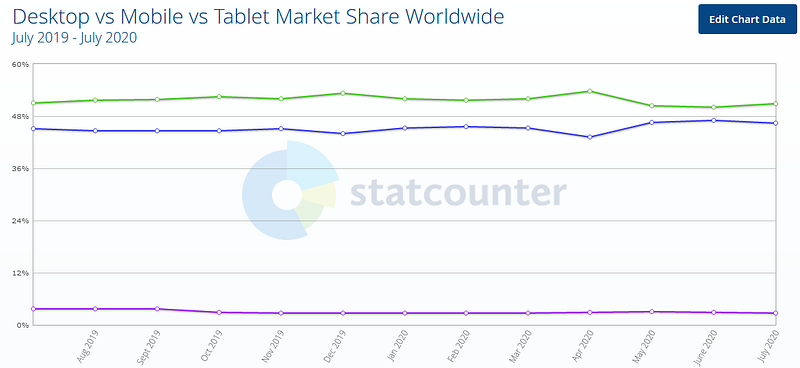
Smartphones really did manage to revolutionize the world when they were introduced. Everybody now has the power of the internet and connectivity in their pocket at all times. The ability to research information at the touch of a button has changed how society works. There were limitations on them. Limited computing power and even more particularly was the issue of size. It’s impossible to perform any kind of a real task on a 4 inch smartphone.
Times have changed. The speed and power along with the size of the smartphone has grown over the years. Pretty much every company now sells their own version with up to a 6 inch screen making working on them much simpler.
Small enough to stick in the pocket and ability to make phone calls. Combined with lowered costs and the phasing out of the analog phone it comes as no surprise that smartphones would be the leader.
The other thing that put a real dent in the tablet market was the changes to laptops. It didn’t take long after the release of the tablet for people to realize they still wanted a keyboard to actually be able to perform real work on it. While some tablets added keyboard modifications to attach to the tablet it still felt clunky.
This led laptop makers to focus more on making smaller laptops for simple daily usage. Often-times referred to as a netbook or a notebook these laptops have all of the bells and whistles of a laptop while being the size of a tablet making them ideal for carrying and working on the go.
Reasons to have a personal tablet
For personal usage if you are looking for something for internet browsing or to view media upon, the price point of a tablet is hard to beat. You can easily obtain one on Amazon for under $200 and there are refurbished ones for as low as $100. They won’t have the computing power of a laptop, but for daily usage of simple tasks they work great.
If you have children this is almost certainly a better way to go than with a laptop. The durability of tablets is generally better than a laptop and if you added a protective case on it the life of it will be extended. If you’re paying a pretty penny for it make sure you get a warranty. Children can be the most destructive force in the universe if they put their mind to it.
With most schools closed due to the Corona-virus this could also mean that your children are having to learn from home. In the technological world that we live in getting your child more adept at using technology will only benefit them in the long term. Giving them access to different methods of learning early on is incredibly important.
Just make sure the child is old enough to be using them properly. Some studies show links in developmental disorders if it’s used at too young of an age.
For the adult in you there are other reasons to have a tablet.
The distance between what most laptops can do and what tablets are capable of has narrowed over the years. If you’re looking to edit video or audio most tablets have built in apps for doing so which rivals what you can get on a laptop.
It is also used often by the elderly. According to Pew Research nearly a third of elderly own tablets and one in five own an e-reader. As the body declines, having access to a tablet could allow the elderly to still enjoy themselves and function in a manner they could not otherwise. Face time with the grand-kids or the ability to play video games is important for longevity and mental health.
As the gap between laptops and tablets narrows it will likely be a matter of time until a tablet is capable of performing all of the duties that a laptop can do. As long as the developers of the hardware and software keep pushing the boundaries there can be a bright future still for the tablet.
Where does the tablet go from here
The tablet is far from a dead market. While the tablet market is not growing at the pace it once did there are still expected to be 1.2 billion people using them by next year. The growth has slowed, but it is still growing.
New product lines are still being introduced. In 2019 Samsung has released three tablets, Apple has launched two, and Microsoft and Asus have each launched one. Lenovo has released 5 tablets in 2019. With new product releases comes new hope of growth in the market.
In 2018 there were more than 173 million tablets that were shipped world-wide. Although it was 11 million lower than the previous year it is still a rather healthy number being sold.
The decline in sales around the world has to be worrisome to the manufacturers and it might be time to work towards maintaining markets rather than growing them if they want the tablet to survive. Focusing towards making the products for school usage and more POS could be the route to keep them around for decades to come.


