
Technology
What Happened to the Man on the Train?
I saw him once and never again
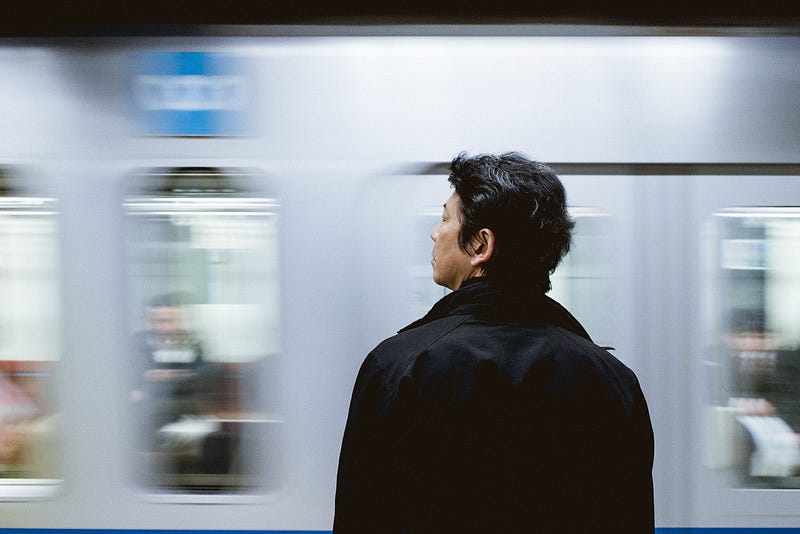
About six months ago, I managed to put into words a kind of exchange that I was on the periphery of yet impacted me significantly.
I say kind of exchange because it wasn’t directly between me and the man standing beside me on a crowded train, because he was talking to himself. He may or may not have been aware of my existence, but either way, it didn’t seem to have any bearing on the conversation he was having.
He was in his own world. But the world he inhabited was very different from the one that the majority of the other passengers existed in.
Or was it?
I ride the train every morning and every afternoon and it’s not a short trip. My journey is 17 stops long each way and it takes about 35 minutes. In the morning it is relatively empty until the third to last stop, where a crowd of people gets on, most en route to the nearby university. I read my book much of the way, making sure to look up to see who gets on at each stop. That’s partly for my own awareness of my surroundings, but also to see if anyone interesting is getting on board.
The majority of my fellow travelers are rather nondescript, if you want to know the truth. But I know that everyone has their story, full of joys and struggles as well as their own daily humdrum. I wonder if they think the same about me. It wouldn’t upset me to know that they did.
Going home, it’s full when I get on, but then empties out, three stops in at the same one I mentioned above. At this point, I usually get a seat and can start reading again. There’s just something I don’t like about reading while standing. I do the same action of looking up at each stop.
Some days, I don’t feel like reading, however. And instead of burying my nose in my book, I will look around a little bit more. Most people are buried in their screens, seemingly content in their own made up worlds.
Or at least as content I am in the made up world of my book. What’s the difference, really?
Maybe there was a time when people didn’t stare at their screens, but those days are forgotten. Maybe there was a time when you’d have a shared human experience on a train, at an airport, at a coffee shop, or on the street. Screens have changed that.
Or was it books, newspapers and magazines that did?
In a response to a different article, my man Bill B said the following:
“Everyone, including me right now, has faces buried deep in their devices. Unimagined access and convenience, but at what cost? Each of us can be our own judge of the bad or good degree this all consuming technology has in our lives. One thing that should not be debatable is the scale of impacts technology has on shared human spaces and interaction.”
It’s not debatable, but mostly because not many people are interested in having the debate. And it’s not that they don’t care, it’s just that they have adapted themselves to the technology as it’s been presented to them, without too much thought as to what the impact of it is.
It’s true that no tech companies have asked us if we want the stuff, and they never will. If there is a profit to be made, it will be produced. Simple as that. There has never been a referendum on any of the stuff that has been inserted into our lives, whether epoch shattering or miniscule. Henry Ford didn’t ask if people wanted cars, he just produced them and offered them. As a matter of fact, he is said to have said that “if I had asked people what they wanted, they’d have said faster horses.”
We don’t even know what we want. Until someone makes it so that we want it.
Cars weren’t. And then they were. They were a leap forward and left behind the days of endless shoveling of mountains of horse shit in cities. That the automobile was powered by carbon monoxide producing fossil fuels was neither here nor there. It was clearly better than what came before.
The ability to carry massive computing power around in our pockets is no different. It wasn’t available. And then it was. A massive leap forward was provided to us. And we were left to our own devices (pun intended) to recognize and deal with the drawbacks.
Or not.
Trying to get people off their devices today. It’s about as easy as getting them out of their cars.
The technology is itself designed to keep us glued, nevermind the content we are consuming. Bill B went on to say,
“Business, neighborhoods, cities, airports, a family car trip, mass transit, a business meeting, listening to music, all have changed due to the screen glow reflecting off our faces. We are self-selecting greater isolation at the expense of more natural and organic interaction. We seldom look up from our screens to internalize just how massive the ongoing change is.”
I’d go a bit further though. It isn’t conscious decision making anymore to pick up a device. It’s conscious decision making to get off it. The technology has rewired our entire decision making process and has enabled it to bypass any thoughts of “should I do this / should I not do this”.
As a result, it is designed to keep those kinds of thoughts at bay. Everyone seems to be living lives of quiet desperation, as if to say “just leave me alone, let me be in my little artificial world”, despite being surrounded — as close quarters as possible with clothes on — with other humans.
The technology makes this possible and that is perhaps the biggest change wrought by it.
I see the same thing on the train I ride every day, Bill. Leaps in technology have had deep impacts on the way we interact with each other, even to the point of making it possible not to have to. And again, nobody asked for it. Monolithic tech companies produce it, we consume it and very few people can see the consequences of our voracious and unquenchable appetites for more.
Until it’s too late.
But it’s never too late. There is always something else. Whatever is coming next will either mitigate the impacts of the present stuff or will make it look like summer camp.
My bet is on the latter.
I see it in the kids I teach every day, though that’s another article entirely. I see it on the train, far more often than not. We have no choice but to be surrounded by one another, but now we have the ability to make that as far as it ever goes.
Maybe that’s what passes for progress these days. But I’d sure like to run into that man again who was having the conversation with himself. Maybe he has some idea where this is all going.