
What Happened to The Great American Peanut Butter and Mayo Sandwich?
What divides the slices sometimes divides us too
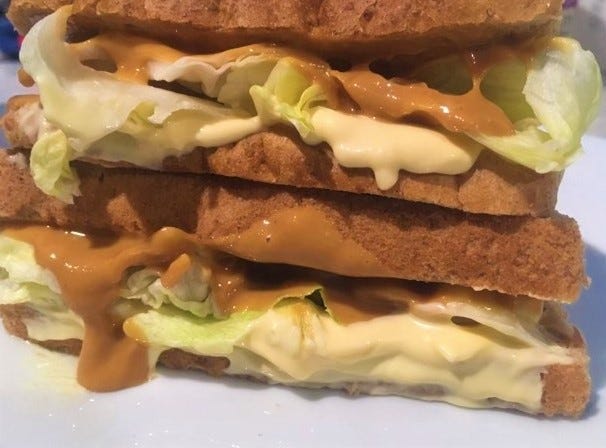
As a single father, my dad always made my school lunches. It wasn’t typical to be raised by a solo-dad and there are ways it influenced me: I don’t window shop; I don’t fuss with too much grooming; also, there’s the lettuce, mayo, and peanut butter sandwiches.
You may be curling up your lips in disgust right now but stick with me — it’s not that weird, I promise — I’ve recently learnt my family isn’t the only one to have eaten them regularly. Peanut Butter and Mayonnaise sandwiches have quite a history. A divisive one!
Invention from necessity
Odd creations often begin as a way to meet a human need. The invention of the peanut butter/mayo sandwich appears to be no different.
When I was a kid, there was always a sandwich in everyone’s lunches. Usually jam or honey. Marmite was the best — that black sticky layer of deliciousness that kids in countries other than New Zealand think is gross.
My dad liked to pack my sandwiches with salad ingredients. I don’t know if you’ve ever had a lettuce and tomato sandwich after it’s been sitting in a warm school-bag for a morning? The white bread goes pink and soggy from the tomato and no matter how much lettuce you put in to protect it, you get the same results.
My dad is a typical kiwi bloke — able to DIY anything — I showed him my damp sandwich and he came up with a fix: Peanut butter.
A layer of peanut butter seals the bread, protecting it from tomato liquids. You can even add mayonnaise to your lettuce without any extra sogginess. Perfect.
In the same way, the American Peanut Butter and Mayo sandwich began with resourceful parents.
The History of a Sandwich
The Great Depression
The Peanut Butter and Mayo sandwich was most popular from the 1930s to 60s and seems to have come out of the struggles families faced during the Great Depression.
The 1920s were prosperous in America and this made the rapid decline into the Great Depression even more shocking for families. Jerry D. Marx PhD. in his report on American Social Policy during the Great Depression makes this statement which shows just how difficult it became:
“…thousands of the most desperate unemployed workers began raiding food stores. Reminiscent of the food riots during the breakdown of the feudal system in Europe, this looting became widespread by 1932.”
The government stepped in, offering relief packages and sending out parcels of beans and other staple foods to families. There was even a radio show teaching people how to create these tiny-budget meals. The Atlantic explains how, “millions tuned in to hear Aunt Sammy, the (U.S. Department of Agriculture) USDA-devised matronly companion to Uncle Sam, who offered recipes on the radio featuring foodstuffs being distributed by the government.”
Meat was expensive and families started switching out their roasts for canned-meat stews, vegetable-based meals, and beans. The peanut butter and mayo sandwich was simply another calorie-packed, protein alternative. One that didn’t require a recipe book or any top-chef skills to create!
Southern Origins
The depression hit especially hard in the areas where families were already struggling. In Southern rural areas around a quarter of the population was made up of poor sharecroppers and tenant farmers, according to James T. Patterson in his book America’s Struggle Against Poverty, 1900–1994. These families were already below the poverty line; when you added in a financial crisis and a few natural disasters, things were looking grim in the South.
The South is where the peanut butter and mayo sandwich seems to have become most popular. But not all Southerner’s ate them! A quick search online reveals strongly mixed results from Southerners, ranging from: “Yuck, Southerners do NOT eat that!” to… “My mother eats those all the time.” Clearly, there’s not a consensus on whether these sandwiches count as Southern food!
Gross or good, during the depression, peanut butter and mayo sandwiches were a staple many people could afford.
A Slippery Solution?
Other than survival, another practical reason people added mayo to their peanut butter sandwiches is the stickiness problem.
Linda J. Skitka, Professor at the University of Illinois at Chicago, spoke with her 91 year old mother about the sandwich. She says, “It was a very regular thing to eat them in her household — she probably started having them for lunch when she was around 2. The way she remembers it, peanut butter back then was not homogenized — it was very sticky, and would stick to the roof of your mouth, which is why they would add mayonnaise or butter when serving a peanut butter sandwich back then.”
Garden & Gun reports that newspaper clippings from the time provide evidence to back up personal accounts such as this one. There are a number of clippings that show adding mayonnaise to peanut butter could have originated as a way of making rough-hewn nut butters more palatable and spreadable pastes.
“A recipe for peanut butter and cheese spread that appeared in the Record, of Troy, New York, in 1943, called for just enough mayonnaise to thin peanut butter to a “spreadable consistency,” and plenty of shredded American cheese.” — Garden & Gun
Disappearance of a Sandwich
Depression era food, according to Jane Ziegelman and Andrew Coe, authors of the book, “A Square Meal: A Culinary History of the Great Depression,” was kept bland and pre-packaged on purpose.
Ziegelman says, “At the beginning of the 20th century, there was the idea that strong seasonings, like chili powder, garlic, vinegar or even mustard, or certainly pickles, would have acted on the body as stimulants in the same way caffeine acted as a stimulant.”
There was concern it would lead to other stimulants like alcohol. With the scarcity of food and reduced food budgets, those in charge also worried that stimulating or flavorful foods would lead to overeating habits, especially in the middle-class.
Fresh foods were out too. Foods that came in jars or cans, like mayo and peanut butter, were people’s preference at this time. Coe explains: “If you bought canned foods, or pre-sliced and pre-wrapped bread, this gave you comfort to know it was not unsanitary, dirty or a potentially hazardous food.”
But in the 1950s and 60s, as restrictions dropped away and resources increased, families wanted to experiment with food and flavor again and break out of the “white bread, 1950s-era diet,” Coe says.
Getting Fancy (or extra gross)
People started making additions to the staple meals, including the peanut butter and mayo sandwich.
“Thinly sliced dill pickle — lengthwise, not as coins, was added — it adds crunch, salt, and acid,” Says Linda Skitka. She asked her mom how common they were and she said not terribly. “What might have been the unusual part though, was the dill pickle, not necessarily the mayo and peanut butter,” she says.
Companies got onboard with ads, such as this 1963 Skippy peanut butter and Hellmann’s/Best Foods mayonnaise advertisement, which suggested using additional ingredients like pickles, raisins, pineapple, or eggs and bacon. Banana was another favorite addition.
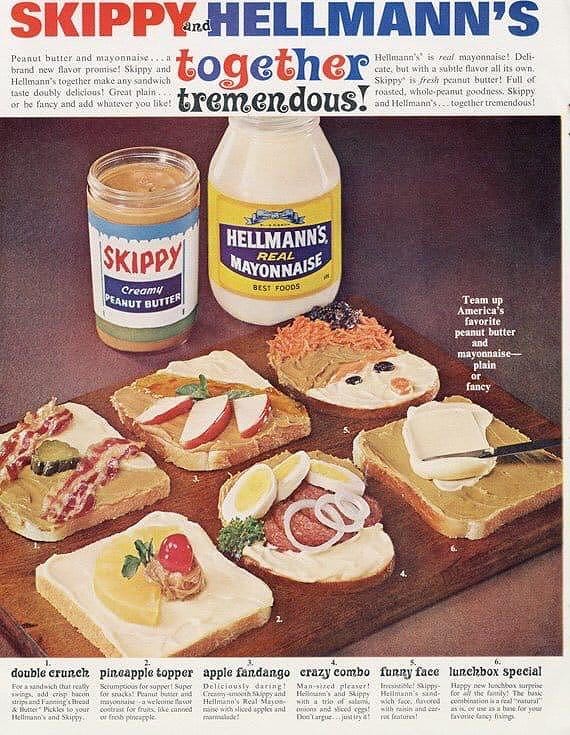
Here’s a closer look at their suggestions:
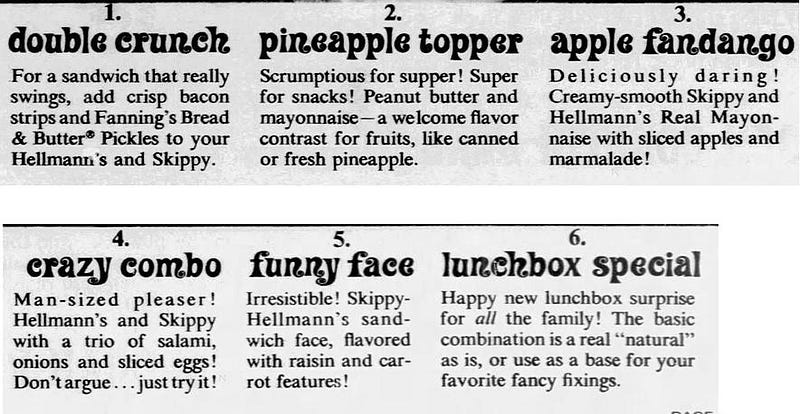
But, as with many other Depression Era foods, the peanut butter and mayo sandwich began to disappear from American diets.
Making a Comeback
People who eat the peanut butter/mayo combination today often eat it as a “memory food”. It gives them nostalgic feelings of childhood or lunch with their grandparents. Many have very specific combinations: pickles, onions, cucumber or a specific mayo (typically “Miracle Whip” which you could argue is not in fact mayo at all).
“I’ve had peanut butter, mayo, and dill pickle slices, but never without the pickles. My mother and grandmother loved this sandwich combo.” says Skitka in her Twitter post.
If you do a search of opinions on twitter, though, it seems many Americans would rather it disappear altogether. One person commented, “The absolute worst and I mean worst is a Peanut Butter and Mayo sandwich. My husband eats those — so does his doctor and her kids — after 36 yrs I still flinch when he eats one…….yuck gross.”
But with the increase in unemployment, as well as pantries emptying out in lockdowns, Great Depression recipes are making a come-back. Perhaps it’s time to whip up a loaf of peanut butter bread with a side of peanut butter stuffed baked onions for lunch?
Or keep it classic: a peanut butter and mayo combo on a nice thick slice of bread. I’ll have mine with lettuce thanks.
Want free tips for your own writing? Join me