
What happened next?
After a humiliating French language class in a room full of teenagers, I realised France wasn’t the only foreign country I was living in. I had also arrived in the Country of Old Age.
I didn’t want to be there.
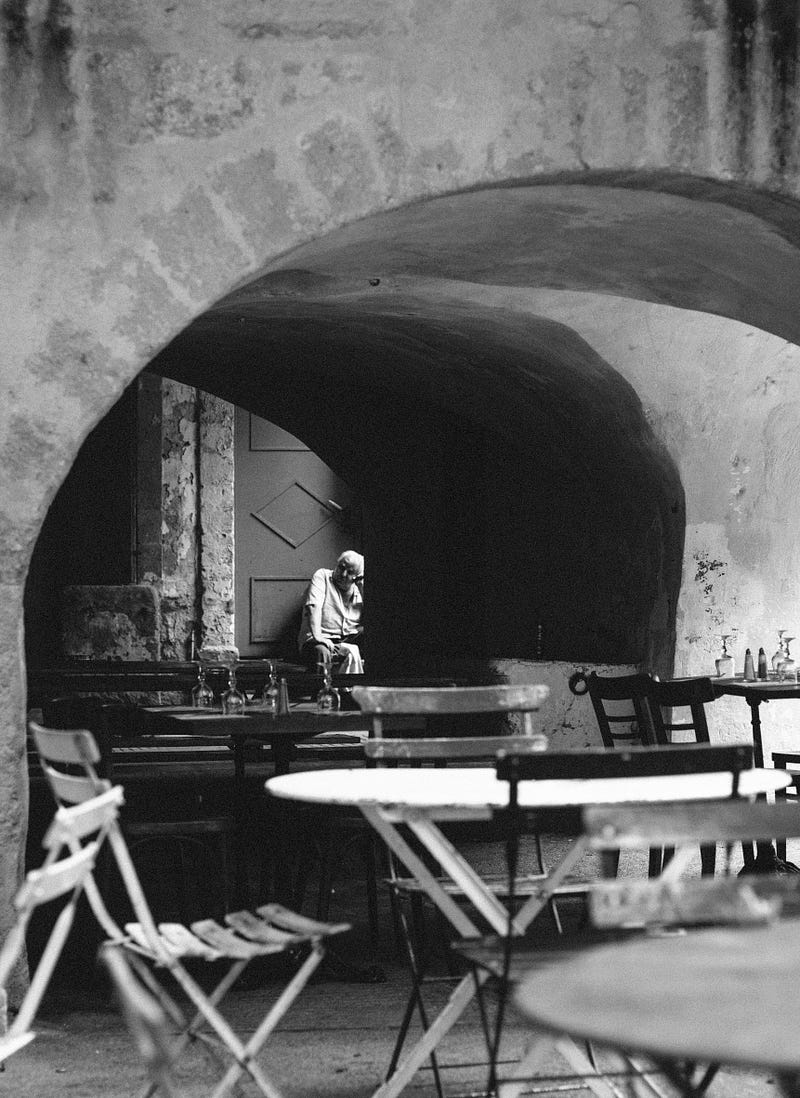
I’d like to say I quickly snapped out of the resulting funk and gracefully came to terms with the aging thing.
I didn’t.
The class didn’t start again until four that afternoon, but there was homework which I decided to tackle over coffee and a croissant at one of the outdoor cafes that line Montpellier’s Place de Comedie.
Montpellier has one of the largest universities in France so the place was filled with the obviously young. Strolling in groups, hopping on and off trams. Beautiful, carefree. I hated them, but not nearly as much as I hated myself right then.
In the space of one day, one stupid interaction, I’d gone from feeling good about myself, optimistic that I’d soon be chatting away in French, to depressed and tongue tied, barely able to muster enough French to ask for a cafe creme.
I hated everything about myself. My hair, the sweater I’d worn, my shoes. The stupid scarf around my neck that I thought made me look French — but, more importantly hid the scraggly bits. If I’d been with a friend, maybe we’d have laughed about it, except that most of my friends in France were still a few years away from the Country of Old Age and probably wouldn’t understand how awful I felt.
They wouldn’t be the only ones. I, too, didn’t understand why I felt so awful. And I felt even worse for feeling awful. Getting old is no great shakes, but it’s certainly better than the alternative.
I tried to focus on my homework, but I might as well have been reading ancient Greek — or French come to that.
My brain was mush.
I’d heard that happens in the Country of of Old Age.
I didn’t like this country.
Arriving here felt like a shameful secret. Until now, I’d slipped under the radar, or thought I had. But now I wondered who I was fooling. Could I go on pretending that, chronological years aside, I was still in that hazy borderland of late middle age, not young, but not exactly old?
I drank my coffee and started sorting out those who obviously belonged — that group over there with their white curls for instance — and those who didn’t — skinny girls, skimpy skirts, swinging hair.
Everyone looked very old or very young. I didn’t know where I fit in. Chronologically, according to Google, the source of all wisdom, I was old. The difference between yesterday and right now was that right now I actually felt old. Older than I’d felt when I ran for the tram in my stacked heel boots.
There are those who age gracefully. Who see wrinkles and grey hair as badges of honour. I wanted to feel that way, but I couldn’t. There’s an attitude about advanced age. You’re old therefore you have nothing more to offer. I remembered telling a male friend about some CheezWhiz I’d brought back from the States as a gag gift for a friend. “It’s vile, bright orange, nothing natural about it,” I said.
“I’ve seen some women like that in Cannes,” he said. When I didn’t laugh, he reminded me that “At our age, we’re just waiting in the departure lounge.” I didn’t laugh at that either.
Time ticked on, the homework became more horrendous. If I couldn’t figure it now, no way was I going to face further humiliation from Chignon and my teenage classmates. I decided to return to my accomodations — a room was included in the price of the immersion course. In the span of eight hours, I’d gone from feeling optimistic and positive to wanting only to shut myself away and fade into oblvion.
Climbing the outdoor stairs to my room, I felt my knees creak and imagined the handsome youngish French landlord watching from his window and thinking, poor old soul. Probably wondering what the stupid old bird was doing so far from home.
Back in my cell like room (you get what you pay for) I tossed my homework on the floor, opened a bottle of wine, fell across the narrow bed and wondered whether to go back to class the next day. More to the point, could I return to class only to demonstrate the inability of my aging brain to figure out les pronoms compléments?
Morose and ancient, I lifted the wine bottle with my gnarled and trembling hands and poured a glass. Perhaps I would finish the entire bottle and fall into a stupor from which I’d awaken to find I was still young and vibrant and Chignon and the teenagers had been a bad dream. Or, perhaps I’d finish the bottle and say what the hell they’ll eventually get old too, we all do.
Then there was a knock at the door. The handsome youngish landlord.
After watching my painful crawl up the stairs, had he come to see if I needed medical assistance? The pompiers, maybe?
But no. He knew I’d lived in California, he said and some Los Angeles friends who now live in Montpellier had invited him to dinner tonight. “They’re grilling anchovies.” He smiled. “Very good, very nice. You should come too.”
And, one other thing. Would I mind riding on the back of his BMW motorcycle?
Zowee.
Like Cinderella going from rags to a ball gown, I was suddenly transformed. There’s a difference between growing old and being old I decided as I climbed on. With relative ease, I might add. Perhaps he hadn’t been watching me climb the stairs after all.
Arms wrapped around his back, we zipped through the streets of Montpellier. Only the helmet he insisted I wear stopped my long blonde hair from blowing in the wind. Departure lounge indeed. To hell with Chignon and the teenagers and struggling with être and avoir. Tomorrow, I would drop out of school. It seemed more in keeping with my rebellious, semi-youthful, persona somehow.
Confusing place, this Country of Old Age
Oh and the anchovies were good too.


