
What Grammarly Thinks of Famous Authors Will Surprise You!
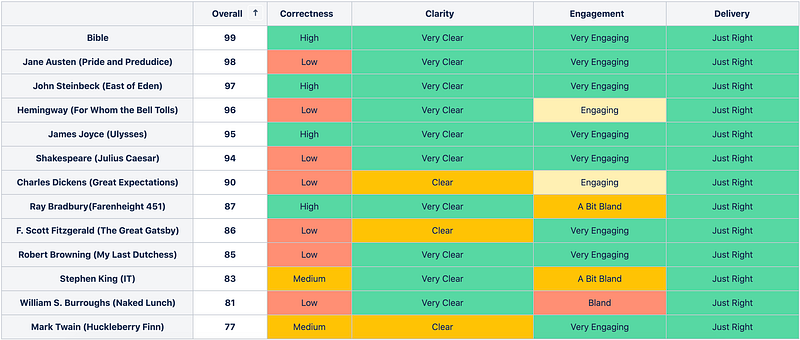
Grammarly evaluates the greats, King, Steinbeck, Joyce, Fitzgerald, Browning, Twain, and so on — See how they score.
Grammarly makes my world go round. Without it, I would be a total and complete writing failure. I’m not kidding. I’ve terrible spelling, grammar, and myopic clarity. Grammarly helps me write better and be better.
So I was damned curious how this tool, which is integral to my writing process, evaluates the greatest writers of all time.
The results are kind of crazy. Enjoy.
Settings
I used the standard, free edition.
Audience: Knowledgeable
Formality: Informal
Domain: General
Intent: Tell a story
Grammarly Definitions
Grammarly uses four key writing dimensions to evaluate a work’s quality:
- Correctness —Correct grammar, spelling, and punctuation. Grammarly Correctness Dimension.
- Clarity — Crisp, clear, and easy to follow sentences that are short and concise. Grammarly Clarity Dimension.
- Engagement —Interesting and effective writing that keeps the reader reading. Grammarly Engagement Dimension.
- Delivery —Is the writing coming across as the writer intended? Is it using the right language, politeness, and formality? Grammarly Delivery Dimension.
Observations
- Delivery is dumb WTF! Every writer scores bang on for delivery, even if it’s written in old English. Honestly, I trust this metric less than the others. It seems kind of hokey to me. Even my writing gets “Just Right” which makes me trust it even less.
- Correctness calamity I’m not surprised that poetry and plays score low here for Browning and Shakespeare because of the work’s inherent structure, but I was definitely surprised to see others scoring low. It seems that missing commas, incorrect hyphenation, and poor article usage (a, an, and the) plague all their work.
- The Bible is the king of kings The Bible scoring so high is the strangest bit for me. Grammarly was all down and hard on Mark Twain for poor clarity, but passages like this get a total pass: “Blessed is the man that walketh not in the counsel of the ungodly, nor standeth in the way of sinners, nor sitteth in the seat of the scornful.” How the hell does it know ‘walketh’ ‘standeth’ ‘sitteth’ and so on? I don’t quite get this. But, I have to admit there are some startlingly clear passages in the work and it was designed to be accessible to the masses, so perhaps its high score makes sense.
- Correctness doesn’t seem to matter Correctness doesn’t seem to affect the overall score too much. Take a look at old Jane Austen, scoring high overall, but according to Grammarly her work is marred with errors. Clearly, correctness doesn’t weigh into it much.
- Stephen King a bit bland? Are you kidding? I’m shocked to see King scoring a ‘ bit bland’. This is IT, after all. Looking deeper into this, I think Grammarly got tripped up by how King creates words and uses them in his work. He’ll make up stuff like, ‘boymeat’ and Grammarly doesn’t understand it and therefore can’t recognize how completely NOT bland it is.
- Naked Lunch is bland Again, like Stephen King being bland, the language of Naked Lunch is a bit whacky, so I think it’s throwing Grammarly’s AI off.
- How did Hemingway get such low correctness? Again the miss-use of commas and articles has dragged Papa’s correctness score down. This exposes an interesting dichotomy between what’s grammatically correct and what the author intended. It’s no mistake those commas aren’t there or are there in his work, but according to the rules which Grammarly abides by they should be there. Honestly, I’ll leave the clever comma usage up to the greats and stick with what Grammarly tells me for my work.
- Ulysses scores high for clarity, though it’s baffling as hell I’m surprised this scored so highly in all the categories, particularly clarity. The whole book is completely confusing and then the main character jumps into the sky and flies away. Huh? I guess Grammarly can only evaluate the individual parts of the work (spelling, grammar, word usage, etc.) but it can’t evaluate the overall meaning of the work. Or, maybe I’m a jackass and everybody gets this book but me?
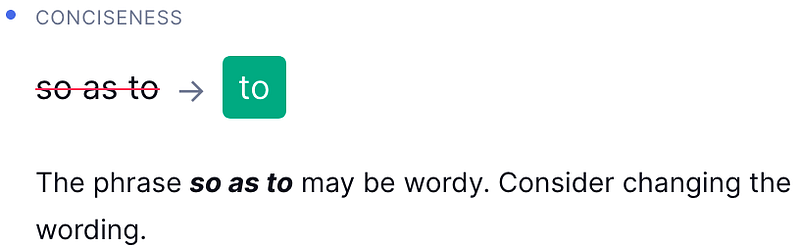
- Huck Finn down in the dumps This was a shocker to see this score so low, as it’s one of the world’s favorite books of all time. Diving into it I see that it’s the clarity component driving the overall score down. Twain uses phrasing like, ‘so as to’ instead of just ‘to’, which is definitely a cleaner way of saying it but would completely ruin the language and flow of the book if he actually wrote that way. It’s interesting how clarity differs from generation to generation.
Conclusions
The big surprise here is how high the greats scored. I didn’t think Grammarly would recognize their genius at all and give them poor performance numbers.
The Bible scoring so high is very strange though. It’s got brutally confusing passages and uses ancient apocryphal words. From the little I’ve read about AIs, I understand that you have to train it to recognize patterns and arrangements. Perhaps, the Grammarly programmers used these great works to train its AI to understand what’s great writing and what’s not. If so, that would make sense why the Bible scores so highly.
Overall, even though some of the scores are kind of whacky, like Stephen King being bland and Twain being crap, I am still a firm believer in the value of this product. If Grammarly can recognize the quality of the greatest books on earth, then it’s damned well good enough to evaluate my work. 😃
Good luck. Happy writing.